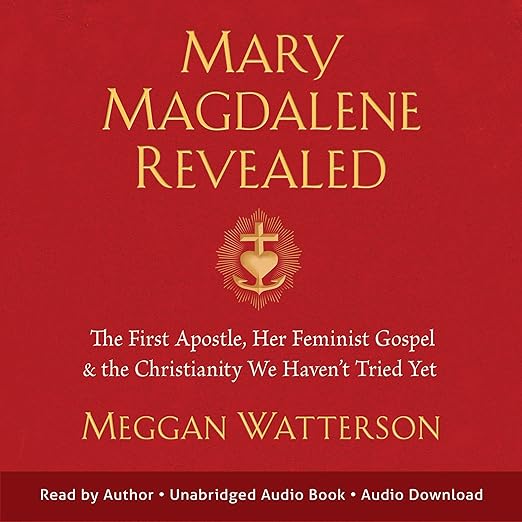
Quick Take
- Narration: Meggan Watterson narrates her own work with devotional warmth and scholarly precision, the effect is closer to a spiritual guide speaking directly to you than a conventional audiobook performance.
- Themes: sacred feminine, early Christian history, inner transformation
- Mood: Reverent, scholarly, and quietly radical
- Verdict: A serious theological investigation that reads as deeply personal, best for listeners open to reconsidering what they thought they knew about the Christian tradition.
I put this one on during a long drive through the French countryside a few years back, not expecting much, honestly, since books about reclaimed spiritual figures can so easily slip into wishful thinking dressed up as scholarship. What I got instead was something far more rigorous and far more moving. Meggan Watterson, a Harvard-trained theologian, does something rare here: she holds the historical and the personal in genuine tension without letting either collapse into the other.
The premise is striking. A gospel written in the name of a woman, buried in the Egyptian desert after a fourth-century edict ordered all copies destroyed, survived thanks to monks willing to defy that order. Watterson takes that gospel seriously as a text, walking through it verse by verse, and the result is less a feminist reclamation project than a genuinely careful theological reading. That distinction matters.
Our Take on Mary Magdalene Revealed
What separates this audiobook from the crowded shelf of divine-feminine titles is the depth of Watterson’s engagement with the source material. She does not simply assert that Mary Magdalene was more important than the tradition acknowledges, she shows you the textual evidence and explains the political and ecclesiastical machinery that buried it. Her account of how and why Mary came to be recast as the penitent prostitute is delivered without bitterness but with considerable clarity. The argument is that this distortion had costs for all of us, and Watterson is precise about what those costs were.
At the same time, the book refuses to stay purely academic. Watterson weaves in her own spiritual autobiography, and those passages carry a different kind of weight, the weight of someone for whom these ideas are not theoretical. One reviewer described the book as healing on a cellular level; another called it a masterpiece that woke them up for the first time in a decade. Glennon Doyle, no stranger to books about spiritual reckoning, offered that same phrase in her endorsement. These are not casual compliments.
Why Listen to Mary Magdalene Revealed
The audiobook format suits this material especially well. Watterson’s voice is unhurried and certain without being preachy, she speaks the way people speak when they have spent years with a subject and no longer need to prove anything. Listening to her move through Mary’s gospel verse by verse creates a meditative rhythm that reading on the page might not replicate as easily. The 8 hours and 21 minutes feel earned rather than stretched.
The core theological argument, that Mary’s gospel presents a spirituality of radical inner sufficiency, one that replaces shame and unworthiness with the idea that being fully human is precisely the point, lands differently when spoken aloud. There is something about hearing Watterson say the words that makes the claim feel less like a proposition and more like a permission.
What to Watch For in Mary Magdalene Revealed
Listeners expecting a conventional Bible study will find this book disorienting, and that is not a flaw. Watterson moves between church history, mysticism, feminist theology, and personal testimony in ways that can feel abrupt if you are not prepared for the genre-shifting. She is not writing a strictly academic text, and those looking for footnotes and peer-reviewed rigor will want to supplement with dedicated scholarship.
The rating count is low, just three reviews at the time of writing, but those that exist are uniformly enthusiastic across a wide range of starting points, including one reviewer who describes herself as a non-Christian. That breadth of resonance is worth noting. This is not a book that preaches only to the converted.
Who Should Listen to Mary Magdalene Revealed
If you have ever found the official version of the Christian story incomplete, particularly around the women in it, this audiobook gives that feeling a name and a history. It works for readers who are spiritual but skeptical, for those with a background in religious studies who want a serious popular treatment, and for anyone drawn to the intersection of women’s history and theology. It is less suited to listeners who want devotional comfort without intellectual challenge, or those committed to a strictly orthodox reading of early Christian texts.
Frequently Asked Questions
Does Watterson present the Gospel of Mary Magdalene as equal in authority to the canonical Gospels?
She argues it is as ancient and authentic as the canonical texts and was excluded by political rather than theological criteria, but she is transparent about this being a contested scholarly position rather than settled consensus.
Is this audiobook accessible to listeners without a theology background?
Yes, Watterson wrote for a general audience and avoids dense academic language, though some familiarity with basic Christian history will help you appreciate how revisionary her reading is.
How does Watterson’s self-narration affect the listening experience?
It strengthens it considerably. Her own spiritual investment in the material is audible, and the verse-by-verse structure benefits from her tone of patient authority rather than a neutral narrator’s detachment.
Is the book only relevant to Christian or Christian-adjacent listeners?
Not at all, at least one reviewer explicitly identifies as non-Christian and found it deeply resonant. The book’s core ideas about shame, inner sufficiency, and the suppression of feminine spiritual voices have broad relevance beyond denominational lines.