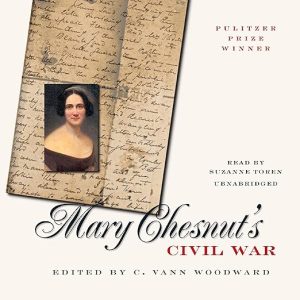
Fifty hours and forty minutes. That figure is the first fact about this audiobook and the one every other judgment follows from, because it is less a running time than a commitment. What the hours buy you is the diary a woman married into the senior ranks of the Confederate government kept while the government she lived inside came apart, in the edition that won the 1982 Pulitzer Prize in History. It is a magnificent book. It is also, in this format, a genuinely difficult one.
Luck to Stumble In on the Real Show
Chesnut wrote that she had the luck "always to stumble in on the real show," and the position she occupied bears her out. The publisher's description sets out the paradox without softening it: aristocratic, patriarchal and slave-holding by circumstance, she nonetheless detested slavery and had claimed the abolitionist label since she was young. She is not a dissenter standing safely outside the system she describes. She is inside it, benefiting from it, and appalled by it, which is what makes the diary stranger and far more valuable than any memoir written afterward.
Bringing Order to the Chaos, Uncredited
Woodward's name is missing from the byline, and that understates what you are buying. This is C. Vann Woodward's edition of the journals, and the four-star reviewer makes the case for why it matters better than the marketing copy does, crediting him with "bringing order to the chaos" of the diaries as they had come down, and with expanding them from Chesnut's contemporaneous journals to show more of her thinking. An editor is doing enormous structural work here. Only Chesnut is named above the title.
Filing is worth a note as well. The listing shelves this under literature alongside biography and memoir, and while the prose has real literary standing, what you are getting is a primary document with a scholarly apparatus rather than a shaped narrative. A five-star reviewer describes the experience as "opening a door through time," followed by a daily gossip session with Chesnut over coffee, which is a more useful description of the reading experience than any genre label on the page.
Suzanne Toren Holds a Sharp, Darkening Tone
Suzanne Toren carries the reading credit, and the assignment is among the largest a single voice can be handed. A diary has no plot to build momentum, no chapters engineered to end on a hook, and no arc to lean on beyond the war itself. What it has instead is a sustained tone, and holding one woman's particular register, sharp, socially fluent, frequently funny and steadily darkening, across a span this long without letting it flatten into recitation is the entire job.
Speech is what a recording gives back, and it is the strongest argument for this format. Chesnut is writing conversation. Her diary is full of what people said at dinner, what a general muttered, what a friend let slip, and half the pleasure is tone: an aside, a private joke about somebody she will be perfectly polite to tomorrow. Read aloud, those return to being speech, which is what they originally were. The same five-star reviewer who likens the book to a daily gossip session has essentially described what an audio edition restores.
Credentials here are unusually strong and they belong to this edition specifically. A Pulitzer Prize in History in 1982, a Newsweek verdict containing the phrase "One of the best firsthand records of the Confederate experience," and a New York Review of Books line from William Styron: "A great epic drama of our greatest national tragedy." Blurbs of that vintage tend to be earned rather than solicited, and a critic reaching for the word drama to describe a private journal is making a real claim rather than extending a jacket courtesy.
A Dizzying Cast With No Footnotes to Help
Apparatus is where the format hurts, and the sharpest warning on this page comes from the five-star review titled "Worth the effort." That reader reports "a dizzying cast of characters," some identified only by a nickname or an initial, and "countless allusions to literary works" that the footnotes name but rarely explain. Footnotes do not exist in a recording. Neither does the ability to flip back and check who an initial belonged to several hundred pages earlier. Every difficulty that reader names gets harder in this format, not easier.
A companion PDF ships alongside the audio, and against that background it is not an optional extra. The PDF is where the character identifications and the literary notes live. Beyond that, weigh the dates. The 4.5 average across 246 ratings is very largely a verdict on Woodward's book rather than on the recording of it, and the written responses make the point plainly: they run from March 2007 to June 2025, and only the last of the five arrived after this audio edition existed.
Difficulty is the final thing to be honest about, and one five-star reviewer gets there ahead of me. That notice opens by calling the book "a tough read," concedes that the length is real, and admits to losing the thread of Chesnut's reasoning more than once before discovering that the recurring figures eventually work as handholds. That is a five-star review. It is also an accurate warning. Anyone treating Confederate dinner parties as background listening will be lost inside the first week.
The Effort Is the Condition of Entry
Serious Civil War readers are the obvious constituency, and specifically the ones who already know the campaign narrative and want the social interior of the Confederacy instead. A five-star reviewer recommends it to any Civil War enthusiast who enjoys reading about both sides, which undersells it a little. The value here is that it is one side, seen from inside, written by somebody who could see her own position clearly and did not much like what she saw.
Nineteenth-century diarists and letter-writers make a natural second audience, and this belongs squarely in that tradition rather than in military history. The four-star reviewer's framing is the accurate one, calling it "a fascinating look into the life and mind of an educated upper-class woman in the South" during the war, a woman that reviewer also describes as "socially well-connected, very smart." Read it on those terms and the endless dinner parties stop being an obstacle and become the actual subject.
Casual Civil War curiosity will not survive this. If you want a narrative history with a shape, a thesis and an ending, look almost anywhere else, because a diary supplies none of those and this one declines to supply them at very great length. The people who love this book love it for precisely the reasons the impatient will abandon it, and my honest summary is that the effort is the condition of entry rather than a defect in the recording.
- Narrator: Suzanne Toren is credited on a diary with no plot to lean on, where tone is the only thing carrying a listener from one entry to the next.
- Subjects: The Confederate home front, slavery seen from inside a slave-holding household, women's diary writing, a society dismantling itself.
- Tone: Witty, sociable, steadily darkening.
- Bottom line: A magnificent primary document, and a listen that will defeat anyone who treats it as background.
Does the Mary Chesnut's Civil War audiobook include the footnotes?
The audio cannot show them, but a companion PDF ships with the recording and that is where the character identifications and literary notes live. Since the diary constantly quotes literature and names people by nickname or initial, having the PDF open changes the experience substantially. Download it before you press play rather than afterward.
Is this audiobook suitable if I know very little about the Civil War?
Not really. The diary assumes you know who the generals and politicians are, and it names many of them casually or by initial alone. Come with the campaign narrative already in place and the social detail becomes fascinating rather than bewildering. Without it, a very long run of first-name references will simply wash past you.