Quick Take
- Narration: Virtual Voice AI narration is functional but flat; the irony is that a man described as warm, funny, and passionate in person is rendered in a voice that is none of those things.
- Themes: Critique of dialectical materialism, free-market economics, history of socialist ideology
- Mood: Argumentative and intellectually bracing, like sitting in on a seminar debate
- Verdict: The content is genuinely valuable for anyone interested in Austrian economics or the intellectual history of socialism, but the AI narration means you’re working harder to access Mises’s warmth that reviewers describe in the text.
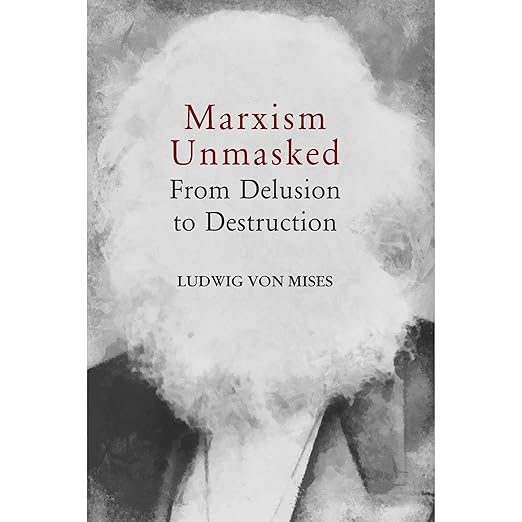
I finished Marxism Unmasked on a train ride, which felt appropriate. There is something about watching industrial landscapes roll past while listening to a man dismantle an ideology that was itself built on industrial-age anxieties. Ludwig von Mises delivered these nine lectures in the summer of 1952 at the San Francisco Public Library, and they were transcribed from what he actually said rather than prepared from notes. That distinction matters enormously. The Mises of his treatises can feel remote, rigorous to the point of austerity. The Mises of these transcripts is something else.
The irony, though, is thick: a recording described as capturing his warmth and rhetorical passion is narrated by a Virtual Voice AI. That’s the edition’s central problem and probably its most honest disclosure. The text itself crackles. The narration does not. So you read what the book promises, and you try to do the imaginative work of hearing Mises’s voice through a digital proxy.
Our Take on Marxism Unmasked (LvMI)
The lectures were delivered to a general public audience, not to graduate students, which gives them an accessibility that Mises’s major works lack. He covers Marx’s place in the history of ideas, the logical contradictions at the heart of dialectical materialism, and the ways in which Marxist claims about history fail against empirical reality. His refutation of the Marxist interpretation of the Industrial Revolution is particularly pointed, and his observation that the improvements in technology were not available only to exploiters, that capitalism made it possible for many persons to survive who otherwise would not have, is delivered with a directness that his more formal writing rarely achieves.
One reviewer noted that Mises may have been the first to attack Marxism and socialism at the core of their philosophy, and reading these lectures you can see why that claim carries weight. His approach is not to engage Marxism on its own rhetorical terms but to demonstrate that its foundational premises are philosophically incoherent. The lack of clear definitions in Marx’s work, the convenient plasticity of dialectical materialism, the circular reasoning that allowed Marxist interpreters to explain away every predictive failure: Mises dismantles these methodically but with wit rather than contempt.
Why Listen to Marxism Unmasked (LvMI)
At under five hours, this is a compact intellectual workout. Compared to Mises’s major works, which run to hundreds of dense pages, these lectures are the ideal entry point. They are systematic but casual, as the publisher’s own notes describe, which means an engaged non-specialist can follow the argument without prior knowledge of Austrian economics. The historical context matters too: 1952 was the height of McCarthyism and the early Cold War, and Mises was speaking to an American public that was both terrified of communism and uncertain about the intellectual case against it. Richard Ebeling’s introduction, which a reviewer praised for covering the impact of Marxism and the world of 1952, provides essential framing.
What to Watch For in Marxism Unmasked (LvMI)
The Virtual Voice narration is the decisive caveat. The publisher is the Ludwig von Mises Institute, not a major audio house, and the production reflects that. If you are drawn to this primarily because reviewers describe Mises as a warm and charming lecturer, know that none of that warmth survives AI rendering. You will be doing significant imaginative reconstruction. The content justifies the effort if you are serious about the subject, but casual listeners who came for a lively intellectual experience may find the gap between promise and delivery frustrating.
Worth noting: this is ideologically committed material. Mises was a committed advocate for free-market capitalism and a relentless critic of all forms of socialism. His arguments are sharp, but they are also arguments, not neutral history. Readers looking for a balanced intellectual overview of Marxism as a historical force should supplement this with other perspectives.
The most striking thing about these lectures, given their age, is how current the underlying argument feels. Mises was responding to a moment when socialism was a serious intellectual and political alternative in the West, not a fringe position. His insistence that the contradictions of Marxism are not peripheral but structural, that no amount of revision or refinement can rescue the core claims from their internal incoherence, is the kind of argument that either convinces you immediately or requires sustained engagement to evaluate fairly. These lectures are dense enough to repay multiple listens even in their brief running time.
Who Should Listen to Marxism Unmasked (LvMI)
Economics students, libertarians, and anyone working through the intellectual history of the twentieth century will find the content rewarding. It is particularly useful for listeners who have bounced off Mises’s larger treatises and want a way in. Skip it if you are hoping for a dynamic listening experience driven by exceptional narration. The ideas are the whole point here, not the performance.
A note on scope: these nine lectures do not cover the full range of Mises’s thought. They are focused specifically on Marxism as an ideology and an economic theory. Listeners who come hoping for his broader critique of interventionism or his philosophy of human action will need to go to those other works. What this audio offers is a contained, vivid entry into how Mises thought and argued, at a moment when both the stakes and the audience were immediate and real.
One final note on context: the Ludwig von Mises Institute, which published this edition, is an ideological organization with a clear mission. That does not invalidate the content, but it does mean the framing and selection of material serve a particular view of economics and political philosophy. Listeners who come in knowing that will engage more critically, and more productively, than those who approach it as neutral academic material. The lectures themselves are worth the encounter on their own terms. Just arrive ready to think rather than just to receive.
Frequently Asked Questions
Is this the same as Mises’s major work Human Action, or is it entirely separate content?
Entirely separate. These are nine transcribed lectures from 1952 focused specifically on Marxism, not the comprehensive treatise on economics. The register is much more accessible and conversational than Human Action.
The narrator is listed as Virtual Voice. How significantly does that affect the experience?
Meaningfully. The published text describes Mises as warm, funny, and passionate, and several reviewers note that the transcribed lectures convey rhetorical energy. The AI narration does not replicate that quality. You get the words, not the presence.
Does the audiobook include Ebeling’s introduction about the historical context of 1952?
Yes, based on reviewer descriptions, the introduction by Richard Ebeling that covers the impact of Marxism and the world Mises was speaking to is included. It provides useful framing for the lectures themselves.
Can someone with no background in Austrian economics follow these lectures?
Yes. The lectures were delivered to a general public audience, and Mises was at pains to make the arguments accessible. Prior knowledge of economics is not required, though familiarity with Marx’s basic claims will help you follow the refutations more closely.