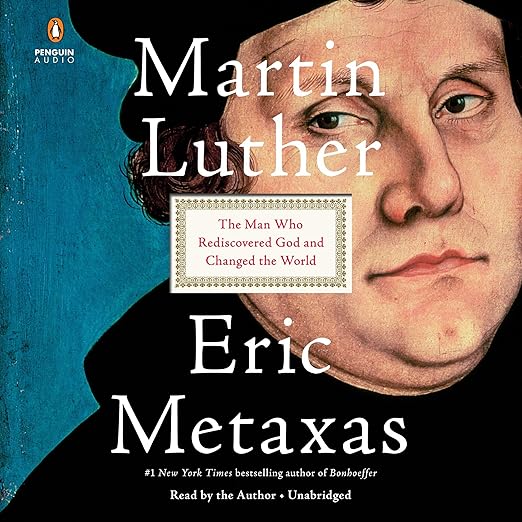
Martin Luther nailing his Ninety-Five Theses to the Wittenberg church door is one of history's most enduring images, and Eric Metaxas, narrating his own audiobook, treats that moment not as a monument but as a detonation. The biography, a New York Times bestseller timed to the 500th anniversary of the Reformation, spans Luther's life from his birth in 1483 to his death in 1546, and at twenty hours and thirty-nine minutes it has the space to be thorough. Metaxas, whose previous biography of Dietrich Bonhoeffer drew wide attention, brings a similar framework here: the life of a man whose faith put him in direct collision with the most powerful institution of his era, and whose collision remade the world he was born into.
The self-narration is worth addressing immediately because it changes the listening experience in specific ways. Reviewer Jess W. Dixon notes Metaxas's personal quips and humor in drawing historical figures to life, and these are audible in the narration in a way that printed text does not quite convey. When Metaxas finds a moment absurd or moving, his voice reflects it. This creates warmth and immediacy that distinguishes the audiobook from what a hired narrator reading from manuscript would deliver. That quality comes with a corresponding risk: the text occasionally tilts toward the evangelical enthusiasm of Metaxas's other work rather than maintaining strictly critical distance, which is a tendency listeners should be aware of before committing to twenty hours.
Metaxas Is a Biographer With a Thesis
Reviewer markpills describes Metaxas digging deeply into the legend and researching meticulously, and the twenty-hour runtime reflects that depth. The biography traces Luther's psychological formation, his years at Erfurt, the thunderstorm that reportedly triggered his entry into monastic life, his theological crisis over indulgences, and the political mechanics of how the Holy Roman Empire responded to a monk who refused to recant. Washington Post critics noted the biography as full, instructive, and pacey, and the pacing is genuine: Metaxas writes with narrative drive and does not lose that energy across the arc of a long life. The Bonhoeffer comparison matters for prospective listeners here. Both subjects are presented by Metaxas as figures of extraordinary moral courage who stood against institutional corruption, and both biographies draw connections between their theological commitments and their practical effects on history.
Listeners who appreciated the Bonhoeffer audiobook will find the same interpretive framework deployed here with similar conviction. The Luther biography argues explicitly that the ideals of liberty, equality, and individualism that lie at the heart of modern life trace directly to what Luther set in motion in 1517. Whether you find that argument compelling or oversimplified will shape your engagement with the full twenty hours, and it is worth knowing the argument in advance so it does not arrive as a surprise. Metaxas is not a neutral narrator of history; he is a biographer with a thesis about what his subject's life means, and the self-narration ensures that thesis is present in every chapter.
Reviewer Jess W. Dixon praises Metaxas's style as super professional with a high level of educational intelligence while enjoying his personal quips and humor in bringing historical figures to life. That combination, academic rigor worn lightly, accessible to curious non-specialists while satisfying to more knowledgeable readers, is the mark of popular biography done well. Reviewer markpills, who praises the aplomb and style with which Metaxas avoids making the listener use the book as a doorstop, confirms that the narrative accessibility holds across the full length of the work.
History, Theology, Psychology, and Adventure Narrative
Self-narration by biographers works when the author has genuine expertise and genuine feeling for the subject, and Metaxas has both. His intimate familiarity with his own research allows him to inflect passages with emphasis that matches the argument being made, something a hired narrator working from manuscript alone cannot replicate with the same precision. When he describes the moment Luther stands before the Diet of Worms and refuses to recant, the delivery carries the weight of someone who has spent years understanding what that refusal cost, not just what it accomplished.
The biography also benefits from Metaxas's gift for what reviewer Warthog describes as presenting the subject matter accurately and making it easy to engage with. At the level of narrative accessibility, this is not a dense academic text requiring prior knowledge of Reformation theology. Metaxas assumes his listener comes with curiosity rather than expertise, and the audio format extends that accessibility by making the historiographical machinery largely invisible. The result is a biography that functions as history, theology, psychology, and adventure narrative simultaneously, and Metaxas's narration holds all four modes together across the full runtime.
The Biography Skips Luther's Response to 1525
The most significant caveat for this audiobook is the interpretive stance Metaxas brings to Luther's significance. His framing of Luther as a hero whose legacy is essentially continuous with modern democratic values is a position that historians debate, and the biography does not engage extensively with scholarship that complicates that thesis, including Luther's later anti-Semitic writings and his response to the Peasants' War of 1525. Listeners who want a more contested portrait should read alongside more academically cautious sources while enjoying the narrative vitality this audiobook provides.
The self-narration also means that Metaxas's personal enthusiasm for his subject occasionally overwhelms critical distance. At twenty hours and thirty-nine minutes, that interpretive stance accumulates into something listeners should be aware of from the start rather than discovering midway through. This is a biography written by a committed Christian author who sees in Luther's life a validation of certain theological and political commitments, and that context shapes every chapter from the first to the last.
Weigh Self-Narration Before Committing to Twenty Hours
This audiobook suits listeners with an interest in the Reformation and its modern consequences, particularly those who appreciated Metaxas's Bonhoeffer biography or his broader project of writing accessible Christian biography for popular audiences. It also works well for general history listeners who want a narrative-driven account of one of the most consequential figures in Western history rather than an academic survey. Listeners who want the theological and historical debates handled with more scholarly objectivity, or who are specifically interested in the complications of Luther's later legacy, may prefer academic treatments alongside this biography. Those who find self-narration distracting when an author's opinions are evident throughout the text should weigh that consideration before committing to the full runtime.