In Brief
- Voice: Bill Meisle is credited on a 2002 Random House Audio record whose date cannot be reconciled with the 2025 book described above it.
- Big ideas: American literary celebrity, self-invention and persona, family grief, bankruptcy and reinvention, the legacy of slavery.
- Atmosphere: Dense, documentary, patient.
- Worth it?: A magnificent subject on a listing whose audio credits and description belong to two different books, so confirm the edition before you buy.
Eight hours and four minutes: that runtime sits at the top of this audiobook, and one written response below it puts the book at 1,133 pages. Both figures belong to the same listing. They cannot both be measuring the same work.
No 2002 Recording Can Be a 2025 Book
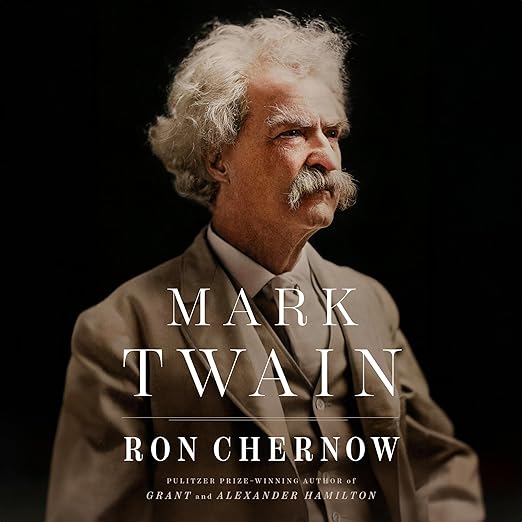
Read the description and the product being sold could not be clearer. It is Ron Chernow's life of Samuel Langhorne Clemens, introduced by a stack of 2025 honors: number one on the bestseller list, a Washington Post and New York Times Notable Book, best-of-the-year selections from TIME, The Guardian, Bloomberg, The Christian Science Monitor and Kirkus Reviews. Read the credits on the same page and the audiobook is filed under Geoffrey C. Ward, issued by Random House Audio, dated January 11, 2002. No recording made in 2002 can be a reading of a book the copy dates to 2025.
Three of the five entries in the review column name the writer the description names. The four-star one from December 2025 opens with that name, places the volume alongside the same biographer's earlier books on Washington, Grant and Hamilton, and warns that none of them suits a casual reader. The other two praise the writing without naming anybody, and not one of the five mentions the name sitting in the author field. So the 4.4 badge and its 57 ratings were earned by a text nobody on this page attributes to the name in the author field, and a buyer working from the star rating alone has no way to know which of the two Mark Twains those stars belong to. My own view of the situation is simple. The writing being praised here is genuinely first rank, the listing describing it is not, and the two halves of this page were assembled by different processes that never checked each other.
A Life Told in Sequence, Twenty Minutes at a Time
Whichever edition reaches your library, the life is worth the hours. Clemens was born in 1835 dreaming of piloting steamboats, lost the river to the Civil War, went west to the Nevada Territory and started filing newspaper dispatches whose brashness got him noticed. Then came the pen name, the lecture circuit, Hartford, a wife and three daughters, Tom Sawyer and Huckleberry Finn, a second career as the country's loudest political commentator, business ventures that bankrupted him, nine years of economizing in Europe, and a last stretch shadowed by the deaths of his wife and two of his daughters. The copy also makes a claim worth weighing, that this was the most important white American writer of his generation to reckon seriously with slavery, and it does not pretend the reckoning was clean.
What the enthusiastic responses actually praise is completeness, and what they complain about is the same quality seen from the other side. A five-star entry from mid-February lands on the formula that fits best: exhaustive and occasionally exhausting, thin on the early years because the record itself is thin, then overwhelming once the archive of letters, travels and documents written by other people opens up. That same reader admits to taking the book slowly, over an extended stretch, which is the honest way to approach a work of this size. Completeness is both the promise and the price here, and whether the trade works is the only real question a biography this large raises.
That is a real argument for hearing rather than reading a book of this scale. A chronological life told in sequence survives being taken in twenty minutes at a time far better than an argument-driven history does, and the long documentary middle stretch, the part more than one reader found heavy on the page, moves at a steadier clip when somebody else is doing the pacing. Eight hours, however, is not a straight reading of a 1,133-page manuscript by any arithmetic, so treat the runtime as information rather than as a convenience. A man who built a career on the lecture platform also rewards being spoken: the timing of the jokes, the mock solemnity, the pauses he engineered into his own sentences were designed for a room, and any competent reading gets a bonus from that which the page cannot supply.
Bill Meisle Belongs to the Other Half
Take the dates seriously before spending a credit. The audio release on this record is January 11, 2002. The oldest written response is from June 2025, a three-word note filed from Canada, and the other four arrive between December and the end of February. A review column that opens twenty-three years after the recording it is attached to is not a review column for that recording, and the gap is wide enough to swallow every other claim on the page.
Bill Meisle, the credited reader, belongs to the 2002 half of the record, which leaves the credit unverifiable against everything else on the page. Publisher, imprint and format all point the same way, and nothing in the listing tells you whether the file you download runs the Chernow text abridged, a different biography of the same subject, or the older recording exactly as it was made. Subtitles would settle it in one line, and the field is empty.
Something else worth knowing before you commit: the responses grade a printed object. Page counts, the weight of the tome, the wish for a shorter edit, all of it comes from readers with a book in their hands. That evidence is genuinely useful about the writing and worth nothing at all about the listening, which on a title with this much metadata confusion is the one thing a buyer most needs graded.
Verify the Edition Before You Spend Anything
Devotees of full-dress American biography will want this life in some form. The most recent entry on the page, five stars from late February, calls the writer one of the best it has ever read and reports being sorry only that the book ends. That is a fair picture of the audience this material rewards: readers who want the archive, the contradictions, the business disasters and the grief, not a highlights reel of the riverboat years. Teachers and students of nineteenth-century America get a second use out of it, since the career maps almost exactly onto westward expansion, industrial boom and the first American foreign wars.
Verify the edition before you spend anything. Open the product page, check the runtime against the edition you mean to buy, check the publication year in the fine print, and sample the opening minutes if a sample is offered. If the opening chapter is not the boy born in 1835 with the Mississippi on his mind, you are holding a different Mark Twain than the one this description advertises, and no star rating on the page will tell you that.
Questions Listeners Ask
Does this audiobook match the biography in the description?
The description sells a 2025 biography by Ron Chernow. The audio credits name Geoffrey C. Ward, Random House Audio and a January 2002 release. Those cannot describe one product, and no field on the record reconciles them, so confirm the edition on the product page before spending money or a credit.
What are the press quotes at the top of the listing praising?
The 2025 biography, not the audio. The description leads with a Boston Globe line calling the book comprehensive and enthralling, and comparing its flow to the Mississippi, followed by a Washington Post note on its clarity and how absorbing it stays despite the length. Both describe the printed edition.
Is this a good audiobook for someone new to Twain?
As an introduction, no. This is full-dress archival biography of a long and complicated life, written for readers who already want that level of detail. Newcomers are better served by Tom Sawyer or Huckleberry Finn first, then this for the man who wrote them and the country he spent his life arguing with.