Quick Take
- Narration: Virtual Voice AI narration delivers the text but struggles to convey the rhetorical urgency that Passio’s teachings are known for in their original lecture format.
- Themes: Natural law philosophy, sovereignty and freedom, institutional control
- Mood: Earnest and polemical, written for listeners already sympathetic to libertarian and sovereignty-focused worldviews
- Verdict: A genuine attempt to compile and systematize Mark Passio’s Natural Law teachings, but the AI-assisted authorship and Virtual Voice narration create distance from the source material’s energy, best treated as a reference companion rather than a standalone introduction.
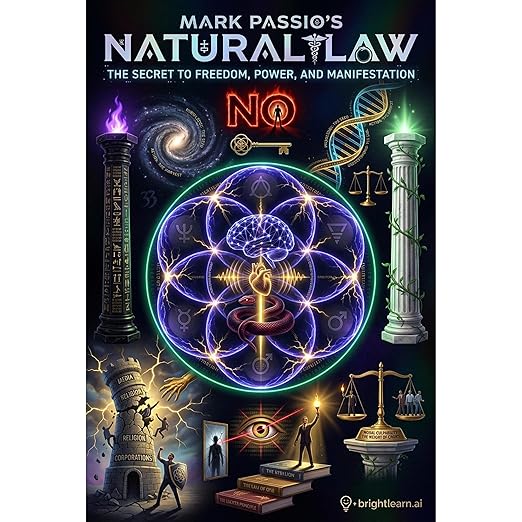
I approached Mark Passio’s Natural Law with particular care, because the book’s own author’s note is unusual enough to warrant full attention before forming any judgment about the content. Cory Endrulat states explicitly that while he is not typically an advocate for AI-generated content, this book was created using a decentralized AI system called BrightLearn, trained on Passio’s source material and developed by Mike Adams. Endrulat describes himself as a student of Passio’s work and a member of his One Great Work Network. The book is, in other words, an AI-structured compilation of another thinker’s philosophy, authored by a follower of that thinker. That is a genuinely unusual provenance for an audiobook, and listeners deserve to have it foregrounded rather than buried.
Mark Passio himself is a former Satanist-turned-natural-law philosopher whose multi-day seminar presentations on natural law, consciousness, and institutional control have circulated widely in libertarian, sovereignty, and truth-seeking communities. His original lectures are lengthy, dense, and delivered with a rhetorical energy that comes from years of public speaking. Endrulat’s project is to distill hundreds of thousands of words from that body of work into something more accessible. That is a reasonable editorial ambition. Whether the execution achieves it is a harder question.
Our Take on Mark Passio’s Natural Law
The book’s central argument follows Passio’s framework: that there are objective, discoverable laws governing human existence and moral consequence; that institutional structures, governments, media, organized religion, deliberately suppress knowledge of these laws to maintain control over populations; and that genuine freedom requires not just intellectual awareness of natural law but active alignment with its principles. Endrulat also distinguishes between nescience and ignorance, not knowing what one has not been exposed to versus willfully refusing to engage with available truth, a distinction Passio treats as foundational to understanding why most people remain in a state of unconscious subjugation.
That framework is coherent and internally consistent. Whether one finds it persuasive depends significantly on prior philosophical commitments. Listeners sympathetic to libertarian philosophy, sovereignty movements, or alternative epistemologies will find the argument resonant. Listeners who approach it from a mainstream political philosophy background will find the institutional critique overstated and the evidentiary standards for claims about deliberate suppression thin. The book does not attempt to persuade skeptics, it is written for those already oriented toward Passio’s worldview.
Why Listen to Mark Passio’s Natural Law
At thirty-four hours, this is an extensive commitment. The runtime reflects the comprehensiveness of Endrulat’s compilation: Passio’s natural law framework covers metaphysics, epistemology, moral philosophy, political theory, and practical sovereignty strategies in a systematic way, and thirty-four hours is what it takes to work through that systematically. Virtual Voice narration delivers the text accurately but cannot replicate the rhetorical fire of Passio’s original lectures. Listeners who want the source energy should seek out the original Natural Law Seminar recordings, which are available freely online and run to several days of material. This book functions better as a structured companion and reference to those recordings than as a first encounter with the ideas.
The single available review confirms the book as a profound and deeply intellectual engagement with the moral and objective laws of the universe. That assessment aligns with what Passio’s supporters consistently say about his work. Whether the AI structuring process has diluted or distorted any of those ideas relative to Passio’s original lectures is harder to assess without direct comparison.
What to Watch For in Mark Passio’s Natural Law
Listeners should be aware that this is a derivative work: Passio’s ideas, compiled and structured by a student using AI tools, delivered by AI narration. That chain of distance from the original source is worth holding in mind throughout. Endrulat’s transparency about the AI authorship is commendable, but it raises genuine questions about fidelity to Passio’s original framing that a thirty-four-hour commitment deserves honest acknowledgment of.
The political and philosophical posture of the book is explicitly anti-institutional and sovereignty-oriented. Listeners who find those frameworks unconvincing will struggle with the book’s tone, which assumes agreement with its premises rather than arguing for them from first principles in ways a skeptical reader could follow.
Who Should Listen to Mark Passio’s Natural Law
Committed students of Mark Passio’s work who want a structured written companion to his lectures will find this a useful reference. Libertarian and sovereignty-oriented listeners exploring natural law philosophy will find the framework coherently presented. Listeners approaching natural law philosophy for the first time as a philosophical concept, rather than as Passio’s specific system, would be better served starting with the original lecture recordings, where the ideas have the energy of direct delivery. Those expecting a neutral academic treatment of natural law theory will find this an advocacy text rather than a scholarly survey.
Frequently Asked Questions
Is this book written by Mark Passio himself?
No. It is written by Cory Endrulat, a student of Passio’s work, using an AI system called BrightLearn to compile and structure Passio’s teachings. Endrulat’s author’s note discloses this explicitly.
How does the Virtual Voice narration compare to listening to Passio’s original lectures?
It does not compare favorably in terms of rhetorical energy. Passio is a forceful and dynamic speaker, and his original Natural Law Seminar recordings convey a quality of urgency that Virtual Voice AI cannot replicate. This book is better as a reference than as a primary introduction.
At 34 hours, is this book accessible enough to sustain a first-time listener through that runtime?
It depends significantly on prior sympathy with the worldview. Listeners already oriented toward natural law, sovereignty, and institutional critique will find the framework engaging across the full runtime. Skeptical listeners will likely disengage much earlier.
Is this a good introduction to natural law philosophy as an academic subject?
No. This is Passio’s specific natural law framework, which draws on hermetic philosophy, libertarian theory, and alternative epistemologies, not the academic natural law tradition associated with Aquinas, Locke, or contemporary moral philosophy. Those seeking the academic tradition should look elsewhere.