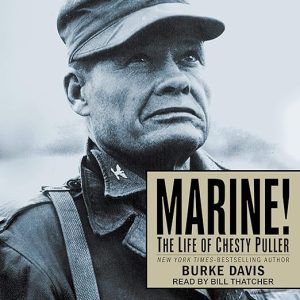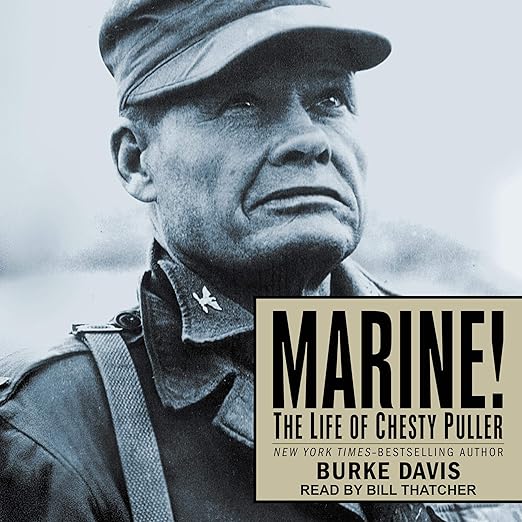
Before You Press Play
- Read by: Bill Thatcher has no prior track record that I could confirm; the five-decade, five-theater military biography demands measured authority over dramatic flourish.
- At its heart: Marine Corps combat legacy, institutional politics versus battlefield heroism, five Navy Crosses
- Vibe: Sober and reverent, with real tension between legend and institutional resentment
- Short version: A rewarding, unsentimental listen for military history readers willing to sit with Puller's full, complicated record.
Did Lewis 'Chesty' Puller really earn five separate Navy Crosses, more than any Marine in Corps history? That specific record, second only to the Congressional Medal of Honor in prestige, is the spine of this audiobook, and Burke Davis spends twelve hours and fourteen minutes proving it wasn't a fluke of paperwork but the result of a career built entirely on being where the fighting was worst. Puller enlisted during World War I, and Davis tracks him through Haiti, Nicaragua, the Horse Marines in Peking, the Pacific theater, and the brutal winter retreat from the Chosin Reservoir in Korea, a service record spanning nearly the entire first half of the twentieth century's American wars. Marine! isn't a sanitized hagiography; it's a bestselling military biographer's attempt to explain how a son of the South, descended from Robert E. Lee and cousin to George S. Patton, became the most decorated enlisted-turned-officer in Marine Corps history and still got pushed into early retirement by a high command that resented him.
What makes Marine! work as biography rather than pure hagiography is Davis's willingness to sit with the contradiction at Puller's center: adored by the troops he commanded, distrusted by the career officers above him. The synopsis is blunt about this, describing a high command that resented his 'lowly' enlisted beginnings and his refusal to play political games, and that tension runs underneath every battlefield chapter rather than surfacing only at the end. Davis gives real weight to the toll of five separate combat theaters on one man's body and reputation, which keeps the book closer to honest military history than to recruitment-poster mythmaking.
One listener review, from someone who actually served in the Marine Corps and came in already familiar with Chesty's reputation, specifically praises the campaign-level detail, enough, in that reviewer's words, to understand the difference between a Marine who simply has a job and one who answered something closer to a calling. That's a meaningful endorsement for a military history audiobook, since readers who already know the subject are the hardest audience to satisfy on accuracy and texture. A second reviewer connects the book to Fortunate Son, the Pulitzer Prize-winning memoir written by Puller's own son, Lewis Puller Jr., a useful companion listen for anyone who finishes Marine! wanting to see how the general's legacy landed on the next generation.
Puller's legacy extends well past the specific battles Davis narrates: his name is still invoked in Marine Corps training and culture today, and streets, barracks, and even a modern-day guided-missile destroyer carry his name. Davis doesn't dwell heavily on this afterlife within the audiobook itself, focusing instead on the historical record of Puller's actual service, but listeners familiar with modern Marine Corps culture will recognize how directly that reverence traces back to exactly the campaigns this book covers in detail.
Why Listen to Marine!
Bill Thatcher narrates, and I found no track record for him to draw on, so the fairest thing is to describe what the material demands of him rather than promise a specific performance style. Military biography spanning five separate combat theaters over roughly forty years needs a narrator who can hold tactical detail, troop movements, campaign names, rank structures, legible without turning every chapter into a dry procedural recitation, while still landing the emotional cost when Davis wants it felt. Five Navy Crosses is not a quiet story, so a measured, unshowy delivery that trusts the material rather than oversells it is generally the safer bet for this kind of decades-spanning military narrative.
A third reviewer admits going in skeptical, unsure why they'd even picked the book up despite having enjoyed history in school, and specifically notes that Puller's name had never registered for them before. That's a useful data point for anyone hesitant about a biography of a subject they don't already recognize: multiple listeners describe the same arc, mild unfamiliarity turning into genuine investment once the campaign detail starts accumulating. For an audiobook running over twelve hours, that kind of unprompted conversion, from someone with no prior stake in the subject, is a stronger signal than uniform praise from readers who came in already primed to admire Puller.
What to Watch For in Marine!
This is straightforward narrative military biography, not analysis or memoir in Puller's own voice; Davis writes from the outside looking in, drawing on the historical record rather than reproducing Puller's personal papers or letters at length. Listeners wanting a first-person account of the Chosin Reservoir retreat specifically should know this is filtered entirely through Davis's own biographer's voice. Because the book covers five distinct combat theaters, the density of place names, unit designations, and mid-century Marine Corps rank structure is real; this rewards listeners with at least some baseline interest in twentieth-century American military history rather than working as a casual introduction to the era.
Worth flagging plainly: the numerical rating here rests on only three ratings, a small sample for a twelve-hour commitment. All three attached written reviews are substantive and specific rather than one-line filler, which helps, but listeners should treat the 4.7 score as an early, promising signal rather than a large-scale consensus. Sampling the first hour, which covers Puller's enlisted origins before the combat chapters begin, is a reasonable way to judge whether Davis's pacing and Thatcher's delivery suit you before committing to the full runtime.
Listeners who want broader Korean War context beyond Puller's own experience at the Chosin Reservoir specifically might pair this with a dedicated Korean War history afterward; Davis stays tightly focused on Puller's personal command decisions rather than the war's full strategic picture, a deliberate narrowing rather than an oversight, and one that keeps the book's focus squarely on its subject.
Who Should Listen to Marine!
Marine! is built for listeners of military history and biography specifically, readers who want their heroes complicated by institutional politics rather than presented as uncomplicated legend. Anyone who's read or wants to read Fortunate Son should treat this as the natural companion piece, since between the two books you get both the general's public record and his son's account of what inheriting that legacy actually cost.
Skip it if you're looking for a brisk single-battle account rather than a full career arc, or if dense campaign-and-rank detail across five different wars sounds more exhausting than engaging. For readers already curious about Puller, or Marine Corps history generally, this earns its twelve hours by refusing to simplify a genuinely complicated man into either saint or myth.