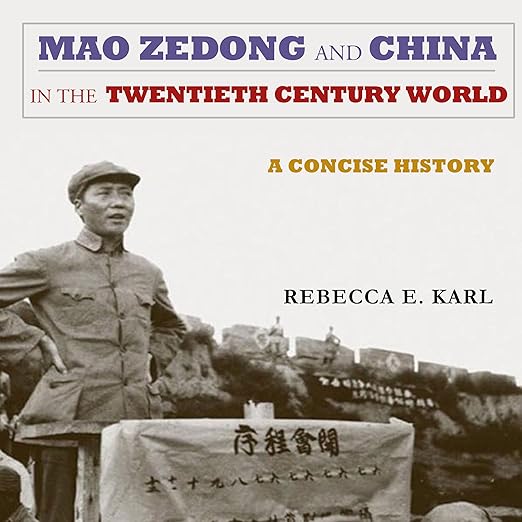
Karl begins in a small village in Hunan province, with a boy's relationships with his parents and his appetite for education, and with the Qing dynasty collapsing in the background in late 1911. Seven hours and fifty-six minutes later the audiobook has covered a life, a revolution and most of a century, which tells you immediately what kind of book this is. Rebecca E. Karl wrote a compressed scholarly account, not a doorstop biography, and the compression is the point rather than a limitation.
Clause Structure Carried by Voice Alone
What separates this from the shelf of Mao books is where Karl puts him. The revolution is placed inside a global frame built from imperialism, decolonization and third worldism, with worldwide movements in politics, economics, military power and territorial sovereignty running alongside the Chinese story. Mao stops being a national curiosity and becomes one figure in a century-wide argument about what decolonizing states were trying to do, which is a far more useful frame than the great-man treatment.
A five-star from March 2017 describes exactly who this works for. That entry assigned the book as short weekly readings in an IB history course, judged it equally suitable for an undergraduate survey of Chinese history, and valued it for delivering usable pieces of information alongside genuine insight into Mao himself. Reading the book as a teaching text rather than as a narrative biography explains most of its choices.
Bobby Brill's name sits under the byline, and the assignment is dense with things that have to be pronounced correctly and kept apart. Hunan, the Qing, the May 4th movement, Chiang Kai-shek and a long run of party bodies and campaigns arrive steadily across eight hours, in a text the copy identifies as a Duke University Press book. Academic prose read straight gives a reader nothing to hide behind, and the sentences are long, so clause structure has to be carried by voice alone.
A Love Letter or Hate Mail, Neither Here
Neutrality is the quality a January 2021 response singles out, and it puts the problem sharply: every book about Mao is either a love letter or hate mail, in the same way that every book about Walt Disney is. That entry finds this one refreshingly free of both, presenting the history in a realistic fashion without frills or unwanted opinions. On a subject where most readers arrive already knowing which side they are supposed to take, that is a real recommendation.
The compression works in audio's favor as well. Under eight hours for the entire arc means the book never stalls in a decade, and a listener gets a complete shape rather than a fragment: village childhood, the shift from liberal to Communist across the 1920s, organizing a revolution in an overwhelmingly agrarian society, and the confrontation with Chiang Kai-shek and the nationalist conservatives. Very few audio treatments of modern China give you that whole outline in a single sitting's worth of listening.
Karl also spends time where popular accounts do not. Mao's early criticism of the subjugation of women gets attention, as do his marriages and romantic attachments, considered specifically in relation to his role as the founder of Chinese Communism rather than as biographical color. That material is genuinely hard to find in short treatments, and it is the strongest argument for choosing this book over a more famous one.
The Thread Is Hard to Recover Once Lost
The one substantial objection on the page is worth taking seriously. A three-star from January 2019 was assigned the book as an introductory text in an undergraduate course on the Cultural Revolution, found nothing factually wrong in the chapters it had read, and objected instead to how facts were characterized and grouped. Its advice is to read the entire preface before buying, because the preface states a personal motivation for writing. A listener cannot do that. Sampling a preface is straightforward with a book in hand, and on a file it arrives after purchase.
Density is the second caveat. A four-star from August 2017 reports not having finished the book and needing to go back over passages to hold them in context, which is a fair description of a scholarly text working at this speed. Rereading is the one thing audio makes genuinely difficult, and a listener who loses the thread during the 1920s has no easy way to recover it. Anyone who finds themselves rewinding twice in a chapter should consider the printed edition instead.
The record itself shows its age. Released in February 2015, the file has collected 4.3 across sixty-eight ratings with five written responses spread from 2017 to 2021, which is a thin written column for a decade-old academic title and gives a browser very little recent signal. The series field names Asia-Pacific: Culture, Politics, and Society and then leaves the number blank, so nothing indicates where this sits in that sequence.
Informative and Concise, a Working Framework
Students and the seriously curious are the core audience. A February 2019 entry sums the value up as informative and concise, a good introduction to modern Chinese history, and that is the honest pitch: eight hours to acquire a working framework for a century you probably half know. Listeners who want the global context, not just the Chinese one, will get more here than from most single-volume treatments.
Anyone hoping for a narrative biography with scenes and dialogue should choose differently, because this is analysis with a chronology attached rather than a story. Readers who want a moral verdict on Mao will not be given one, which is either the reason to buy it or the reason not to. Listeners who need to work slowly through argued academic prose should weigh the format honestly, since a compressed scholarly text is the hardest kind of nonfiction to rejoin once attention has drifted.
Is this audiobook a good introduction to Mao for someone with no background?
It is pitched at that level, but the prose is academic rather than popular. The book covers Mao's whole life alongside the global context of imperialism and decolonization in under eight hours, which means a fast pace and few concessions. Expect a course text rather than a narrative biography.
What runtime should I plan for, and who narrates?
Seven hours and fifty-six minutes, with Bobby Brill named as the narrator. The recording dates from February 2015 and is a straight reading rather than a dramatized production, which matches a book written to be assigned in courses rather than to be enjoyed as a story.
How much of the audiobook covers the Cultural Revolution and the later years?
The description details the early material closely, from a Hunan childhood through the May 4th movement, the turn to Communism and the organizing of an agrarian revolution. It stops short of listing what the later chapters contain, so how much weight falls on the decades after 1949 is not stated anywhere.
How much background does the audiobook assume?
Enough to move fast. The account starts with the collapse of the Qing dynasty in late 1911 and works forward without pausing to define its terms, in prose written for a scholarly readership. Some prior familiarity with modern Chinese history makes the experience substantially easier and considerably more rewarding.