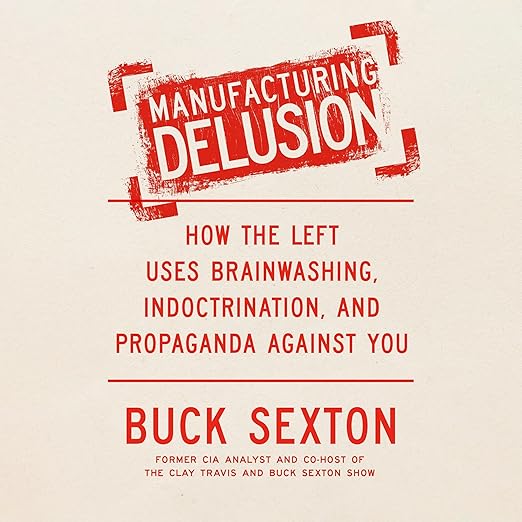
Quick Take
- Narration: Buck Sexton reads his own book with the practiced confidence of a radio host; the delivery is assured and the chapter structure keeps a five-hour listen from feeling padded.
- Themes: Mass psychology, propaganda history, political manipulation
- Mood: Urgent and polemical, historically grounded
- Verdict: A historically informed examination of crowd manipulation tactics that will resonate strongly with its intended conservative audience and less so with those who disagree with its contemporary applications.
I want to be honest about the position I am reviewing Manufacturing Delusion from. I am a literary critic who reads across the political spectrum, and I try to evaluate books on their own terms before I evaluate their arguments. Buck Sexton has written a book that is genuinely useful in some of its historical analysis and genuinely limited in some of its contemporary applications. Those two things can be true simultaneously, and treating them as though they cannot is what produces bad reviews of politically charged nonfiction.
I listened to most of this on a Tuesday evening in early spring, doing the kind of mindless kitchen tasks that let a dense nonfiction argument settle at the pace it needs. Sexton narrates his own book, and his radio background shows in the best possible way: the pacing is disciplined, the transitions are clean, and he never buries the listener in subordinate clauses. For a five-hour political argument, that matters more than readers might expect.
The Historical Cases That Do the Heavy Lifting
The strongest sections of Manufacturing Delusion are the historical ones. Sexton draws on Stalin’s use of Pavlovian conditioning techniques in Soviet political culture, Chinese thought reform practices under Mao, and the rhetorical methods used by jihadist preachers to build loyal followings by isolating individuals from outside social ties. These are not original scholarly contributions, but Sexton synthesizes them clearly and with evident familiarity. His CIA background working on counter-terrorism analysis gives him credibility when discussing how radicalization operates at the level of individual psychology, and the eight tactics of mass delusion he identifies are organized accessibly from this historical material.
Reviewers who come to the book primarily for the historical content tend to be the most satisfied. One describes it as providing needed information for pattern recognition and notes that the research is genuinely scholarly rather than conspiratorial in tone. Another reviewer who listened while familiar with crowd psychology literature found Sexton’s synthesis capable of standing alongside more academic treatments of the subject. Those assessments hold for the historical sections specifically.
Where the Framework Gets Applied to the Present
The book’s second major move is applying its historical framework to contemporary American life, specifically to public health debates, gender politics, and racial justice. This is where the book will divide readers most sharply. Sexton argues that early stages of mass delusion are already present in the United States in these domains. Readers who share his political priors will find the argument compelling and will likely find the connection between the historical cases and the contemporary examples persuasive. Readers who do not share those priors will find the historical framework doing work it was not quite built for.
One reviewer who found the historical analysis excellent also noted disappointment that no solutions were offered for reuniting people divided by these dynamics, expressing concern that the book diagnoses a problem without providing a path toward repair. That is a fair critique. The book is better at diagnosis than prescription, and in its contemporary applications the diagnosis assumes agreement about what constitutes delusion in the first place, which is precisely the contested question.
Self-Narration and the Radio Discipline It Requires
Author narration of political nonfiction is almost always a gamble. The author’s investment in the argument can make the narration feel prosecutorial when a more measured delivery would serve better. Sexton mostly avoids this. His radio discipline keeps the self-narration from tipping into performance. The chapter and sub-chapter organization that reviewers praise in the written text also benefits the audio experience: it is easy to track where the argument is in its structure at any given moment, which matters in a book that covers Stalinist psychology, Chinese thought reform, and American culture in under six hours.
How to Read It Honestly
Manufacturing Delusion is a book that requires intellectual honesty from both its admirers and its skeptics. The historical framework is legitimate and clearly presented. The contemporary applications are selective and reflect a specific political worldview. Listeners who read widely in political thought and can hold those two assessments in tension will get more from the book than those who arrive either to confirm everything or to dismiss everything. Sexton is most persuasive when he stays inside the historical record. He is most controversial when he steps outside it to make claims about the present. Both modes are present, and knowing which is which is the reader’s responsibility rather than the author’s burden.
Frequently Asked Questions
Is Manufacturing Delusion primarily a history book or a political commentary?
Both. The first half draws heavily on historical cases including Stalin, Mao, and jihadist radicalization. The second half applies the resulting framework to contemporary American political debates, making it explicitly political commentary.
How does Sexton’s CIA background shape the analysis?
His intelligence experience informs the sections on counter-terrorism and radicalization most directly. Having worked on jihadist movements, his discussion of how preachers isolate followers from outside influences carries particular credibility.
Does the book offer practical advice for resisting mass manipulation, or is it primarily diagnostic?
Primarily diagnostic. Sexton focuses on identifying tactics of mass delusion through historical examples. Several readers noted disappointment that the book does not offer concrete strategies for deprogramming or reconciling with people they believe have been manipulated.
How does Manufacturing Delusion compare to other books about propaganda and crowd psychology?
It is more historically grounded and politically engaged than behavioral psychology books like Robert Cialdini’s Influence. It is less academically neutral and more openly polemical, which is a feature for its intended audience and a limitation for others.