Quick Take
- Narration: Virtual Voice narration keeps this under an hour, which suits the compact practical format, but listeners who prefer human narration will find the delivery noticeably synthetic.
- Themes: neuroplasticity and manifestation, subconscious reprogramming, cross-tradition spiritual wisdom
- Mood: Calm and hopeful, like a guided introduction to ideas you can investigate further.
- Verdict: A short, accessible primer that blends neuroscience and spiritual practice more responsibly than most in the genre, though its brevity limits how deep it can go.
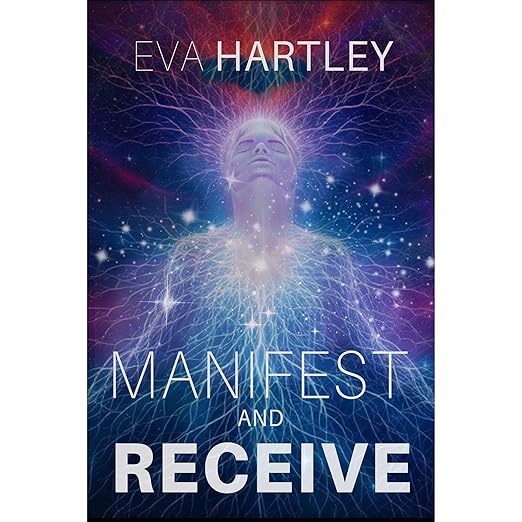
I have a complicated relationship with the manifestation genre. The better books in this space do something genuinely useful, which is bring neuroscience and behavioral psychology to bear on how our internal narratives shape our external circumstances. The worse books promise magic and deliver platitudes. Eva Hartley’s Manifest and Receive falls meaningfully closer to the former, though its one-hour runtime means it covers the territory more as an introduction than a complete guide.
The central claim is careful: manifestation is not wishful thinking, but rather the natural result of consciously reprogramming the subconscious mind and creating new neural pathways. Hartley anchors this in recognizable science, specifically neuroplasticity and the Reticular Activating System, which governs what your brain pays attention to. This is legitimate neuroscience presented accessibly, and the book’s willingness to be specific about the mechanism rather than gesturing at vague energy feels like a meaningful distinction from most titles in this category.
Our Take on Manifest and Receive
The book operates in the tradition of works that try to close the gap between the spiritual and the scientific, showing how contemplative practices from multiple traditions, Christian mysticism, Sufism, Judaism, Hinduism, all arrived at practical methods that modern neuroscience can now partially explain. This is a genuinely interesting framing, and Hartley handles it without either dismissing the spiritual dimensions or overselling the science. One reviewer described the experience as making neuroscience understandable and inspiring, which captures what the book does at its best: it translates technical concepts into language that feels personally relevant rather than academically remote.
The 30-Day Alignment Plan at the book’s center combines mindset work, somatic practices, and what Hartley calls spiritual habits. The inclusion of breathwork, movement, and journaling alongside more abstract concepts like scripting gives the program a practical texture that distinguishes it from purely theoretical books. Reviewers who describe the experience as helping them understand how their body and brain work together point to this integration as the key contribution.
Why Listen to Manifest and Receive
At just over an hour, this sits in an interesting position in the personal growth audiobook landscape. It’s short enough to complete in a single session, which works in its favor if you want to get an orientation to the ideas before deciding whether to investigate further. The brevity is also its constraint: the 30-Day Plan is outlined rather than fully elaborated, and some of the concepts, particularly around emotional imprinting and somatic regulation, would benefit from more extended treatment. Think of this less as the complete program and more as a lucid invitation into a larger conversation.
The Virtual Voice narration is the book’s most significant practical limitation. For a short, instructional listen, this is manageable, but the synthetic quality of AI narration removes some of the warmth that this kind of content benefits from. Listeners who are sensitive to this will notice it throughout. That said, the content is clear and the pacing is deliberate, so the information comes through without distortion.
What to Watch For in Manifest and Receive
The book’s rating of 4.2 from nearly 360 listeners is solid for a title released in early 2026, and the review content suggests that most listeners are coming to this as beginning or intermediate students of these ideas rather than experts. Reviewers consistently describe the accessibility as a feature, noting that the book explains complex concepts in ways that feel immediately applicable. One reviewer, describing themselves as having benefited from the book’s help with their spiritual growth, pointed specifically to the explanation of how the body and brain work together as the passage that resonated most.
Where the book requires some generosity from the listener is in its scope. Hartley is trying to integrate neuroscience, multiple spiritual traditions, and a practical thirty-day program in sixty-five minutes. The integrations are mostly handled gracefully, but the depth on any individual thread is necessarily limited. Readers who want a rigorous examination of neuroplasticity should look to dedicated scientific literature. Readers who want a rigorous examination of any of the spiritual traditions cited should seek those out individually. What Hartley does is show you the shape of a synthesis that you can then pursue further.
Who Should Listen to Manifest and Receive
Listeners who are curious about the intersection of neuroscience and spiritual practice but have found existing books in the manifestation genre either too woo or too dry will find this hits a useful middle register. Those already well-read in both areas will find it introductory. If you’re looking for a short, grounded orientation to these ideas that you can complete in a single commute and then revisit while you work through the 30-Day Plan, this serves that purpose well. The Virtual Voice narration is a genuine downside for listeners who value the human quality of audiobook performance.
Frequently Asked Questions
Is Manifest and Receive grounded in actual neuroscience or does it misuse scientific terminology?
The science it references, neuroplasticity, the Reticular Activating System, and emotional imprinting, is real and the descriptions are generally accurate for a popular audience. It doesn’t make claims that go beyond what the science supports, which distinguishes it from books that use scientific-sounding language loosely.
At just over an hour, is there enough content to make the 30-Day Alignment Plan actionable?
The plan is outlined with sufficient specificity to follow, combining mindset work, somatic practices like breathwork and movement, and journaling. However, the compressed format means you’ll likely want to take notes or re-listen to specific sections as you work through the thirty days.
How does the book handle the spiritual traditions it references, given their diversity?
Hartley draws connections between Christian mysticism, Sufism, Judaism, and Hinduism to show that practices resembling manifestation appear across traditions. The treatment is respectful and comparative rather than syncretic or reductive, though it’s necessarily brief on any individual tradition.
Is Virtual Voice narration a significant problem for this particular title?
It’s noticeable throughout, especially in a content area where warmth and presence in the narrator’s voice would add value. The content is clear and well-paced, but listeners who find synthetic narration distracting will find it a consistent background friction over the hour’s runtime.