Quick Take
- Narration: Alister Austin reads the dense economic material with steady clarity; this is not performance narration, and that restraint is appropriate for a scholarly text that demands listener focus.
- Themes: Financial contagion, speculative excess, systemic fragility in international markets
- Mood: Dense and demanding, with the slow satisfaction of genuinely shifted perspective
- Verdict: One of the most intellectually substantive books ever written about financial crises, now updated through recent events, essential for serious students of economics, challenging for casual listeners.
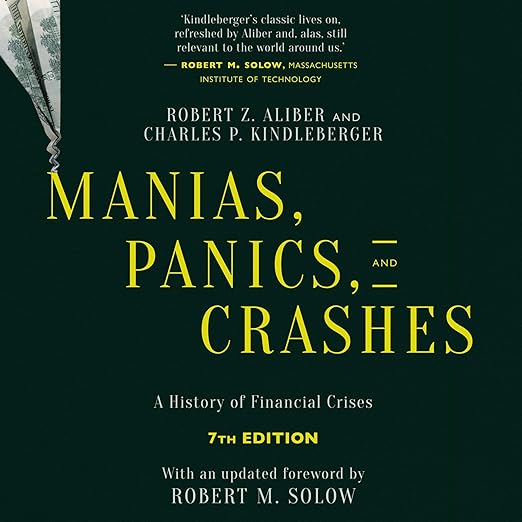
I first encountered Manias, Panics, and Crashes in the weeks after the 2008 financial crisis, when everyone I knew in publishing and literary circles was suddenly and urgently trying to understand what had just happened. The first edition predated me; the book itself had been in continuous publication since the late 1970s, updated periodically to absorb new catastrophes into its framework. That longevity is not accidental. Charles Kindleberger built something durable here, and Robert Aliber has maintained and extended it through successive editions without diluting its core argument.
This seventh edition, released in 2021 and now available in nearly twenty hours of audio narrated by Alister Austin, incorporates the crises of the 2010s and the early 2020s into a framework that Kindleberger first articulated in 1978. The central thesis is uncomfortable and important: financial crises are not aberrations or surprises. They are the recurring product of a structural instability in the international monetary system, driven by the same psychological and institutional patterns that have generated panics, manias, and crashes for centuries. The individual crises change their costumes. The underlying mechanism does not.
Our Take on Manias, Panics, and Crashes
Aliber’s most significant contribution to this edition is the argument that the major financial crises of recent decades are not independent events but interconnected symptoms. The Asian financial crisis of 1997, the dot-com collapse, the 2008 housing crisis, the European sovereign debt crisis, these are not separate stories. They are episodes in a continuous pattern of credit expansion, speculative excess, and the inevitable correction that follows when the distance between asset prices and economic fundamentals becomes unsustainable.
This is not a comfortable argument for anyone invested in the idea that modern financial regulation has fundamentally changed the system’s risk profile. It is also, as reviewers have noted, not an easy argument to follow. The seventh edition engages seriously with currency interactions, international capital flows, and the mechanics of financial contagion at a level that presupposes some economic background. One reviewer accurately described it as dense, this is not a pop finance book, and it does not want to be.
Why Listen to This Audiobook
Alister Austin’s narration serves the material rather than performing it. This is a nineteen-hour audiobook about monetary economics, and the appropriate register is measured and clear rather than dramatically varied. Austin reads with the kind of steady authority that allows the listener’s attention to remain on the argument rather than on the performance, which is exactly right for a book of this nature.
The audio format has specific strengths for this particular text. One reviewer noted that Manias, Panics, and Crashes can feel fragmentary in print, boxed sections, digressions, examples that interrupt the main argument’s thread, and the audio format linearizes that experience in a way that may actually make the argument easier to follow than the page does. The voice keeps you in forward motion even through the denser passages, which is a genuine service.
What to Watch For in This Edition
The book’s structural organization will test some listeners. Kindleberger’s original design was not strictly linear, and the additions of successive editions have not always been integrated seamlessly. One critical reviewer memorably described the reading experience as resembling life itself, material coming at you in random bits and starts. That description, while unkind, is not entirely unfair. The book requires active engagement rather than passive listening.
The economic content involving currency interactions is the most technically demanding section for non-specialist listeners. Aliber’s discussion of how exchange rate movements interact with speculative capital flows and crisis transmission across national borders is the intellectual core of what distinguishes this from earlier crisis literature, but it requires some baseline familiarity with international economics to follow without difficulty. Listeners who lack that background should expect to replay sections and accept some ambiguity.
Who Should Listen to Manias, Panics, and Crashes
Serious students of economics, finance professionals, and anyone who wants to understand financial crises at a structural level rather than a narrative one will find this essential. One reviewer said it would have predicted the 2008 crisis, and the book’s track record of predictive insight across multiple editions does carry a specific authority that newer crisis literature cannot replicate.
Listeners looking for a more accessible introduction to the history of financial crises might begin with something by Michael Lewis or John Kenneth Galbraith and return to Kindleberger and Aliber once they have the foundational vocabulary. This book rewards preparation. The perspective shift it offers, the sense that financial crises are not surprising events but predictable structural outputs, is genuinely valuable. Getting there requires patience with demanding material.
Frequently Asked Questions
How much economics background do I need to get full value from this audiobook?
A moderate amount is helpful. The sections on currency interactions, international capital flows, and the mechanics of financial contagion presuppose some familiarity with basic macroeconomics. Listeners without that background will find certain chapters difficult to follow. A general understanding of how markets work, why central banks intervene, and what exchange rates are will carry you through most of the text.
How does the seventh edition differ from earlier editions, is it worth the update if I’ve read a previous version?
Aliber has substantially incorporated the financial crises of the 2010s and early 2020s into the framework, strengthening the core thesis that recent crises are interconnected rather than independent events. If you read an earlier edition before the 2008 crisis, the updated analysis of that event and its aftermath alone makes the seventh edition worth revisiting.
Does the audiobook format work for a text that reviewers describe as structurally fragmentary?
It may actually help. The audio format linearizes the reading experience in a way that makes the argument easier to follow than the book’s somewhat discontinuous printed structure. Austin’s narration keeps you moving forward even through denser sections. One reviewer suggested the audio experience may be more coherent than the print version.
Is Alister Austin’s narration engaging enough to sustain nearly 20 hours of dense economic analysis?
Austin reads with measured clarity rather than dramatic variation, which is the appropriate choice for academic economic content. This is not a performance narration but a functional one. Listeners who find economics genuinely interesting will not struggle to stay engaged; those looking for narrative energy in the performance itself may find the style flat.