Quick Take
- Narration: James Matthews Vannoy delivers Frank’s particular combination of earnest conviction and spectacular poor judgment with a dry wit that is exactly right for Joe Barrett’s absurdist sensibility.
- Themes: Institutional absurdity and the fight against it, unlikely surrogate families, bad decisions made for good reasons
- Mood: Broadly comic and warmly chaotic, with an unexpectedly sincere heart
- Verdict: A genuinely funny, offbeat comedy about three suburban misfits waging war on impersonal bureaucracy, Kirkus had the right word for it: unqualified delight.
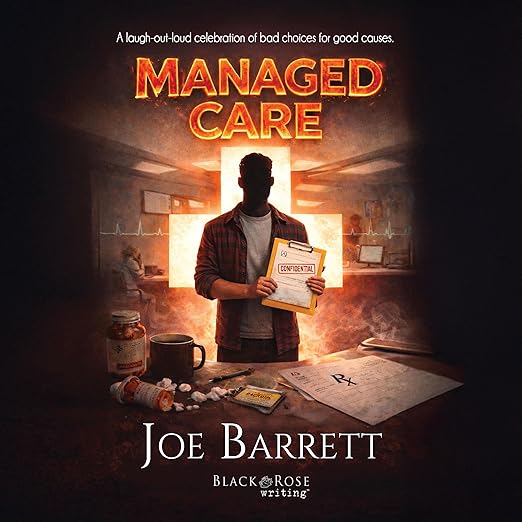
Managed Care arrived in my queue on the recommendation of someone who described it as the funniest book they had read in years, which is both the most useful and the most dangerous kind of endorsement. Funny is the hardest quality to deliver consistently across a nearly ten-hour audiobook, and books described as hilarious on their covers often traffic in a kind of winking, comfortable comedy that mistakes charm for wit. Joe Barrett’s novel is not that. It is actually funny in the way that requires structural commitment to absurdity, the kind of funny that comes from following an illogical premise to its logical conclusion with absolute deadpan sincerity.
The setup is, on its face, preposterous: Frank Johnson, thirty-three years old, paid a year in advance for his grandfather’s nursing home stay. The grandfather died before moving in. The facility refuses to refund the prepayment. Frank’s response, moving into the nursing home himself to extract value from the transaction, is the act of a man with limited resources, considerable stubbornness, and an unshakeable sense that this is probably what Jesus would have wanted. That last detail is load-bearing. Frank is not cynical. He is radically sincere about his bad decisions, and that sincerity is what makes him funny rather than merely irritating.
Frank, Elroy, and the Improbable Family
The novel’s emotional engine is the relationship between Frank and Elroy, the foster kid who gets thrust into his life. Frank’s initial plan to leverage this forced relationship to his advantage, extracting utility from an inconvenience, is immediately complicated by the fact that Elroy is a real person with his own interior life and needs. Barrett is too smart a writer to let the sentimentality overwhelm the comedy, but he is also not afraid of the sentiment. The three misfits at the novel’s center accumulate into something that reads as a genuine argument about connection and belonging, even while the plot around them involves chess match feuds with management and what Kirkus calls occasionally crass behavior.
Barrett’s Satirical Target and Why It Works
The managed care industry is not, on its face, the most obvious comedic subject. But Barrett understands that the comedy of institutional impersonality is really the comedy of what happens when systems designed to process people encounter people who refuse to be processed. Frank is in many ways the ideal satirical protagonist: he has enough institutional knowledge to understand how the system works and enough stubbornness to refuse to play by its rules. He is deploying his campaign against an industry whose primary function is the management of human vulnerability, and the chess match with management, which the synopsis notes does not occupy nearly enough of his time, is both a literal plot element and a description of Frank’s entire worldview.
James Matthews Vannoy and the Deadpan Requirement
Absurdist comedy in audio format requires the narrator to never blink. The moment the performer signals to the audience that they know this is ridiculous, the comedy deflates. Vannoy understands this. He plays Frank with earnest conviction throughout, which is what allows the novel’s more extreme moments to function as comedy rather than as chaos. The dry delivery he brings to Frank’s increasingly unhinged justifications, each presented as though perfectly reasonable, gives the listener the pleasure of seeing the absurdity clearly while being in the company of someone who does not. That is the correct technique, and Vannoy deploys it consistently.
Who Should Spend Time in the Nursing Home with Frank
Readers who appreciate Christopher Moore’s brand of warmly unhinged comedy, or who love the absurdist American tradition from Vonnegut onward, will find Managed Care in their wheelhouse. It is also a strong recommendation for listeners who are tired of cynical comedy and want something that believes in its characters even while laughing at them. Those who need narrative tidiness or conventional plot structures may find Frank’s approach to problem-solving frustrating. The novel is not interested in efficiency. It is interested in Frank, which is a different and more rewarding thing.
Frequently Asked Questions
Is Managed Care part of a series, or does the nursing home adventure begin and end in one book?
It is a standalone novel. Frank Johnson’s campaign against the managed care facility is contained within this single book, which arrives at a complete resolution. There is no sequel.
Is the foster kid Elroy’s storyline developed substantially, or is he primarily a comedic foil for Frank?
Elroy is genuinely developed as a character. Barrett gives him his own interior life and needs, and the relationship between Frank and Elroy becomes one of the novel’s primary emotional investments. The decision to give the kid real weight rather than using him purely for comedic contrast is one of the novel’s better choices.
How does the Jesus reference in the synopsis function, is there a religious element to the story, or is it purely satirical?
Satirical, though affectionate rather than hostile. Frank’s occasional invocation of what Jesus would have wanted is less theological argument and more a window into his particular moral logic, he has a sincere if idiosyncratic code of ethics, and that code is part of what makes his bad decisions feel principled rather than random.
The Tom McCaffrey blurb calls this the funniest book he has ever read, does the comedy hold up across a nearly ten-hour runtime?
The reader consensus suggests yes, though comedy is the most subjective quality to evaluate. The novel maintains its tone consistently because the absurdity is structural rather than dependent on individual jokes. Listeners who surrender to Frank’s worldview in the first hour tend to find the investment sustained.