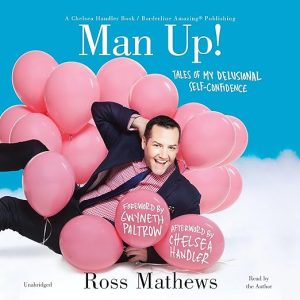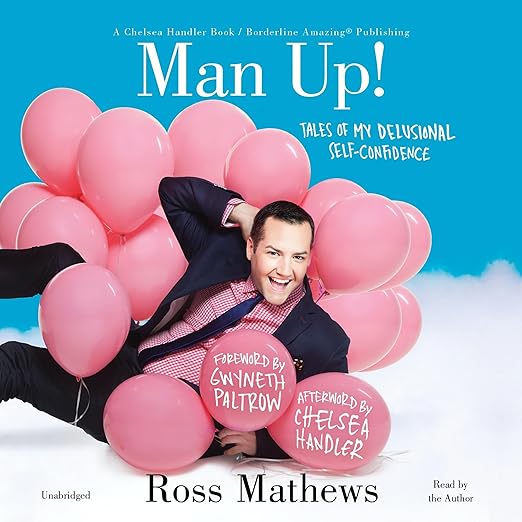
- Narration: Ross Mathews narrates his own memoir and the result is exactly what fans would hope for - his voice has the same buoyant, slightly breathless quality he brings to television, making the funnier passages land with perfect comic timing.
- Themes: LGBTQ+ identity, Hollywood ambition, small-town outsider experience
- Mood: Warm, funny, and surprisingly candid
- Verdict: Fans of Mathews will find this audiobook experience almost indistinguishable from a long, hilarious phone call with him.
Ross Mathews grew up in a small Northwestern farm town where becoming a Hollywood television personality was not exactly the expected career path. That gap between where he started and where he landed is the engine driving Man Up!, his memoir audiobook narrated by Mathews himself, and the format could not be a better fit. The voice you hear is recognizably the same one that made him famous as "Ross the Intern" on The Tonight Show with Jay Leno - quick, warm, self-deprecating, and always a little louder than the room strictly requires.
This audiobook runs just over five hours, which is the right length for a memoir built primarily on episodic storytelling rather than heavy psychological excavation. Mathews does not pretend his life has been a tragedy or a triumph in the conventional sense. He frames it as a series of absurd, funny situations that somehow added up to a career, and the honesty in that framing is more disarming than most celebrity memoir confessions.
Our Take on Man Up!
The question the book is really asking - which Mathews answers obliquely rather than with a thesis statement - is whether someone who doesn't fit any obvious mold can survive without becoming a different, safer version of themselves. His answer comes through accumulated anecdote: the high school girlfriend situation he describes with obvious affectionate horror, the embezzled sandwiches, the pot butter misadventure. None of these stories would mean much in isolation. Together, they build a portrait of someone who was always slightly sideways to his environment and had to figure out whether to correct for that or lean in.
Mathews leans in, obviously. But what the audiobook captures that a written read-through might miss is the genuine warmth underneath the comedy. Reviewers who came in expecting one-dimensional celebrity gossip consistently report being surprised by how much they liked him. That reaction is not accidental - it comes from a performer who has spent years managing the distance between his public persona and his actual self, and who apparently decided to close that distance in this book.
Why Listen to Man Up!
The self-narration is the reason to choose audio over print here. Mathews writes like he talks, which is a cliche that reviewers apply to this book specifically because it is literally true in this case. Jokes that might read as labored on the page have momentum when he delivers them. The rhythm of his storytelling - digressive, tangent-happy, always circling back - plays better in audio because you can hear when he is setting up a punchline versus when he genuinely got sidetracked. One reviewer noted that following his stream-of-consciousness thought process is "a ride in itself" and called it hysterical one minute, then emotional the next. That tonal range, managed almost unconsciously in the narration, is the audiobook's real achievement.
The celebrity anecdotes - Gwyneth Paltrow, Tiffani-Amber Thiessen, Madonna, Michelle Kwan, and others - are deployed with more taste than the marketing suggests. Mathews is not in the business of embarrassing people he admires. The stories he tells about his famous encounters are mostly about his own awkwardness and enthusiasm, which keeps them affectionate rather than predatory. The Behind the Scenes material from Full House and America's Funniest Home Videos is lighter than you might expect, though.
What to Watch For in Man Up!
The book is most interesting when it drops the performance and gets quiet for a moment. Those passages are brief - Mathews is not temperamentally suited to extended earnestness - but they give the comedy context. His account of growing up gay in a small farm town where that particular reality had no vocabulary is handled with more plainness than sentiment. He does not dramatize the suffering he might have experienced or claim a harder childhood than he had. He simply describes the gap between his internal life and what was available to him in that environment, and then explains how he got out.
The five-hour runtime means some of the youth material does feel compressed. One reviewer noted that the stories of his early years seem "fairly glossed over," which is accurate. You get the emotional truth of those years more than the documentary detail. Whether that is a flaw depends on what you want from celebrity memoir. If you are looking for the kind of self-analysis that comes from years of therapy, this is not that. If you want a funny, honest account of how an unusual person made it work, the compression serves the story rather than shortchanging it.
Who Should Listen to Man Up!
Listeners who already have some affection for Mathews will get the most from this audiobook - not because you need prior knowledge to follow it, but because the narration rewards familiarity. Hearing him voice the characters from his own life, including his family members and the various celebrities he encountered, is funnier if you already have his cadence in your head. Listeners who have never seen him on television can absolutely follow the story, but they may spend the first twenty minutes calibrating to his delivery style before the comedy fully opens up.
Skip this one if you want deep structural reflection on identity or culture. Mathews is interested in those questions but not at the expense of pace. He keeps things moving, which means the book can feel slight in retrospect even if you enjoyed every minute of it. Comedy memoir fans, LGBTQ+ readers looking for something warm rather than heavy, and anyone who has ever felt constitutionally out of place in their hometown will find this audiobook well worth the five hours.