Key Details
- Read by: Patrick Stewart narrates his own memoir, and decades of Shakespearean stage training turn the reading into a genuine performance rather than a simple recitation.
- At its heart: A working actor's full six-decade career, Yorkshire origins, the RSC alongside science fiction fame
- Vibe: Reflective and unhurried, with real warmth and theatrical timing throughout
- Short version: A must for genuine fans of Stewart's full body of work, though patient listeners will get the most from its deliberately paced, decades-spanning structure.
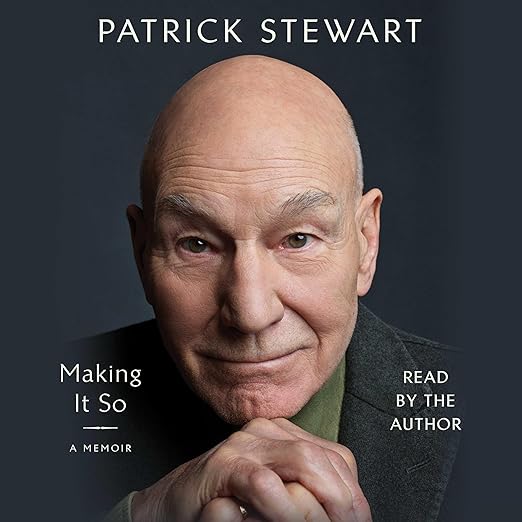
Patrick Stewart spent four decades at the Royal Shakespeare Company before Captain Picard ever entered his life, and Making It So, his Audie Award winning memoir, spends real time on that theatrical foundation rather than rushing straight to Star Trek. Narrated by Stewart himself, this audiobook traces a career from a working-class Yorkshire childhood through the RSC, television, film, and the science fiction and comic book roles that made him a household name to generations who never saw him on a British stage.
A Masterclass Spanning Six Decades of Acting
What comes through clearly in listener response is how much the book earns its scope. One reviewer calls it 'a masterclass in storytelling, blending humor, poignancy, and profound insights' across Stewart's full career, while another, a lifelong fan who came to Stewart through Star Trek: The Next Generation, describes gaining genuine new appreciation for his British theatre background after reading, name-checking his work in Excalibur and Dune alongside decades on stage most American audiences never got to see.
The book covers extraordinary range: Jean-Luc Picard, Professor Charles Xavier across the X-Men franchise, more than forty years with the RSC, a widely admired one-man staging of A Christmas Carol, and comedic turns in American Dad!, Ted, Extras, and Blunt Talk. Stewart resists treating any single role as the definitive one, instead building a portrait of a genuinely restless working actor across six decades rather than a single-franchise celebrity memoir.
Why a Bald Actor Got to Command a Starship
Some of the book's best-known trivia has become part of Star Trek lore in its own right: Gene Roddenberry reportedly liked the idea that a bald actor commanding a starship implied baldness would still exist unremarked upon in the twenty-fourth century, a small detail that speaks to how thoroughly Stewart's stage-trained gravitas overrode any doubts about non-traditional leading-man casting for the role that introduced him to American audiences.
The title itself is a direct nod to Picard's own catchphrase, 'make it so,' repurposed as a statement about a whole life rather than a single command on a starship bridge. That choice signals something about how comfortably Stewart has made peace with being permanently associated with one role among many; rather than resisting the connection, the memoir leans into it as a framing device for a much broader story.
A Shakespearean Actor's Case for Self-Narration
Self-narration by a classically trained Shakespearean actor is about as strong a case as this format gets. Stewart's decades of vocal training and stage command translate directly into a performance rather than a simple reading, and Sir Ian McKellen, quoted directly in the promotional material, praises the writing itself for its 'insight, truth, and passion,' a description that extends naturally to hearing Stewart deliver his own words aloud.
At eighteen hours and fifty minutes, the audiobook has genuine room to slow down inside specific memories rather than racing through a career highlight reel, and Stewart's pacing choices, informed by a lifetime of knowing exactly how long to hold a pause on stage, are frequently cited by listeners as a defining strength of this specific edition over simply reading the book in print.
Ian McKellen's blurb carries more specific weight here than a typical celebrity endorsement might, given the two actors' decades-long public friendship, shared Broadway run of Waiting for Godot, and their long joint tenure as Professor X and Magneto across the X-Men film franchise. Hearing Stewart narrate a book blurbed by someone who has shared a stage and a franchise with him across so many years adds a layer of lived context a stranger's praise could not offer.
Stewart trained at the Bristol Old Vic Theatre School before his RSC years began, a foundational stretch of formal actor training that predates almost everything most American listeners associate him with by decades. Hearing him narrate that early period himself, in the same voice that later commanded a starship bridge, gives listeners a fuller sense of the craft foundation underneath the more famous later roles.
The Audie Award Recognizes the Performance Itself
Listeners coming to this purely for Star Trek or X-Men content should know the book gives substantial, unhurried attention to Stewart's Yorkshire upbringing and his RSC decades before reaching the franchises many listeners will recognize him for first. That structure rewards patience rather than front-loading the most famous material.
At nearly nineteen hours, this is a long sit even by memoir standards, and listeners looking for a brisk celebrity retrospective rather than a full life account should know Stewart's pacing is deliberate and unhurried throughout, consistent with the theatrical instincts that shaped his career.
As a self-narrated memoir rather than a professionally distinct voice performance, listeners expecting the kind of dramatic character work Stewart brings to scripted roles should recalibrate expectations toward a more measured, reflective register suited to memoir rather than fiction.
Winning the Audie Award for Autobiography and Memoir specifically recognizes the audio production and performance, not just the writing, which is a meaningful distinction for listeners weighing whether to experience this as audio versus print. That category-specific recognition reinforces that Stewart's own narration is doing real interpretive work here rather than simply reading his memoir aloud competently.
Theater Fans Get the Full RSC Backstory
This suits any listener with genuine curiosity about a full acting career rather than just its most famous chapters, along with theater fans wanting insight into the Royal Shakespeare Company era that shaped Stewart long before science fiction found him.
Skip it if you specifically want a tightly focused Star Trek or X-Men production memoir; those franchises get real attention here, but as chapters within a much larger, deliberately paced life story rather than the book's central focus.
Listeners who have followed Stewart primarily through more recent work, Star Trek: Picard or his stage return in recent years, will find this memoir extends their picture of him considerably further back than most contemporary coverage typically reaches.
Good to Know
Does Patrick Stewart narrate Making It So himself?
Yes, and his decades of Shakespearean stage training make the self-narration a genuine asset, praised by listeners for pacing and delivery rather than just recognizability.
How long is the Making It So audiobook?
Eighteen hours and fifty minutes, a genuinely long, unhurried memoir covering Stewart's full six-decade career rather than a condensed highlight reel.
Did Making It So win any audiobook awards?
Yes, it won the 2024 Audie Award for Autobiography and Memoir, and it was a New York Times and USA Today bestseller.