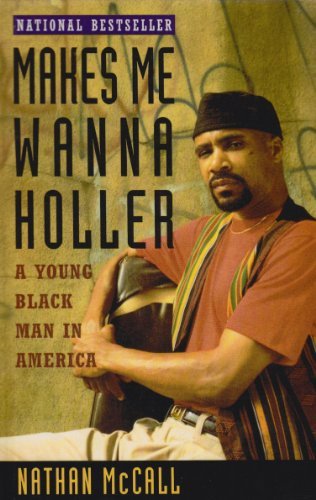
Nothing about seventeen hours and nineteen minutes suggests a quick pass over a life. That runtime is the largest fact the audiobook offers, and on an entry this bare it ends up carrying far more weight than a runtime should. Makes Me Wanna Holler is filed as a memoir, credited to Nathan McCall, and read by Leon Nixon. Past those four items the record goes quiet: no summary, no date in the field built to hold one, no written responses, and one star rating cast by a single person who said nothing. Seventeen hours is a serious commitment to make on that much information.
A Title Left to Do the Whole Job Alone
Listeners do get one strong signal from the title itself. Makes Me Wanna Holler is a spoken phrase, not a description: a first-person fragment with the subject sheared off, the kind of sentence said out loud instead of printed on a jacket. Memoirs generally carry a colon and a clause after the main title, explaining who the subject is and what territory the book intends to cover. This one has no subtitle anywhere on the entry. Whatever the publisher put after that colon, if anything was put there at all, has not reached this record, and the title is left doing the entire job alone. A title in that register announces a voice before it announces a subject, which is genuine information about what seventeen hours will sound like.
That the author is not the reader is the most concrete editorial decision visible here. Nathan McCall wrote it; Leon Nixon performs it. For a memoir in the first person that is not a neutral arrangement. A hired reader has to occupy somebody else's life, somebody else's rhythms and somebody else's idiom, and hold all three steady across seventeen hours without sliding into impersonation. Some memoirs gain from it, because a trained voice keeps a hard book level where its author might waver. Others lose the exact texture that made the writing worth recording in the first place. Nothing on this listing indicates which happened.
One Vote, Five Stars, and Nothing Else
Where the record does offer something usable is in the way it has been filed. The genre reads biographies and memoirs; the subject tag reads Art and Literature. Taken together those two labels place the book as an account of a life whose work sits inside the literary world, which narrows things considerably from a runtime alone. Seventeen hours of that means a full-length account with room for childhood, formation and consequence, not a slim reflection or a set of essays with an autobiographical tilt. Length in this genre usually signals a book given room to argue as well as to recount, and seventeen hours is a great deal of room. The scale of the recording is itself an argument about what sort of book you are buying.
Two numbers are all the crowd has left behind: one vote, five stars. With one vote on a whole-star scale the arithmetic is complete and trivial, five points of a possible five, and it is also useless as guidance. One person is not a sample. No written response accompanies the click either, so the badge establishes that somebody graded this at the top of the scale while revealing nothing whatsoever about what they were grading. On a seventeen hour purchase, a perfect score built out of one voter carries about the weight of a nod from a stranger across a room.
A Date Buried Inside the Publisher's Name
Anyone checking when this recording was made will not learn it from the field built to say so. The release date is blank. The only date anywhere on the entry is buried inside the publisher line, which reads Paw Prints followed by a string of digits arranged as a year, month and day. That has the look of a catalog identifier fused to an imprint name somewhere in the pipeline and never separated again, and a stray invisible character sits in front of the whole thing. What the date refers to, the record declines to say, while nothing here lets a listener work out whether it belongs to this recording or to some earlier printed edition.
Once the summary field is empty, most of what a shopper normally does becomes impossible. You cannot check whether the memoir covers a whole life or one stretch of it. You cannot check whether the recording is complete or cut. You cannot check what period it covers, which city it happens in, or what the book is arguing with. The entry supplies a name, a reader, a runtime and a price of $11.79, then asks you to decide. For seventeen hours that is not enough, and no amount of careful reading will turn this listing into enough.
Runtime and Nixon Are All This Listing Truly Knows
Whatever gap the record leaves has to be closed somewhere else. The practical move with an entry this thin is to go looking for the book itself, not the recording, since a memoir with a title this distinctive will have a publisher's page and a library record that say what this one does not. Then come back for the two facts only the audio edition can supply, which are the runtime and the reader. Seventeen hours and Leon Nixon are the whole of what this listing uniquely knows, and everything else has to be imported.
The Title Is the Loudest Thing Here
Most of the audience for this has decided before arriving. If the name Nathan McCall means something to you, the runtime and the reader are the only open questions, and the entry answers both. If the name means nothing, this record gives you no reason to begin, and that is a failure of the listing more than of the book underneath it. Nobody browsing casually will get past the blank space, which is unfortunate for whatever sits behind it. Anyone who picks memoirs by subject should note the Art and Literature tag and understand that it constitutes the only thematic guidance offered anywhere on the listing.
Something has clearly gone wrong in the assembly of this entry, and it is worth keeping that separate from the recording underneath. A blank summary, a date hiding inside a publisher's name, an empty review column and one silent vote add up to a database problem. Seventeen hours and nineteen minutes of Leon Nixon reading Nathan McCall add up to a book. The first of those is easy to see and the second is not, which is exactly the wrong way round. The title is, for now, the loudest thing on this record and the only thing speaking.