Quick Take
- Narration: Janice Dean narrating her own book brings the warmth and directness of a seasoned broadcaster to a collection of stories that benefits enormously from a personal voice.
- Themes: Everyday heroism and quiet generosity, grief and resilience coexisting, the accumulation of small acts of kindness
- Mood: Warm and quietly moving, designed to be listened to in pieces
- Verdict: A carefully curated collection of true acts of generosity that earns its emotional reach through specificity rather than sentiment, and Dean’s narration is exactly the right delivery for this kind of material.
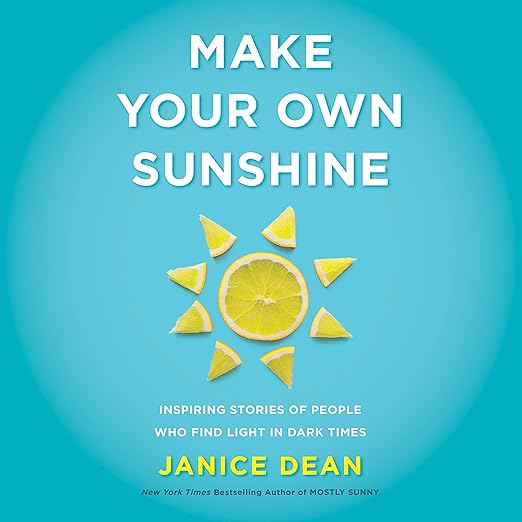
I listened to the first two chapters of Make Your Own Sunshine on a commute when I was running low on patience with the news cycle, which is probably the exact circumstance Janice Dean had in mind when she wrote it. Dean is a Fox News meteorologist who became an unlikely public figure after her parents-in-law died of COVID-19 in New York nursing homes in 2020, and her public grief gave her both a platform and a very specific understanding of what it feels like to need a story that goes in a different direction. This book is that attempt, assembled from interviews and reported stories of people who did something generous, sometimes quietly, sometimes at real cost to themselves.
The format is short stories, which works particularly well in audio. Dean herself designs the book for modular consumption: you can pick it up when you need a lift and put it down when you get busy. That kind of structure is rare in nonfiction and it serves the material well. The individual stories range from a few pages to slightly longer, and each is self-contained enough to work as a standalone listen. Reviewers describe returning to specific sections when they needed something particular, which is the strongest signal that the modular structure is working as intended. This is not a book you need to finish in order to benefit from it.
The Stories Dean Chose and Why They Work
Dean is specific in a way that separates this from generic inspirational fare. The book includes the story of Ray Pfiefer, a New York firefighter who fought for nine years for proper healthcare for 9/11 first responders and became the face of the campaign that eventually succeeded. There is the father who wrote daily napkin notes for his daughter throughout her childhood, who left extra notes hidden in her room before he died of cancer so she would continue to find them. There is the Uber driver who noticed a new mother in distress and helped her buy baby clothes. The bow-tie maker for shelter dogs waiting to be adopted.
Each of these stories could be sentimental in the wrong hands. Dean avoids that trap by keeping the details specific and the framing restrained. She is not telling you how to feel about these stories. She is telling you the stories and trusting the details to do the work, which is the correct instinct. The bow-tie story earns its warmth because Dean tells you specific things about the person making them and the dogs wearing them. The napkin note story works because she gives you the texture of what those notes actually said and what finding them meant after the father was gone. The emotional precision is what elevates this above the inspirational-story genre average.
Dean Reading Her Own Material
The author-narrated format is a real asset here. Dean has spent decades as a broadcaster, and the warmth and directness she brings to television translates to audio with full effect. She reads with the kind of trained voice that handles emotional material without tipping into manipulation: she gets close to the things that are genuinely sad without performing sadness for the listener. This is harder than it sounds. Many author narrators who are not professional voice actors either over-emote or flatten; Dean, with her broadcasting background, has the technique to hold the appropriate register throughout a six-and-a-half-hour listen.
Her own experience of loss is present in the book without dominating it. Reviewers consistently mention that her personal grief gives her an understanding of what these stories mean to people going through their own hard things. That biographical context does not need to be explicit on every page to function. It is there in the selection of stories and in the quality of attention she brings to documenting them, and it is there in the way she reads the more difficult moments without making them about herself.
What This Book Does Not Argue and Why That Is the Right Choice
Make Your Own Sunshine is not arguing a thesis about human nature or proposing a sociological account of why some people help others. It is a collection of documented acts of generosity, assembled by someone who wanted to demonstrate that such acts are happening regularly and everywhere, even when the news does not cover them. The title functions as a directive rather than an observation, and Dean’s elaboration of it, that if we do not make our own sunshine no one will, is about attention and agency rather than toxic positivity. She is not arguing that kindness will fix systemic problems. She is arguing that noticing and documenting kindness has value, and that argument is made persuasively through the specificity of the stories rather than through any direct assertion.
Readers looking for a rigorous argument about kindness, or a self-help framework for becoming more generous, will not find that here. What they will find is something harder to systematize and in some ways more valuable: specific evidence that the world contains people who chose to do something generous at some personal cost, told in enough detail to be believed and remembered. The Fox News connection will be noise for some listeners, and it is worth knowing that Dean does not let politics enter the stories themselves. The book is genuinely nonpartisan in its selection and framing of stories.
The Right Listening Context for This Collection
Make Your Own Sunshine is well matched to listeners who want something warm and true to listen to in short sessions, who are tired of narratives organized around conflict and failure, and who respond to specific true stories rather than general inspirational exhortation. It is not a book for dedicated long listening sessions; it is a book for the moments when you need something that goes in a different direction from wherever you have been. Dean built it for exactly that function, and it performs that function reliably across six and a half hours that feel much shorter than they are.
Frequently Asked Questions
Can I listen to Make Your Own Sunshine out of order, or does it need to be followed sequentially?
The modular short-story format is designed for non-sequential listening. Each story is self-contained, and Dean explicitly designed the book to be picked up when you need it and put down when you get busy. It works as a sequential listen but does not require one.
Does Dean’s personal grief over her parents-in-law’s COVID deaths play a significant role in the narrative?
It is present as context rather than as central subject matter. Dean’s own loss informs her selection of stories and the quality of attention she brings to people going through hard things, but the book is organized around other people’s stories of generosity rather than her own memoir.
Is Janice Dean’s broadcasting background an asset in the narration, or does her TV personality intrude?
Her broadcasting background is clearly an asset. She handles emotional material with the technique of someone trained not to over-emote or flatten, and the warmth she brings to the stories feels earned rather than performed. Her TV persona does not intrude.
Is this book politically neutral, given Dean’s association with Fox News?
The stories themselves are nonpartisan. Dean selects acts of generosity from across American life and does not frame them politically. Listeners who find her public profile distracting may notice it, but the book’s actual content does not carry a partisan argument.