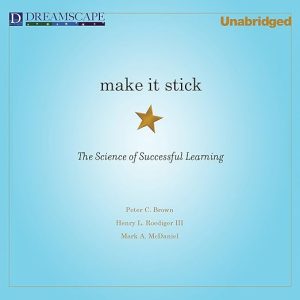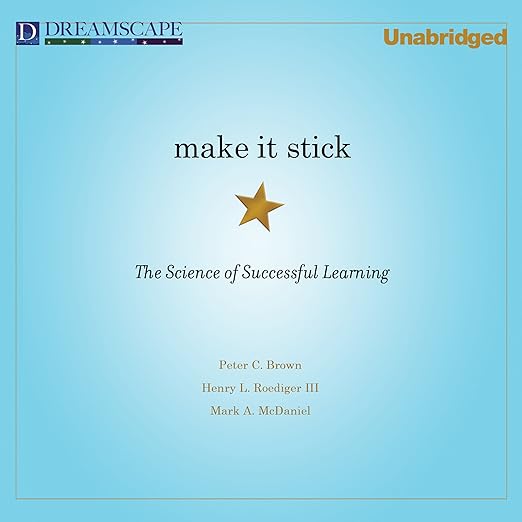
Make It Stick is the kind of audiobook that makes you uncomfortable in the most productive way possible. Peter C. Brown, Henry L. Roediger III, and Mark A. McDaniel open by cataloging study habits that most listeners will recognize from their own experience, and then systematically demonstrate that those habits are counterproductive. Highlighting, rereading, cramming, single-minded repetition: the things that create the feeling of learning are, the research shows, precisely the things that produce learning least efficiently. That is not a comfortable finding if you have spent years trusting those habits. Qarie Marshall's narration handles the research exposition with enough warmth that the discomfort stays productive rather than demoralizing throughout the 8-hour-and-34-minute runtime.
The book draws on decades of cognitive science, and one reviewer highlighted its unusual position in the education writing landscape: this is a book about learning that is actually based on science. That observation sounds like a low bar, but the self-help and education shelves are crowded with learning frameworks derived from intuition and anecdote rather than empirical study. Brown and his colleagues conducted and reviewed rigorous research, and the difference is audible in how specific and testable their recommendations are, compared to the confident generality of most competing titles in the genre.
The central argument is counterintuitive in a way that keeps giving. Learning is more durable when it is effortful. Study methods that feel difficult and slow, methods like self-testing, spaced practice, interleaved topics, and retrieval practice, produce better retention and transfer than methods that feel smooth and fast. The authors call the harder approaches desirable difficulties, and they are careful to distinguish productive difficulty from merely wasting time. The distinction matters: not all struggle is useful, but the specific kinds of struggle that force your brain to reconstruct knowledge rather than simply recognize it produce qualitatively different results that persist rather than fading after the exam.
The authors address the popular myth of learning styles directly and dismantle it with research evidence. The idea that students learn better when instruction is matched to their visual, auditory, or kinesthetic preferences has been tested repeatedly and has not held up. The book treats this finding not as an attack on teachers who have used the framework in good faith but as useful information that should change practice. That tone, firm about the evidence, generous toward people operating under wrong assumptions, runs throughout the book and keeps it from feeling adversarial toward its readers.
Marshall's Narration Blocks Passive, Comfortable Rereading
The audiobook format suits this material in a specific and somewhat ironic way. Marshall's narration means you cannot fall into the trap the book warns against: passive, comfortable rereading of highlighted passages. Listening requires you to hold ideas in working memory long enough to connect them to what you already know, which is actually one of the book's recommended learning strategies applied in real time. Whether or not that was intentional by the authors, it works.
At 8 hours and 34 minutes, the book is thorough without feeling padded. The authors use case studies and examples to anchor the research findings in concrete situations, which keeps the material accessible to listeners without formal backgrounds in cognitive psychology. A reviewer who teaches noted using sections of the book to show students how to be more successful, which reflects how the material works in practice. The book functions both as a practical guide and as an argument that genuinely changes how you think about the entire enterprise of acquiring new skills and knowledge, not just academic study.
Interleaving Beats Block Practice for Real Retention
One fair criticism of the book is that it covers the introduction to the research well but is thinner on application for listeners who want highly specific implementation guidance for their particular context. A college student who finishes this audiobook will have a clear sense of what to do differently and why, but the bridge from general principle to specific practice in their own situation requires some additional work. That is not a failure of the book so much as a reasonable boundary on what a single audiobook can deliver. The authors point toward the research; what to do with it in your specific setting is somewhat left to you.
The chapters on interleaving and spacing are particularly worth close attention, since these are the strategies most at odds with how courses are typically designed and how most people intuitively approach practice. The book makes a credible case that block practice, doing one skill until you get it before moving on, produces the illusion of mastery more reliably than actual retention. If you take only one thing from the full listening experience, the interleaving chapter is probably the most immediately actionable finding for most listeners.
Coaches and Trainers Gain a Useful Challenge
Students at any level who want to understand why their current study habits may not be serving them as well as they feel like they are will find this audiobook directly and practically useful. Teachers who are open to evidence-based revisions to their practice will find it equally valuable. Coaches, trainers, and anyone designing learning experiences for other people, whether formal courses or workplace onboarding programs, will encounter a useful challenge to assumed best practices. Skip this one if you are already deeply familiar with the retrieval practice and spaced repetition literature from academic sources; the book covers that ground well but does not extend significantly beyond it for already-informed readers. For everyone else, this is a rare education audiobook that changes behavior rather than just confirming existing beliefs.
Quick Take
- Narration: Qarie Marshall delivers the research material with approachable authority, never letting the cognitive science feel like a lecture.
- Themes: Evidence-based learning, the illusion of mastery, desirable difficulties in study
- Mood: Practical and quietly revelatory
- Verdict: A genuine corrective to how most people study, backed by research that holds up, and worth the 8-hour investment for students and anyone who teaches them.
Good to Know
Is the Make It Stick audiobook practical enough to implement its strategies without reading the print book afterward?
Yes for most listeners. The core recommendations around retrieval practice, spaced repetition, interleaving, and desirable difficulties are explained clearly enough in audio to act on immediately. The print book offers more reinforcement but is not required.
Does this audiobook cite specific studies or is it anecdote-heavy like many learning books?
It cites specific research throughout, which is one of its genuine differentiators in the genre. The authors are cognitive scientists who conducted much of the underlying research themselves, and the evidence base is more rigorous than most comparable books.
How does Qarie Marshall's narration handle the technical cognitive science material in this audiobook?
Effectively. Marshall keeps the research accessible without oversimplifying it. The book is written for a general audience rather than specialists, and the narration reflects that accessibility without losing the precision of the findings.