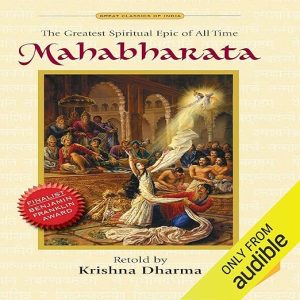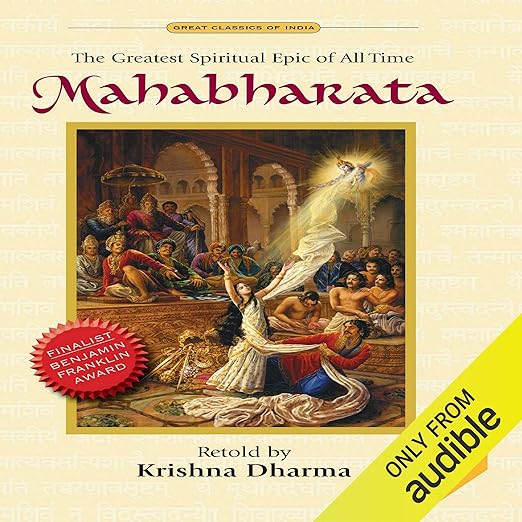
Some books require you to prepare before you begin them. I spent a few days reading about the Mahabharata before I started this audiobook, not because I needed the context to follow the narrative but because something about committing to forty-five hours of a text that has been considered sacred in Hinduism for millennia felt like it warranted a different kind of attention than I typically bring to a new listen. I am glad I did. The preparation changed how I heard it.
The Mahabharata is, by one measure, the world's longest poem, originally composed in one hundred thousand Sanskrit verses by the ancient sage Vyasa. Krishna Dharma, whose condensed novel-form version is what this audiobook presents, has compressed that oceanic text into a fast-paced narrative that runs just under forty-six hours. That compression is itself an achievement worth acknowledging before anything else, because the Mahabharata is not just long in the sense of containing a lot of plot. It contains entire philosophical systems, including the Bhagavad-gita, which appears in one of its central episodes and is itself among the most important texts in world religion.
What We Made of It
The condensation question is the first practical matter for any prospective listener of this audiobook. One reviewer who had read three different versions of the Mahabharata described this one as an excellent rendition that forgoes some details, noting that the original would mean at least three more books of this length, and uses modern English prose to tell a many-millennium-old epic. That assessment is accurate and worth sitting with. Krishna Dharma's version is not a scholar's translation or a critical edition. It is a literary retelling oriented toward accessibility and devotional resonance.
What the condensation keeps is the narrative spine of the Pandava brothers, their exile, their encounters with gods, sages, mystics, and warrior kings, and the apocalyptic war that culminates the story. It also keeps the Bhagavad-gita, which is positioned here as it is in the original, embedded in the lead-up to the war as a dialogue between the warrior Arjuna and his charioteer Krishna. The spiritual teaching is not stripped out or summarized; it is present in its essential form. What the condensation necessarily sets aside is the vast substructure of mythology, genealogy, philosophy, and sub-narratives that surround the main spine in the original. Listeners who encounter the Mahabharata through this version should know they are meeting a portion of something immeasurably larger.
What Makes Mahabharata: The Greatest Spiritual Epic of All Time Worth Hearing
The choice of narrator is significant for a text like this. Sarvabhavana Das is not a professional audiobook narrator in the conventional sense. He is someone who comes to the material from within the tradition it belongs to, and that orientation shapes every aspect of the performance. The voice carries a quality of genuine reverence without tipping into liturgical monotony. The pacing across forty-five hours is sustained and consistent, and the material's scale, the sheer number of characters, battles, divine interventions, and philosophical exchanges, never overwhelms the narration's clarity.
What listeners accustomed to professional audiobook narration may notice is that the performance does not deploy the range of vocal effects and character differentiation that genre fiction narrators use. The approach is more integrated, as though the story and its telling are a single continuous act rather than a writer's text being performed by a separate voice. For the material, this turns out to be correct. A more theatrical narration of the Mahabharata would feel like the wrong frame. The epic is not asking to be performed so much as to be transmitted.
Points to Consider
Encountering the Bhagavad-gita within the context of the full narrative rather than as a standalone text changes the experience of both. The famous dialogue between Arjuna and Krishna, which contains some of the most profound spiritual teaching in world literature, arrives in this audiobook at the moment it was always intended to arrive: when Arjuna stands between two armies, unable to act, paralyzed by the moral impossibility of the war he has entered. The teaching is a response to an actual situation rather than an abstract philosophical treatise, and hearing it in that context restores the urgency that reading the Gita in isolation can sometimes flatten.
Reviewers who came to the book from the devotional tradition describe it as life-changing. One listener who had read the Ramayana first described the combination as very enlightening and philosophical without being over complicated. The characterization is useful. This is not a text that requires prior theological sophistication. The philosophical content is demanding in the sense that it asks fundamental questions about duty, action, and the nature of the self, but it poses those questions through story rather than through argument, which is the Mahabharata's essential method and its greatest accessibility.
Should You Listen to Mahabharata: The Greatest Spiritual Epic of All Time?
This audiobook is one of the longest in any standard catalog, and the commitment requires honest assessment. Forty-five hours at any pace that allows genuine absorption is a multi-week experience. The text rewards that absorption. The Mahabharata is designed to be heard over time, with the weight of individual episodes settling before the next arrives. At the same time, the narrative drive that Krishna Dharma has built into the condensed version means there are extended stretches where the story moves with enough momentum to sustain longer sessions.
The ideal listener is someone with genuine curiosity about Hinduism, world mythology, or epic literature, and with the patience to let the text's scale work on them rather than against them. Listeners who have worked through similarly long experiences, the longer works of Tolkien in audio, or comparable mythology cycles, will have a sense of the kind of attention this requires. The reward is proportional to the investment. The Mahabharata is considered one of the world's most important texts for reasons that forty-five hours begins, but does not fully exhaust, to make legible. This version is an honest and gripping entry point into a work that does not fully end when the audiobook does.
- Voice: Sarvabhavana Das brings a distinctive quality to the material, narrating from inside the tradition rather than as an outside voice presenting foreign scripture, which meaningfully shapes how the epic is received.
- Big ideas: Dharma under impossible conditions, the spiritual wisdom of the Bhagavad-gita embedded in a narrative of war and kinship, the moral complexity of heroism
- Atmosphere: Epic and measured, with the weight of a text that has been considered sacred for millennia
- Worth it?: At forty-five hours this is a serious commitment, but Krishna Dharma's condensation holds the majestic quality of the original remarkably well, and Sarvabhavana Das's narration sustains attention across the full duration.