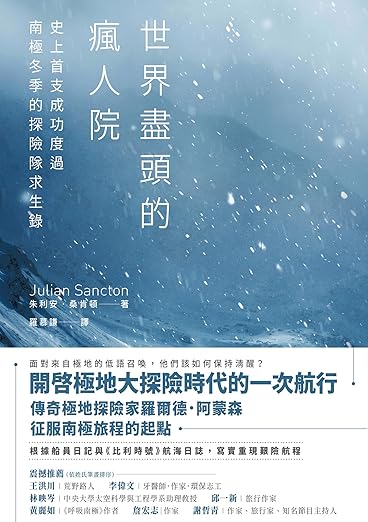
Quick Take
- Narration: Vikas Adam brings a cinematic intensity to Sancton’s prose that suits the claustrophobic, psychological tension of a crew trapped in Antarctic winter darkness.
- Themes: Psychological disintegration under extreme isolation, the birth of the Heroic Age of Antarctic exploration, collaboration between unlikely partners
- Mood: Dark, airless, and propulsive, like a thriller set at the boundary of what human minds can endure
- Verdict: One of the finest works of polar narrative nonfiction in recent memory, with the Amundsen and Cook alliance as its unexpected emotional spine.
I started this one on a Friday night with no particular plan to finish it quickly, and I was still listening at two in the morning. Julian Sancton’s account of the Belgian Antarctic Expedition of 1897, the first to winter over in Antarctica, does something that is harder than it sounds: it makes you feel what an Antarctic winter darkness does to a human mind, through the medium of a story that is already more than a century old. By the time the crew of the Belgica were rationing seal meat and the ship’s doctor was experimenting with light therapy to prevent madness, I had completely lost the comfortable sense that I was listening to history rather than participating in it.
The Belgica expedition is not the famous one. It is the one that happened before the famous ones. Before Scott, before Shackleton, before the Heroic Age became the Heroic Age. In 1897, no one really understood what an Antarctic winter would do to a crew. This expedition found out.
The Alliance That Made Survival Possible
The book’s most distinctive narrative choice is centering the unlikely alliance between two figures who would later become famous through separate paths: Frederick Cook, the ship’s doctor who would later claim to have reached the North Pole, and Roald Amundsen, the young first mate who would eventually become the first man to reach the South Pole. In 1897, both are relatively unknown, thrown together on a ship that gets locked in the pack ice and cannot get out before the sun disappears for months.
Sancton’s thesis is that this expedition, specifically the experience of surviving it, was formative for Amundsen in ways that shaped everything he did afterward. The systematic approach to Antarctic logistics that would eventually beat Scott to the South Pole in 1911 was partly built from the lessons learned when everything went wrong on the Belgica. Cook, who would later be discredited, comes across here as genuinely brilliant under pressure. The man who designed the escape from the ice was not yet the fraud he would become. That trajectory adds a layer of dramatic irony to his heroism on the Belgica that Sancton is too good a writer to over-explain.
What Winter Darkness Does to People
The psychological material is handled with exceptional care. Sancton is drawing on the diaries and logs kept by crew members during the winter, and the degradation of mental function they document is specific and clinical rather than sensationalized. Men stop sleeping at normal times. They stop eating. They develop obsessions and phobias that have no obvious origin. They stop speaking to each other. The ship’s captain retreats into a near-catatonic state. Cook and Amundsen keep functioning when almost everyone else has stopped, and the book follows them closely enough that you understand not just what they did but how they managed to keep doing it.
The connection to subsequent research is one of the more striking aspects of the book’s reception: NASA has studied the Belgica expedition as preparation for long-duration space missions, and Mars mission planners have examined the crew’s psychological collapse as a model for what extended isolation from sunlight and normal social rhythms can do to a team. That detail, when you encounter it, reframes the historical narrative as a document with ongoing scientific relevance.
Vikas Adam and the Long Darkness
At thirteen and a half hours, this is a substantial listen. Vikas Adam’s narration is one of the book’s significant assets. He handles the ensemble of characters, many with Belgian and European names that require sustained pronunciation accuracy, with the kind of consistency that builds listener trust over a long audiobook. His reading of the psychological deterioration passages is measured rather than theatrical, which is the right choice: the horror in this material is in the facts, not the delivery, and overplaying it would diminish the effect.
Walter Isaacson, who wrote the biographies of da Vinci and Jobs among others, called this an engrossing true horror story with research and storytelling that transforms real history into a classic thriller. Nathaniel Philbrick, whose own polar-adjacent work appears elsewhere in this catalog, praised it as one of the most gripping adventure stories he had read in years. The book deserves both descriptions.
Who Should Listen and Who Should Skip
This belongs on the short list of essential polar narrative nonfiction alongside Alfred Lansing’s Endurance and Hampton Sides’ In the Kingdom of Ice. Listeners who have read Galvin’s The Great Polar Fraud will find the Cook portrait here adding a significant dimension to that book’s later treatment of his North Pole fraud.
The content is dark in ways appropriate to the subject. If prolonged accounts of psychological deterioration, isolation-induced illness, and the specific depredations of Antarctic cold are not what you are looking for right now, this is a book to hold for another season. But if you want to understand what polar exploration actually cost the people who did it, this is among the best answers that literature can provide.
Frequently Asked Questions
Does the book explain why the Belgica expedition is not as well known as Shackleton’s Endurance mission?
Sancton addresses this partly through the expedition’s outcome. Unlike Shackleton, who returned with all his men and generated enormous public narrative energy, the Belgica crew’s survival was less dramatic as a media story and the expedition had Belgian rather than British public backing its fame. The expedition’s significance to Antarctic history was recognized by experts but never translated into the popular mythology that Shackleton achieved.
Is the psychological deterioration material appropriate for all listeners, or does it become disturbing?
It is disturbing in places, deliberately so. The crew’s mental collapse is documented through their own diaries and the ship’s logs, and Sancton does not soften the specifics. Listeners who are sensitive to extended accounts of mental illness, paranoia, and isolation-induced breakdown should approach with that awareness.
How does Sancton handle Frederick Cook given that Cook was later discredited as a fraud?
With considerable nuance. Cook’s heroism on the Belgica is presented as genuine, and his later fraud does not retroactively invalidate what he achieved in 1897. Sancton is careful not to reduce Cook to his later disgrace, which makes the portrait more complex and more honest than a simpler condemnation would be.
Does the book require any prior knowledge of Amundsen’s later career to appreciate the Belgica narrative?
No, but knowing the broad outlines of Amundsen’s subsequent achievements adds a layer of dramatic significance to his time on the Belgica. The expedition functions fully as a story on its own terms, but listeners who know that the young first mate will eventually beat Scott to the South Pole will read his Belgica experience differently.