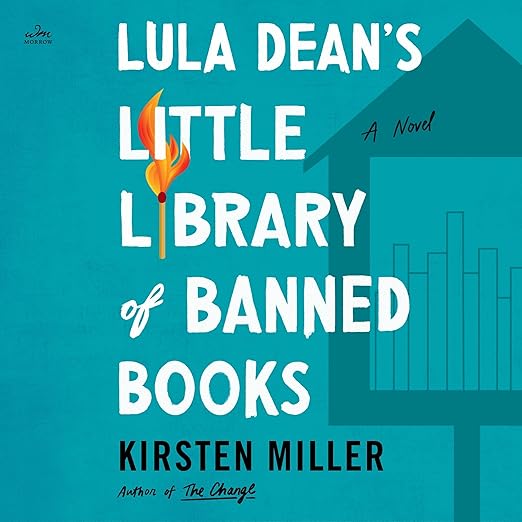
I started Lula Dean's Little Library of Banned Books on a Sunday afternoon when I had a long drive ahead of me and wanted something I wouldn't have to concentrate on too hard. That was a miscalculation. By the time I arrived at my destination, I had missed two exits and genuinely cared about what was going to happen to a Troy, Georgia mailman whose encounter with a copy of The Joy Luck Club hidden inside a dust jacket for something called Wholesome Readings for Wholesome Families had quietly wrecked him in the best possible way.
Kirsten Miller, whose previous novel The Change demonstrated a gift for small-town female ensemble storytelling with political underpinning, has done something similar here but more pointed. The satire has a specific target: the book-banning movement, or more precisely, the specific psychology of someone like Lula Dean, who has embarked on a mission to cleanse the local library of inappropriate books without having read a single one of them. The comedy of that position, its perfect self-sealing logic, is the engine that drives the novel.
What We Made of It
The conceit is elegant. Lula Dean sets up her own wholesome lending library in front of her house to replace the books she's had challenged at the public library. Someone steals the wholesome books, removes their dust jackets, and restocks the library with exactly the books Lula has been trying to suppress: literary classics, gay romances, Black history, Judy Blume, witchy spell books. The community then borrows these books believing they have Lula's endorsement.
What Miller does with this premise is the difference between a satirical sketch and an actual novel. Each person who borrows a book becomes a small chapter, a life that gets touched by a story it was never supposed to encounter. A woman finds the courage to name her rapist. A deflated mailman recovers his sense of purpose. The catalog of transformations is structured to show that literature's power is specific, that the right book at the right moment works not through instruction but through something harder to explain. This is a meta-argument as well as a plot, and Miller walks the line between making it and over-stating it with considerable skill.
The Best Parts of Lula Dean's Little Library of Banned Books
January LaVoy is the ideal narrator for this kind of novel. The ensemble demands constant differentiation: Beverly Underwood and Lula Dean must sound like women who have known each other since childhood and can barely be in the same room, while a rotating cast of community members each need enough distinctiveness to be tracked across ten hours. LaVoy achieves this through subtle adjustments in pace and register rather than through exaggerated characterization, which is the right approach for a novel that asks its readers to take all of these people seriously even when they're being ridiculous.
The audiobook format suits Miller's narrative structure particularly well. The multi-character design, each section functioning almost as a linked short story focused on a different borrower, plays as a series of voices that LaVoy inhabits rather than just reads, and the accumulation of those voices builds the book's argument more effectively in audio than it might on the page.
What Might Not Land
The cast of characters is large, and one reviewer flagged this directly. Miller is running perhaps one too many storylines simultaneously in the middle section of the novel, and some of the community members get less resolution than others. The novel's political stakes, Beverly and Lula running against each other to replace the disgraced mayor, are the weakest element structurally; the civic procedural feels less lived-in than the personal transformation stories.
The book will inevitably be read through the lens of current events around book banning, and that context sharpens the satire significantly. A reviewer noted that the meaning beneath the humor is all too serious in today's news cycle, which is accurate. The comedy is doing political work, and how much that resonates will depend partly on where you're listening from geographically and politically.
Who Should Pick Up Lula Dean's Little Library of Banned Books
Listeners who loved Miller's The Change, or who responded to novels like A Man Called Ove or Eleanor Oliphant is Completely Fine for their quality of quiet revelation through an ensemble, will find this genuinely satisfying. It works for anyone who wants satire that earns its emotional moments rather than using them as cover for didacticism, and for book lovers specifically who will get the full comic impact of Lula Dean's library being used against her. Listeners who prefer linear plotting focused on a single protagonist will find the rotating ensemble structure harder to settle into; the novel is organized around a community more than a character.