- Narrator: Bruce Mann's untheatrical delivery is the correct match for a primary source document that refuses its own interpretation.
- Subjects: Eastern Front air war, the ethics of primary source history, operational accumulation
- Tone: Spare and disquieting
- Bottom line: An unusual and genuinely valuable piece of unmediated World War II primary source material, best approached by listeners who understand what the diary form will and will not give them.
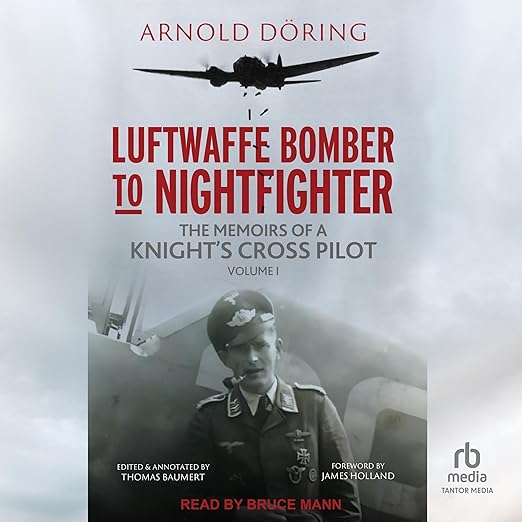
Arnold Döring's diaries are among the most discomfiting things this audiobook format has produced in the military memoir category: documents that refuse the retrospective shaping most war memoirs rely on, translated from the original German and read aloud by Bruce Mann in a steady, untheatrical delivery. The result is something closer to a field report than a confession. Döring was twenty-three years old when he flew his first bombing mission against the Soviet Union on 21 June 1941, assigned to Luftwaffe bomber wing Kampfgeschwader 53. He kept writing until he had logged 392 aerial attacks. Luftwaffe Bomber to Nightfighter: Volume I gives us access to that record in English for the first time, and access is exactly the right word for what this audiobook provides.
I came to this one expecting the familiar arc of World War II aviation memoir: the innocence, the horror, the moral reckoning. That is not what Döring offers. Reviewer DMWFred puts it best: 'free of politics and moralizing and clearly in the moment.' The diary form is not a rhetorical choice here; it is the literal document, and its refusal to interpret itself is what makes it unusual and, in places, genuinely unsettling for listeners accustomed to war narratives built around retrospective conscience.
The ethical challenge of this kind of document is real and worth naming directly. Döring was a Luftwaffe officer flying bombing missions on the Eastern Front during one of the most devastating chapters of the Second World War. The diary does not dwell on what happened to the people below the aircraft. What it records instead is the technical and operational reality of the air war from inside one cockpit: the narrow escapes from enemy fighters, the equipment failures, the missions flown through weather that grounded other units, the accumulation of operations day after day that eventually produced a Knight's Cross citation in April 1945.
That accumulation is, in a strange way, the book's actual subject. Döring is not processing his experiences for an audience; he is logging them. The 'detached professionalism' the synopsis describes is not a stylistic stance adopted for rhetorical effect. It is the actual texture of the document as it was written. For listeners approaching it with historical interest rather than looking for moral resolution, this is genuinely valuable primary source material unlike most of what exists from this perspective.
Flat-Affect Restraint Is the Correct Choice
Bruce Mann's narration is calibrated for exactly this kind of material. He does not impose emotional coloring on passages that contain none in the source text. No gravitas is added for effect, no slowing at potentially significant moments to signal importance to the listener. This flat-affect restraint is the correct interpretive choice: the diary's power comes from its absence of interpretation, and a narrator who tried to supply what Döring withheld would undermine the document's central quality entirely.
Mann's pacing also handles the repetition that is inherent to diary form. Missions accumulate across days and weeks. The same types of entries appear again and again with minor variations. A lesser narration might make this feel numbing. Mann's steady delivery lets the cumulative weight of 392 missions build naturally over the listening hours, which is the effect the text itself produces when read on the page. The weight arrives gradually rather than through emphasis.
Bob Finds a Minor and Amusing Polikarpov Error
This is Volume I, meaning the story does not conclude here. The designation matters to planning your listening: you are getting a portion of a larger diary record. Be prepared for a listening experience that builds operational detail rather than narrative arc, and that will require continuation to reach whatever endpoint the full series provides. The commitment is not just to this installment but to a multi-volume project.
Reviewer Bob points out a minor factual error in the aircraft type designation, specifically the Polikarpov identification, that he describes as 'minor and kind of amusing.' This is characteristic of translated primary source material: the translation may carry errors from the original or introduce new ones. For military history specialists, this kind of inaccuracy is worth noting even when it does not significantly affect the broader value of the overall record.
What also makes this document historically unusual is the period it covers. 21 June 1941 is the date of Operation Barbarossa's launch, and Döring begins his diary on exactly that day with his first mission against the Soviet Union. Listeners with some knowledge of the Eastern Front's scale and duration will hear in his accumulating entries a quiet chronicle of an air war that went on far longer and at far greater cost than either side anticipated. The diaries are not a commentary on the war's arc; they are a record of one man's operational participation in it. But that record, translated and placed in audio form for the first time, carries historical weight that transcends the individual entries.
Mann's Fidelity Won't Supply What Doring Withheld
Military history listeners who want unmediated primary source access to the Eastern Front air war, and who can sit comfortably with a document that provides no moral framework for its own content, will find this genuinely rewarding. It belongs alongside other unvarnished firsthand accounts rather than with the more literary German war memoirs that were written with retrospective awareness of what the war meant. If you have read Heinz Knoke's I Flew for the Fuhrer or encountered the Eastern Front through Guy Sajer's ground-level accounts, Döring adds a distinct aerial perspective that those other texts do not provide.
Listeners who need a war memoir to provide moral reckoning, or to process the historical horror of what it describes, will find this audiobook frustrating. The diary does not do that work, and Bruce Mann's narration is faithful enough to the source that it will not supply what Döring withheld. Understand what you are choosing before you start: this is primary source history, not literary memoir.
Frequently Asked Questions
Does this audiobook require prior knowledge of World War II Eastern Front history?
Some familiarity helps contextualize Döring's operations, but the diary's own specificity makes it accessible without deep background. Military aviation enthusiasts will get more from the technical detail, but general WWII listeners will follow the essential arc.
How does this audiobook compare to other Luftwaffe pilot memoirs?
The diary format makes it more immediate and less retrospectively shaped than memoirs written after the war. Where books like Knoke's involve considerable hindsight and reflection, Döring's record is contemporaneous and operational.