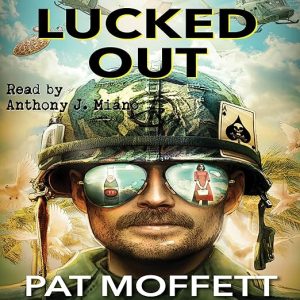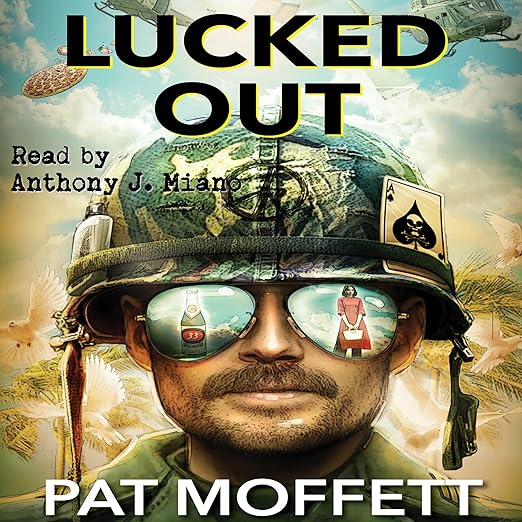
A single typographical error saved Pat Moffett's life, misdirecting him away from the platoon that would later be wiped out in a jungle ambush, and that near-miss anchors everything Lucked Out is really about. Can dumb luck and genuine heroism coexist in the same war story without canceling each other out? Moffett, a self-described street-smart wise-ass from Brooklyn who joined the 101st Airborne Division at twenty, spends this audiobook answering that question across fourteen months of secret missions, black-market currency schemes, a hijacked helicopter commandeered for pizza, and, somehow, a Bronze Star.
A Hijacked Helicopter, Commandeered for Pizza
What sets this apart from the standard Vietnam memoir shelf is tone. Moffett isn't reaching for solemn testimony or definitive historical accounting, he's telling the specific, often absurd story of how one wise-ass kid from Brooklyn survived fourteen months by working every angle available: running secret missions for army brass, impersonating officers, dating bar girls, cutting deals, and somehow getting dragged into rescuing orphans along the way. Reviewer Richarddevall calls it 'refreshingly irreverent,' and that irreverence is doing real narrative work, not just providing comic relief between the dangerous parts.
The pizza-helicopter story alone is worth the price of admission, a genuinely unbelievable detail that somehow fits naturally into a memoir this comfortable admitting its narrator got by more on luck and nerve than on any conventional heroism. But Lucked Out earns its subtitle honestly too, closing, per reviewer Nancy Gingrich, with what she calls 'the most wonderful story of the Spirit world coming to the rescue of this stranded returning soldier,' a genuine tonal shift from raucous comedy into something quieter and more reflective.
Luck as the Understatement of the Story
Naming the series after himself rather than a thematic title is a notable structural choice, suggesting Moffett and his publisher see this less as a single self-contained war story and more as the opening chapter of an ongoing personal account, closer in spirit to a memoirist building a multi-volume life story than to a standard single-book war memoir. That framing raises the stakes for how this first entry needs to land, and on its own terms it succeeds as a complete, satisfying tour even without knowing what comes next.
Richarddevall's review title borrows directly from the book's own framing, calling 'luck' the understatement of Pat Moffett's remarkable story, and that understatement runs through nearly every chapter: brushes with death recast as inconvenience, genuine heroism downplayed as accident, a rhetorical habit that makes the eventual Bronze Star land as a surprise rather than an inevitability the narrative was building toward all along.
Nancy Gingrich's four-star review, the most reserved rating among the available reviews, still calls the rest of the book 'satisfactorily interesting,' a useful reminder that even listeners less enthusiastic about the memoir's dominant comic register found real value in its historical and personal specificity.
Miano's Brooklyn Energy Avoids Caricature
Anthony J. Miano's narration is doing serious work throughout this listen. His command of Brooklyn street energy avoids caricature, no small feat for a regional voice this specific and this easy to overplay, and his comic timing gives Moffett's misadventures the actual rhythm humor requires rather than just reading the jokes aloud flatly. That distinction matters enormously for a memoir built as much around comic set pieces as around danger.
Just as important is how Miano handles the book's late tonal pivot. A narrator who nails Brooklyn wise-guy energy but can't shift registers would undercut the ending's quiet spiritual turn entirely; instead, that shift arrives with appropriate gravity rather than feeling like a mismatched addendum tacked onto a comedy. Reviewer Arnold Chapman's praise for how the book 'captures many aspects of military life' while still landing its 'unique and colorful' personal voice tracks closely with what strong narration of tonally mixed memoir requires.
Most acclaimed Vietnam memoirs, Philip Caputo's A Rumor of War or Robert Mason's Chickenhawk among them, lean toward sober reckoning with trauma and moral injury, and rightly so given the subject matter. Lucked Out sits in a smaller, less crowded tradition of war memoirs that use comedy as the primary lens rather than the exception, closer in spirit to Catch-22's absurdist wartime bureaucracy than to the more solemn combat-memoir mainstream, even though Moffett's story is entirely nonfiction rather than satirical invention.
Room to Breathe Instead of a Highlight Reel
At nearly twelve hours, this is a substantial listen for a memoir covering roughly fourteen months of service, and that density reflects how much ground Moffett actually covers: currency schemes, black-market dealing, brushes with military police, and a genuine massacre narrowly avoided all get room to breathe rather than being compressed into a highlight reel. Listeners wanting a tighter, more streamlined account should know upfront that expansiveness, not brevity, is the book's whole approach.
This is billed as the first entry in a Pat Moffett series, which suggests more material is planned beyond this single tour. Whether that means a direct continuation of his Vietnam service or a broader life story remains unclear from the available listing, but listeners who finish this one invested in Moffett's voice should watch for future installments rather than assuming this is a standalone account of his entire life.
A 4.4 rating across 890 ratings is a robust sample for a self-published or small-press military memoir, suggesting word of mouth within the Vietnam veteran and military history community specifically has carried this well beyond a niche audience. That reach is worth noting for listeners wondering whether a first-time memoirist's account can sustain twelve hours of listener interest; the rating volume alone suggests it has.
Black-Market Hustle Over Standard Combat Focus
Readers of irreverent, humor-forward war memoirs, in the vein of anything that treats survival with dark comedy rather than solemn reverence, are the obvious audience, and Vietnam-era military history fans specifically get a genuinely different angle here than the standard combat-focused account: this is about the black market, the hustle, and the sheer improbability of staying alive by wit as much as by soldiering.
The 101st Airborne Division carries specific historical weight worth knowing for listeners less versed in Vietnam-era unit history: one of the most decorated and heavily deployed American divisions of the war, involved in some of the conflict's most intense sustained fighting. Moffett's specific assignment within that division, working secret missions for army brass rather than standard infantry duty, gives his account a genuinely unusual vantage point even within a unit whose broader history is relatively well documented elsewhere.
Skip this one if you're looking for a strictly conventional, chronological combat memoir centered on firefights and unit history; Moffett's story runs through checkpoints, deals, and misadventures as much as through combat itself, and listeners wanting a more traditional war narrative may find the constant hustle-and-scheme energy an odd fit for what they expected going in.
Is this audiobook a typical combat-focused Vietnam War memoir?
Not really. Pat Moffett's story runs through black-market schemes, impersonating officers, and a hijacked helicopter as much as through combat, with a genuinely different hustle-driven angle on the war.
Does Anthony J. Miano's narration suit both the comedy and the serious moments in this audiobook?
Yes. He handles the shift from raucous comedy to the book's quieter spiritual ending with appropriate gravity, a real technical achievement for one performer.