Quick Take
- Narration: Rick Adamson delivers Birkenfeld’s account with a measured authority that suits the material, keeping the tone close to reported nonfiction without losing the thriller energy the story naturally generates.
- Themes: Whistleblowing and institutional betrayal, Swiss banking secrecy, justice delayed and complicated
- Mood: Propulsive and indignant, with a whistleblower’s particular combination of conviction and bitter surprise
- Verdict: A first-person account of the UBS scandal that reads like a financial thriller because it effectively is one, though listeners should weigh the fact that the narrator is also the story’s most interested party.
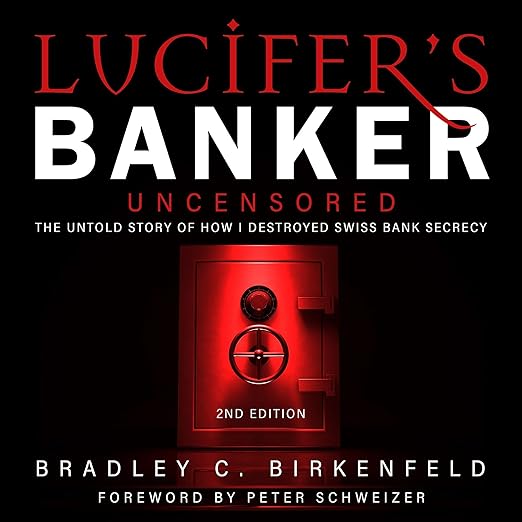
I came to Lucifer’s Banker Uncensored already knowing the broad outlines of the Bradley Birkenfeld case. He was the UBS banker who blew the whistle on Swiss banking secrecy, cooperated with the US government, went to prison for it anyway, and then received a $104 million IRS whistleblower award, the largest in history. That sequence of events sounds almost too dramatic to be real, which is precisely why the audiobook version works as well as it does. Knowing the ending does not diminish the story; it makes the institutional logic that produced it more fascinating and more troubling.
The subtitle promises the story of how Birkenfeld destroyed Swiss bank secrecy, and the book largely delivers on that claim. What makes it complicated is that Birkenfeld is telling his own story, which means the account is unambiguously sympathetic to its narrator. He is a man who genuinely blew the whistle on a massive tax evasion scheme, genuinely cooperated with US authorities, and then genuinely went to prison anyway. That the Department of Justice pursued him even as he cooperated is the central injustice the book documents, and it is a real injustice worth documenting carefully.
The Architecture of Swiss Secrecy
The early sections of the book, covering how offshore accounts actually function and how private banking at UBS operated in practice, are among the most informative passages I have encountered on the subject. Birkenfeld describes the mechanics with the specificity of someone who spent years inside the system: the shell companies, the numbered accounts, the deliberate geography of client visits designed to keep American clients from triggering domestic reporting requirements. The information is presented through the lens of someone who was very good at his job and who understood exactly what that job entailed and what it enabled.
One reviewer compared the book to equal parts John Grisham, Tom Clancy, and James Bond, and while that is marketing language more than literary criticism, it captures something real about the pacing and self-dramatization of the early chapters. The US Treasury ultimately recovered over $15 billion in back taxes, fines, and penalties as a result of Birkenfeld’s revelations. That figure is extraordinary, and the book earns its anger at the DoJ’s continued prosecution even as that recovery was happening. The institutional logic that led to his 30 months in federal prison is explained in enough detail to make the absurdity register clearly.
Where the Narrator’s Perspective Shows Its Limits
One reviewer noted, fairly, that the book veers toward political bias in its later chapters, and that this weakens the author’s credibility as a reporter of objective events. Another observed that no one survives Birkenfeld’s account without his judgment, including himself in ways he may not fully intend. Both criticisms have merit. Birkenfeld is not a neutral party, and the book reads most strongly when it sticks to documented events and most weakly when it ventures into editorial territory that his position as a convicted felon and whistleblower makes complicated.
Rick Adamson’s narration is helpful here. He does not amplify the more indignant passages beyond what the text requires, which keeps the audiobook from tipping into polemic even when the underlying writing is pushing that direction. His delivery has the flat authority of a financial news reader rather than an advocate, and that quality is a genuine counterbalance to Birkenfeld’s natural tendency toward self-justification.
The Human Stakes of Offshore Finance
Among the most interesting review data attached to this title is a short comment from a self-identified Swiss listener who simply notes that UBS caused real harm to ordinary account holders and that Birkenfeld’s actions were overdue. That outside confirmation, from someone with no stake in the American angle of the story, adds a dimension the book’s US-centric framing sometimes obscures. The damage Swiss banking secrecy did was not abstract or victimless, and the book is most compelling when it grounds the financial mechanics in their human consequences rather than in Birkenfeld’s personal drama.
The section covering Birkenfeld’s Senate testimony and his interactions with the IRS is genuinely thrilling in the way that good financial crime reporting can be. The gap between what he delivered to the government and how the government treated him is documented with the kind of specificity that makes the reader’s indignation feel appropriately calibrated rather than manufactured.
Who Should and Should Not Listen to This
Listeners interested in financial crime, whistleblower dynamics, and the specific machinery of international tax evasion will find this audiobook genuinely informative and consistently engaging. The journey from UBS insider to prison to $104 million is considerably more complicated than the headlines suggested, and that complexity is where the book’s real value lies.
Listeners who want a balanced account with equal attention to Birkenfeld’s own moral compromises will need to supplement this with outside reporting. The book is not dishonest about his past, but it is sympathetic in the way that first-person memoir necessarily is. Come for the financial thriller; stay for the institutional critique; cross-reference what you can with contemporaneous journalism.
Frequently Asked Questions
Is Lucifer’s Banker Uncensored different from the original Lucifer’s Banker, and if so, how?
The uncensored edition restores material that was removed or modified in the original version, reportedly due to legal concerns. Birkenfeld has been vocal that the uncensored edition represents the account he actually wanted to tell. Listeners who read the first edition may find new material here, though the core narrative arc is the same.
How does Rick Adamson’s narration handle the more self-aggrandizing passages in Birkenfeld’s account?
Adamson maintains a measured, news-reader quality throughout, which effectively tempers the moments where Birkenfeld’s self-interest as narrator is most visible. He reads the indignant passages with authority rather than amplifying their emotional temperature, which keeps the audiobook closer to documentary than polemic even when the text pushes toward advocacy.
Does the book explain Swiss banking secrecy in accessible terms for listeners without a finance background?
Yes, and this is one of its genuine strengths. Birkenfeld explains the mechanics of offshore accounts, shell companies, and the geography of client management with the clarity of someone who lived inside the system. Reviewers with finance backgrounds found the technical sections sound, while those without that background found them entirely accessible.
How should listeners weigh Birkenfeld’s account given that he is both the whistleblower and the narrator of his own story?
With appreciative skepticism. The documented facts, UBS’s offshore scheme, the Senate testimony, the Treasury recovery, his prison sentence, and the $104 million award, are verifiable and not in dispute. The interpretation of events, particularly around the DoJ’s motives, reflects Birkenfeld’s perspective and should be read as such. Supplementing with contemporaneous news reporting adds useful context.