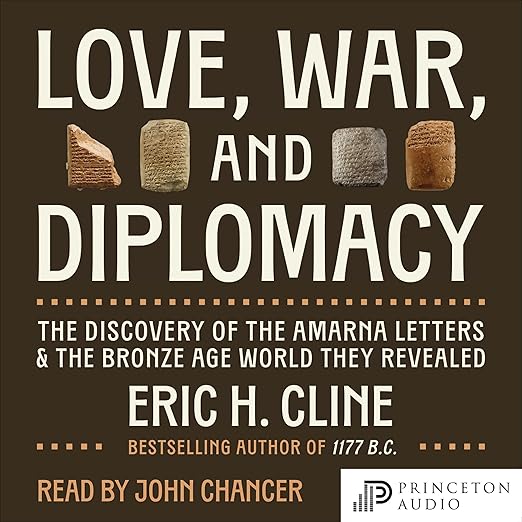
Quick Take
- Narration: John Chancer brings measured authority to Cline’s scholarly prose, keeping the material accessible without softening its academic weight.
- Themes: Bronze Age diplomacy, archaeological discovery, ancient international relations
- Mood: Scholarly and absorbing, with the quiet thrill of buried history surfacing
- Verdict: A rich, carefully assembled account of the Amarna Letters that rewards patient listeners with a genuine sense of the ancient world’s diplomatic complexity.
I came to this one on a quiet Saturday afternoon, the kind of day when I find myself wanting something that feels genuinely illuminating rather than just entertaining. Eric Cline’s name was familiar to me from his previous work on the Bronze Age collapse, so when I saw he had turned his attention to the Amarna Letters, I was already leaning in before the first chapter was through. What I did not fully anticipate was how much story there was wrapped around those clay tablets, not just the ancient story, but the nineteenth-century story of their recovery.
Published by Princeton University Press and running just over eight hours, this is the kind of audiobook that sits comfortably at the intersection of archaeology, diplomatic history, and scholarly detective work. John Chancer narrates with a calm, measured cadence that suits the material well. He does not dramatize unnecessarily, which is the right call here. The text itself carries enough inherent drama without embellishment.
Our Take on Love, War, and Diplomacy
Cline structures his account around three overlapping narratives. The first is the discovery itself: in 1887, an Egyptian woman digging among the ruins of Akhenaten’s capital city at Amarna stumbled upon nearly four hundred cuneiform tablets. This was not a planned excavation. It was an accidental find with world-altering consequences for our understanding of the ancient Near East. Cline describes the scene with the kind of restrained excitement that only a scholar who genuinely loves his subject can muster.
The second narrative follows the fierce competition among dealers, museums, and collectors who scrambled to acquire these tablets before the scholarly world had even properly understood what they were. British and German scholars racing to translate them, the tablets being split between institutions, some damaged in transit, some sold before anyone knew their full significance. This part of the book reads almost like a thriller, though Cline never loses his academic footing.
The third and most substantial narrative is the content of the letters themselves. Dating to the mid-fourteenth century BCE, during the reigns of Amenhotep III and his son Akhenaten, these tablets represent the only surviving royal archive from New Kingdom Egypt. In them we find pharaohs negotiating marriages, requesting gold, trading diplomatic pleasantries with Hittite and Babylonian kings, and dealing with complaints from petty Canaanite rulers who owed them allegiance. It is correspondence that feels startlingly recognizable. Rulers posturing, demanding respect, offering flattery as a tool of statecraft. The review from Kathryn captures this well: it is, she notes, a complicated history, but Cline handles it with skill.
Why Listen to This Audiobook
The audio format works particularly well for this material because Cline’s writing has a lecture-hall quality. He is a professor who knows how to build an argument patiently, layer by layer, and Chancer’s narration honors that rhythm. There are moments where the depth of historical detail might challenge listeners who come in cold, but Cline does the work of contextualizing the Bronze Age world before asking you to populate it with names and kingdoms.
What I found most satisfying was the way Cline repeatedly draws lines between then and now. The diplomatic language of the Amarna Letters, with its careful calibrations of brotherhood and rivalry, its gift-giving as geopolitical signaling, its back-channel negotiations and barely concealed threats, is not so different from what we see in modern international relations. That comparison is not strained or cheap. It feels genuinely earned by the time Cline makes it.
What to Watch For in the Scholarly Detail
Listeners should be prepared for a book that takes its academic responsibilities seriously. The sections on translation debates and competing scholarly interpretations are thorough, and while Cline makes them as accessible as possible, they do require sustained attention. The reviewer from MacWise, a self-described Cline enthusiast, still had mild quibbles with wording choices in the title. That level of attention to precision is what Cline’s readership tends to bring, and it reflects the kind of engaged audience this book is written for.
The geopolitical geography of the Bronze Age Near East, with its Hittites, Babylonians, Assyrians, Mittanians, and Canaanite city-states all jockeying for position relative to Egypt, can feel dense if you are new to the period. I would suggest that first-time listeners to ancient Near Eastern history might want to have a basic map of the region handy. The audio does not provide the visual anchoring that a printed text with maps would offer, and that is probably the most significant limitation of this particular format for this particular book.
Who Should Listen to Love, War, and Diplomacy
This audiobook is ideal for listeners with an existing interest in ancient history, archaeology, or the history of diplomacy who want a scholarly but readable account of one of the most important archival discoveries ever made. It also works well for anyone fascinated by the intersection of colonial-era scholarship and ancient artifacts, because the nineteenth-century recovery narrative is compelling in its own right.
Listeners looking for narrative-driven popular history in the mold of, say, David Grann or Erik Larson may find the pacing more methodical than they prefer. This is a scholar writing for intelligent general readers, not a narrative journalist writing for maximum momentum. Those are different things, and being clear about the distinction will help you approach the book on its own terms. At just over eight hours, it asks for a meaningful investment, and it delivers one in return.
Frequently Asked Questions
Do I need prior knowledge of the Bronze Age or ancient Egypt to follow this audiobook?
Some familiarity helps, but Cline contextualizes the period carefully before diving into the letters themselves. Listeners new to the subject may want a basic map of the ancient Near East to follow the geopolitical references.
Does John Chancer’s narration make the scholarly content easier to absorb in audio form?
Yes. Chancer maintains a measured, authoritative tone that suits Cline’s lecture-style prose. He does not dramatize or embellish, which keeps the focus on the material rather than performance.
Is the book primarily about the ancient letters themselves or about the modern story of their discovery?
Both. Cline weaves together three threads: the 1887 discovery, the nineteenth-century competition among dealers and scholars to acquire and translate the tablets, and the content of the letters themselves. The ancient diplomatic world receives the most attention, but the modern archaeological drama is substantial.
How does this compare to Cline’s earlier book on the Bronze Age collapse?
The two books share Cline’s characteristic blend of scholarly depth and readable prose, but this one is more tightly focused on a single archival source. Fans of his previous work will find the same methodology and the same gift for contextualizing ancient events within broader patterns of human behavior.