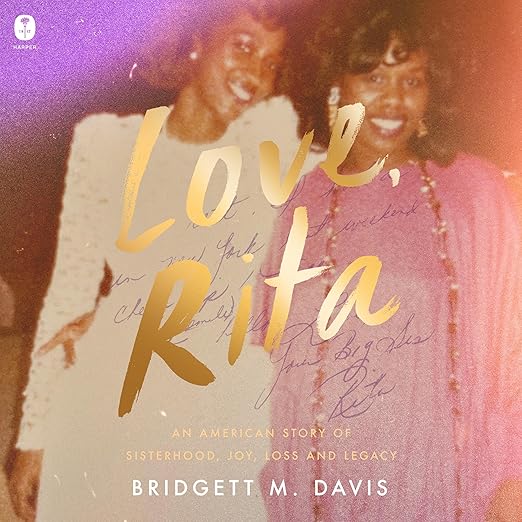
Nine people have graded this audiobook and, unusually, the arithmetic closes: nine votes totaling exactly 37 points out of a possible 45, which puts eight stars somewhere on the page you cannot see. Three of those nine wrote something, and all three gave full marks, so the six silent graders are carrying every one of the missing points between them. I mention it first because Love, Rita is a memoir about a person who is no longer here to be asked, read aloud by the sister who outlived her, and the gap between what a page shows you and what it withholds turns out to be the book's own subject as well as its listing's problem.
Why Rita, the Question the Whole Book Asks
Bridgett M. Davis is writing about Rita, four years older, who knew Bridgett before Bridgett knew herself. The biography is extraordinary in the way ordinary lives sometimes are when someone finally writes them down: Fisk University at sixteen, work as a car test driver, amateur belly dancing, an MBA, and eventually a career as a popular special education teacher. Then lupus, and death at forty-four. The question the book is built on is stated in the description without ornament, as the simple, heartbreaking one that grief actually asks. Why Rita. The memoir spends sixteen and a half hours refusing to answer it cheaply. What it does instead is set a family history alongside an American one and let the two explain each other, which is a harder structure to hold and the reason the length is not padding.
What lifts it above private tribute is the second argument running underneath. Davis uses one life as a lens on the persistent effects of racism in the lives of Black women, and the medical dimension of that is not incidental. The three notices on file identify the machinery precisely: one names the weathering concept associated with Dr. Geronimus, along with implicit bias among medical professionals and the progressive nature of lupus, and calls the memoir surprisingly educational for a book that is fundamentally about a sister. Another describes the weathering effect on Black women's bodies as the thing the book made visible. Those are the responses of readers who came for grief and left with an analysis.
The Sister Who Survived It Delivers the Testimony
Read by the sister who survived it, this memoir does something to you across sixteen hours that a hired voice could not. Grief writing performed by a professional is an interpretation, however skilled. Grief writing spoken by the person who did the grieving is testimony, and the listener's relationship to it is different in kind. No co-narrator appears in the credits and no archival material is listed, so the whole span belongs to one voice describing a person that voice has lost.
Davis is not a first-time memoirist either, and one response makes the useful comparison. That reader has followed her from an earlier book through her memoir about her mother and reports that this one feels different, more intimate, while describing her prose as gentle and carefully attentive in a way that pulls a reader through a long book quickly. Length is worth flagging honestly: sixteen hours and twenty-nine minutes is substantial for a memoir, and that reviewer's observation that it reads faster than it looks is the most practically useful thing in the column.
You Cannot Skim a Voice Like a Page
Return to the numbers, because in this one case they say something. Every visible grade is a five, and the badge underneath them reads 4.1. With the total pinned at 37 of 45, someone graded this considerably lower and did not explain why, and the three people who did explain themselves are the ones who loved it. That is the opposite of the usual pattern, where enthusiasm is silent and complaint is loud. Whatever the dissent is here, it stayed private, and a prospective listener has no access to it whatsoever.
Be aware also of what the book asks of you. This is a memoir about watching an autoimmune disease take somebody over four decades of a shared life, written by the person who watched, and read by the same person. No professional distance exists anywhere along that chain, which is the point and also the warning. The description reaches for words like searing and homage, and for once the marketing is not overselling. If you are currently sitting with a loss of your own, this will not be gentle with you, and the audio format offers less escape than a page does because you cannot skim a voice.
Two smaller things about the page. The description fuses the title into the byline, running the words together so that a newcomer meets Love, Rita Bridgett M. Davis as though the whole string were somebody's name, when a single comma would have fixed it. And two of the three handles attached to the written responses are marketplace defaults rather than chosen names, which matters when you are deciding how much weight a column of three can carry. On the other side of the ledger, and this is rarer than it ought to be, all three were posted after the recording was published in March 2025, so they could at least be about this edition, even though not one of them says a word about the reading.
Choose Print Instead If You Need to Control the Pace
Come to it if you want a memoir that holds a single person steadily in view and lets the larger argument arrive through her rather than around her. Come to it if you read the earlier book about the family and want the sister's story. And come to it if the intersection of medical racism, chronic illness, and family history is territory you want handled by someone with a stake in it rather than by a reporter, since the difference shows in which details get kept.
Wait if you are grieving right now, or choose the printed edition, where you control the pace and can put it down mid-paragraph without a voice continuing in the room. Wait too if you want the health argument as its primary content, since the analysis emerges through the biography rather than organizing it. Nobody should come to this expecting distance, because distance is precisely what neither the writing nor the recording is offering.
Common Questions
Does Bridgett M. Davis narrate the Love, Rita audiobook herself?
Yes, author and narrator share the credit across sixteen hours and twenty-nine minutes from Harper. Since the book is her account of losing her older sister, that removes any professional distance between the writing and the delivery. The credits name no co-narrator and no supplementary archival material either.
Is this audiobook a grief memoir or a book about health and racism?
Both, with the biography carrying the argument. Written responses single out the weathering concept associated with Dr. Geronimus, the biases that medical professionals carry into a consulting room, and the way lupus advances. One calls it surprisingly educational. The analysis surfaces through Rita's life rather than being organized separately from it.
Do I need to have read the author's earlier memoir first?
No. One reviewer arrives having read an earlier book of hers and her memoir about her mother, and finds this one more intimate by comparison, but nothing here depends on that background. The story of the sisters is told from the beginning and stands entirely on its own terms.
Is sixteen and a half hours long for a memoir like this?
It is substantial, and the most useful note in the column addresses exactly that: one reader calls it a long book that reads quickly, crediting the storytelling for pulling you through. Expect a steady pace rather than a brisk one, and budget the length before you begin.