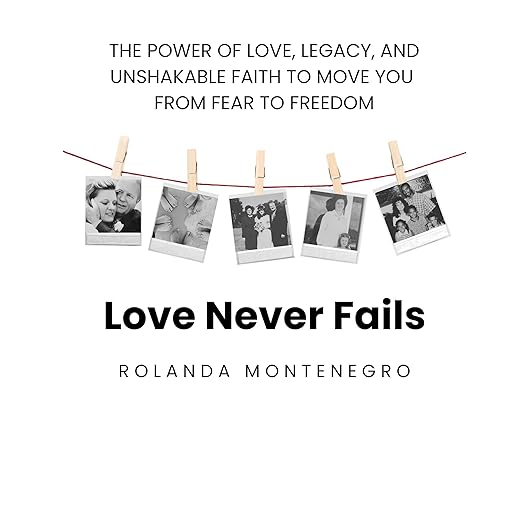
How do you narrate your own cancer diagnosis out loud? Rolanda Montenegro answers that question across three hours and ten minutes in this Love Never Fails audiobook, a memoir she wrote and narrates herself, moving through marriage, ministry, motherhood, and illness inside a single sustained testimony. Released in February 2026 and already carrying eighteen ratings with a perfect average, it has clearly found its audience quickly for a self-published title with no larger marketing apparatus behind it.
Eighteen Perfect Ratings That Actually Add Up
This is a memoir built around a specific structure rather than a chronological life story: love, marriage, ministry, motherhood, cancer, and calling, six threads Montenegro weaves together around the idea that faith carried her through each one. The cancer thread in particular gives the book real stakes beyond the usual inspirational-memoir formula, since illness forces a different kind of testimony than a marriage or a ministry story does on its own. At just over three hours, the book moves briskly through material that could easily have filled twice the runtime, which keeps momentum but also means each thread gets a compressed treatment rather than an expansive one. One reviewer describes the book as reading like a conversation, with Montenegro sharing the moments that shaped her life through honesty rather than polish, which fits a memoir this compact: it favors direct testimony over a heavily crafted narrative arc.
All eighteen ratings currently recorded for this audiobook land at five stars, the only total that adds up to the number the badge displays, so this is not a case of a favorable average smoothing over a mixed reception; every recorded vote is a perfect score. That kind of unanimous response tracks with the tone of the visible written reviews too, which lean heavily toward personal, emotional testimony rather than measured critique. It is worth remembering that eighteen ratings is still a modest sample for a public rating, so treat the perfect average as a strong early signal from an engaged, likely word-of-mouth audience rather than as proof of universal appeal beyond that circle.
A Sister's Own Memories Resurface While Listening
The most striking review comes from someone who identifies as Montenegro's own sister, describing memories she had forgotten resurfacing while listening, and calling the author a gifted storyteller whose account renews faith and hope for the reader alongside her own. That is an unusually intimate piece of testimony to have on a review page, someone who lived alongside the events being narrated confirming that the account holds up against her own memory of it, which is a form of validation a stranger's review simply cannot offer.
Montenegro narrating her own story is the format working exactly as it should for this kind of book: a memoir about faith carrying someone through marriage, illness, and ministry gains something specific from hearing the actual person describe it in her own voice rather than through an interpreter. One reviewer describes the whole experience as feeling like a conversation rather than a performance, which is precisely the register a self-narrated memoir should be aiming for, and a harder effect to fake than straightforward narration competence alone. Another response specifically credits the book with offering encouragement to anyone navigating fear or uncertainty, not only listeners facing a cancer diagnosis themselves, which suggests the memoir's reach extends past the exact circumstances Montenegro describes. That broader applicability matters for a book this specific in its particulars, since a memoir anchored so tightly to one person's marriage, ministry, and diagnosis could easily have stayed narrow rather than speaking past its own details.
One Reader Calls Out Finishing It in Three Days
This is self-published, with Montenegro listed as her own publisher, and it is explicitly a faith-centered account rather than a secular memoir about illness or resilience. Readers looking for a purely medical or clinical cancer narrative, or one without a religious throughline, should know upfront that scripture and ministry are central to how Montenegro frames every chapter of her own story, not an occasional aside layered on top of a more general account. Independent publication also means no outside editorial house has shaped or vetted the framing, so the perspective on the page is entirely Montenegro's own, unfiltered by a publisher's house style or a co-writer's structure. That has upsides for authenticity and downsides for polish, and listeners should weigh the two against each other rather than expecting the pacing and structure of a traditionally edited memoir.
Three hours and ten minutes is short for a memoir covering six major life threads, and that brevity means listeners hoping for extended reflection on any single event, the diagnosis itself, a specific ministry moment, will find the book moves on before dwelling too long. One review specifically calls out finishing the whole thing in three days, which either speaks to how readable it is or how much ground each chapter covers before advancing to the next thread. A book moving between marriage, a cancer diagnosis, and a ministry calling inside three hours has to compress transitions, so listeners who prefer memoirs that linger inside a single chapter of a life should adjust their expectations for pacing here. The listing does not break the book into named chapters, so it is worth going in expecting a flowing, testimony-style structure rather than clearly separated sections for each of the six threads the description names.
Faith Is the Organizing Principle of Every Chapter
Right choice for a reader drawn to faith memoirs built around a specific, hard chapter, cancer alongside ministry and motherhood, rather than a general testimony without much texture to it. It also suits listeners who value hearing an author narrate her own material directly, since Montenegro's presence behind the microphone is a meaningful part of what reviewers respond to here, including one write-up that closes by thanking her directly by name rather than describing the book at arm's length. This won't be for you if you are looking for a secular account of illness and recovery without a religious framework, since faith is the organizing principle behind every chapter rather than a supporting theme. Three hours is a small ask for a story reviewers describe reaching them on a genuinely personal level, and the short runtime makes it easy to return to specific sections later rather than committing to a single long sitting.
Common Questions
Is this audiobook narrated by Rolanda Montenegro herself?
Yes. The narrator field for this release lists Rolanda Montenegro, the same name credited as the author, confirming this is a self-narrated memoir rather than a separately cast reading. That pairing is common for personal memoirs where the author's own voice is considered part of the material.
How long is the Love Never Fails audiobook?
This audiobook runs three hours and ten minutes, covering marriage, ministry, motherhood, cancer, and calling within that single runtime. It is a brisk length compared to many full-life memoirs, moving through several major threads rather than dwelling extensively on any one of them.
Does this audiobook focus specifically on Rolanda Montenegro's cancer experience, or is that one part of a larger story?
Cancer is one of six threads the description lists alongside love, marriage, ministry, motherhood, and calling, rather than the sole focus of the memoir. Listeners specifically seeking an illness-centered narrative should know the book moves across a broader span of Montenegro's life instead.
Is Love Never Fails written from a specific religious perspective?
Yes. The description frames the entire memoir around trusting God, built specifically on what the synopsis calls an invitation to trust God and find hope through life's hardest seasons. Listeners looking for a secular memoir about resilience or illness without a faith framework should factor that in before choosing this one.