Quick Take
- Narration: CJ Bloom handles the tonal tightrope well, keeping Izzy’s voice warm and self-aware while ensuring Cal reads as intense without tipping into parody.
- Themes: Manufactured intimacy, the ethics of being truly known, what we reveal when we think no one important is listening
- Mood: Dark and flirtatious in equal measure, with genuine comedy running underneath the obsession
- Verdict: A smart dark rom-com debut that earns its genre-blending premise and benefits considerably from Bloom’s narrator casting.
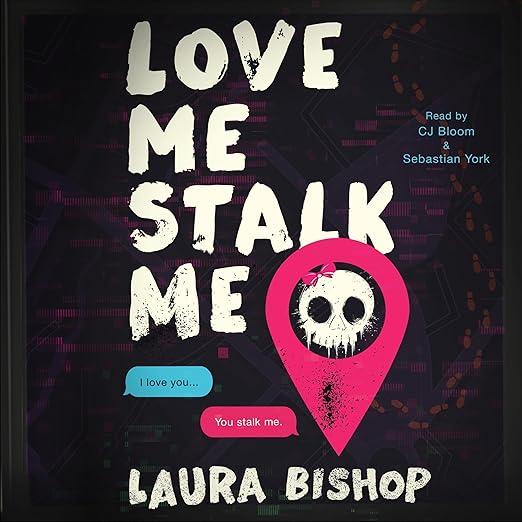
I should admit upfront that I approached Love Me Stalk Me with some wariness. The dark romance subgenre has flooded audiobook charts over the past few years, and the combination of AI boyfriend app, hacked phone, and tattooed security guard had all the hallmarks of a trend-chasing premise engineered by algorithm. What actually happened was that I was somewhere in chapter four, walking home from the grocery store, and I stopped on the sidewalk because Izzy had just said something genuinely funny to the chatbot she believes is named Caleb, and I realized the book knew exactly what it was doing.
Laura Bishop’s debut gets described on the cover as being for fans of Lights Out and You, which is a canny positioning: the first a dark romance, the second a psychological thriller about an obsessive man who genuinely believes his surveillance of the object of his desire is a form of love. The comparison to You is the most revealing one. Both books understand that the most interesting thing about this premise is not the horror of being watched but the philosophical knot at its center: what does it mean to be truly known by someone, even if the method of knowing is completely wrong?
The AI Boyfriend Gap and Why It Works as a Setup
The emotional architecture here is precise. Izzy downloads the AI app because her actual boyfriend is checked out, leaving an emotional void she fills with a chatbot she names Caleb. What she does not know is that Callahan Knight, the store’s new head of security, has hacked the app and has been reading, and then listening to, everything she types. The question the novel is really asking is uncomfortable: if someone comes to know you through the things you say when you believe no one you know is listening, is that intimacy real? Cal is not cataloguing information to use against Izzy. He is cataloguing it because he finds her extraordinary. That distinction matters, and Bishop holds it carefully enough that the reader can occupy both positions simultaneously: this is wrong, and also, she is being seen in a way her actual boyfriend has never managed.
Reviewer Brianna L. Earlley went in with significant skepticism, having seen the promotion machine behind the book, and came out genuinely won over. That trajectory maps onto my own experience. The premise is constructed to sound like every other overhyped dark romance, and then it delivers something more interesting: a debut novelist who has thought through the ethical dimensions of her premise rather than simply using them as erotic backdrop.
CJ Bloom and the Dual Register Problem
The audiobook format poses a specific challenge for this kind of story. CJ Bloom needs to carry Izzy’s interiority while also making the listener feel the slightly uncanny quality of Cal’s intense, focused affection. She handles this better than many narrators would. Izzy sounds like a woman who has been coasting through her own life, slightly dissociated, and the humor she finds in her own situation is delivered with a self-awareness that keeps the character sympathetic even when she is making obvious bad decisions. Bloom also differentiates the chat-interface sequences from the real-world ones, which matters more than it sounds: a significant portion of the book’s setup happens in text exchanges, and flattening those into the same register as the in-person scenes would drain them of their specific charged quality.
Reviewer Lindsay B notes that Cal is simultaneously very intense and also a soft and gooey cinnamon roll, which is the dark romance characterization tightrope Bloom manages to hold. He never becomes a cartoon and never becomes purely threatening.
The Fourteen Hours and What They Earn
At fourteen hours and five minutes, Love Me Stalk Me is longer than its premise might suggest it needs to be. The first third is deliberately slow: Izzy’s dissatisfaction with her real relationship, her growing investment in Caleb-who-is-actually-Cal, the widening gap between what she is getting in real life and what she is getting from the app. This patience earns the middle and final sections considerably. When the book’s comedic and romantic registers collide in the latter half, it lands harder than it would have without that groundwork. Reviewer Nicole Swanson describes it as a light dark romance, not too crazy, and that is roughly right as a calibration for listeners coming from the heavier end of the dark romance spectrum.
Who Should Listen, Who Should Skip
Listen if you enjoy dark romance that takes its own premise seriously rather than using moral complexity as set dressing. Listen if you appreciated You as a book but wanted the emotional resolution to tilt differently, or if you want a debut that actually delivers on its marketing comparisons.
Skip if you need your romantic leads to conduct themselves within conventional ethical frameworks. The hacking is not played as a deal-breaker in the way it would be in a realistic novel, and that requires a genre-specific willingness to operate in the space between what is right and what is compelling. Also skip if you are looking for a quick, light listen: the runtime is committed to its slower emotional build.
Frequently Asked Questions
Is Love Me Stalk Me the first book in the Obsessively Yours series, and does it end on a cliffhanger?
Yes, it is the first book in the Obsessively Yours series. Without specific spoilers: the central relationship arc reaches a meaningful point of resolution within this book. Whether further volumes continue Izzy and Cal’s story or introduce new characters in the same world has not been confirmed in the available metadata.
How explicit is the content, and is this categorized as a steamy dark romance?
Reviews describe it as spicy, and the dark romance genre framing suggests mature content. Reviewer Nicole Swanson calls it light dark romance, meaning the dark elements are present but not extreme compared to the heavier end of the subgenre. Prospective listeners should expect adult content with an obsessive love interest premise.
Does CJ Bloom voice both Izzy’s perspective and Cal’s dialogue, or does the book use dual narration?
Based on the metadata, CJ Bloom is the sole narrator. This is a single-narrator production, meaning Bloom voices both perspectives. Her ability to differentiate the characters’ emotional registers, particularly the chat-interface sequences versus real-world scenes, is one of the production’s genuine strengths.
The book is compared to You, how closely does the obsessive dynamic here mirror that novel’s framing?
The comparison to You is in the marketing positioning. Both books center a man who surveils a woman and frames his observation as love. The key tonal difference is that Love Me Stalk Me operates as a dark rom-com rather than a psychological thriller, meaning the reader is invited to find Cal’s obsession charming rather than deeply unsettling. Your comfort with that distinction will determine how well the book works for you.