Quick Take
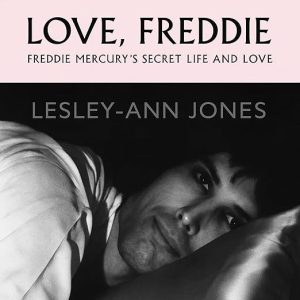
- Narrator: Lesley-Ann Jones reads her own book, which matters more than usual on a title whose entire value rests on the author's claim of access.
- Subjects: Freddie Mercury's private diaries, a secret daughter, fame and concealment in the 1970s and 1980s, contested biography
- Tone: Intimate, affectionate and hotly disputed
- Bottom line: Fluent and full of new material if you accept the premise, and the one-star notice in the record explains precisely why some listeners will not.
Seventeen handwritten notebooks are the entire foundation of this book, and whether you believe in them will decide what you make of twelve hours of it. Lesley-Ann Jones says Freddie Mercury kept a diary from 1976 until weeks before his death in 1991, that he entrusted the collection to one of the four people closest to him, and that in 2021 she was given complete and unrestricted access. This audiobook is her account of what she found in them.
The Secret Daughter Claim Only Four People Knew
Everything turns on a single claim, and the listing states it flatly: Freddie Mercury had a secret daughter, she is alive, and she speaks in this book about the love and affection he showed during her upbringing. Everything else Jones promises, the childhood secrets, the deepest fears, the songwriting origins, the identification of the love of his life, follows from access to a source that only four people supposedly knew existed.
Alfred Mason's five-star notice from September 2025 is the purest version of the believing response: a wondrous revelation, a mesmerizing read, a life more complex and radiant than anyone had imagined, with Fred Bulsara still taking a reader's breath away a quarter of a century after his death. That notice closes on a rhetorical question about how anybody knows who their father is, which is the book's whole argument compressed into one line.
Jones spent three and a half years inside the material, according to the description, and what she has built is a narrative rather than a transcript. That choice carries consequences. Anyone who wants the diaries reproduced, dated and quoted at length will not get them. What arrives instead is Jones's reading of them, shaped into continuous prose, and a listener has to take the intermediary on trust.
Hearing Jones Make the Claim in Her Own Voice
The author reads it herself, and on this particular title that is not a neutral production decision. The whole edifice rests on her access and her judgment, and hearing her make the claims in her own voice removes the buffer a hired reader would put between an assertion and the person making it. Whether that helps or hurts depends almost entirely on what you already believe.
A Flight Pass Quickly Despite the Controversy
Cindy's five-star notice from October 2025 is the plainest recommendation in the record: bought as a gift for a mother who loves Freddie, enjoyed tremendously, lots of new information. Whatever the arguments about provenance, that purchase delivered what the description promised, which is a book full of material its recipient had not encountered anywhere before.
The least contested strength is context. Queen were at their global peak when the diaries supposedly begin in 1976, and one anonymous five-star notice singles out exactly that: an excellent book about an amazing personality, the era in which he lived, and the harsh truth of life. The era is the part nobody is arguing about.
Jones has three and a half years of material and a description promising to overturn everything readers thought they knew, and a book with that ambition needs room to work. What the length buys is accumulation, which is where a claim of this kind either becomes persuasive or fails to, and accumulation is something a continuous recording delivers better than a book picked up and put down.
Patti Mcclure's four-star notice models the most sustainable way to approach all of this. That reader knows about the controversy over the book's validity, was intrigued enough to read it anyway, and says outright that whether Freddie had a secret daughter is no concern of theirs and changes nothing about how they regard him as a singer, a songwriter, a performer or a person. It still made a flight pass quickly in both directions.
No DNA, No Pictures, and Audio Cannot Help
BH's one-star notice is the most detailed thing written about this book, and it is a demolition. No DNA. No pictures. No handwriting analysis. Not even a photograph of the notebooks. That reading argues the alleged daughter exists chiefly to introduce the diaries, that without the diaries very little story remains, and that virtually everyone who might have known of her is conveniently dead while those still living never heard of her. Read that notice before committing twelve hours.
The structural problem is that audio cannot help you here. A printed biography making a contested claim carries footnotes, plates and an apparatus you can interrogate at the moment of doubt. A recording gives you a voice asserting things in sequence. On a book whose entire value depends on whether the underlying documents are genuine, losing the ability to check a citation as it goes past is a real loss.
Diaries Rebranded a Mind-Blowing Listen for Audio
Only one notice arrived after this recording did. December the eighth, 2025 is the audio release date, while the other four are dated September the sixth, September the twenty-first, September the twenty-fifth and October the twenty-eighth. The 4.2 across two hundred and nineteen ratings is a verdict on a text, delivered largely before anybody could listen to anything.
One small thing on the listing shows how the copy was assembled. The description calls the diaries themselves "a mind-blowing listen," which is a peculiar way to describe seventeen handwritten notebooks and reads like print copy with a single word swapped out for the audio edition. Trivial in itself, and a useful prompt to read every promise on this page slowly.
A Story Where a Court Would Want a Document
Queen listeners who want more of the story and are relaxed about provenance will enjoy this a great deal. Jones writes fluently, the period material is solid, and the emotional register is affectionate rather than sensational. If you can hold the central claim at arm's length and stay interested in the account built around it, this will keep you comfortably occupied.
Anyone who came specifically for the daughter should understand what the book offers on that point, which is testimony rather than evidence. The description says she talks about her upbringing. It does not say that anybody has verified it, and the strongest dissent in the record is aimed precisely at that gap.
Two audiences will finish this satisfied and a third will not. Believers get a wealth of new material and a warm portrait. Skeptics get a well-written account of a documented era wrapped around a claim they are free to decline. The listener who ends up angry is the one who wanted the question settled, because Jones offers a story where a court would want a document, and no recording can supply the difference.
Does Lesley-Ann Jones narrate the audiobook herself?
She does. On a book that stands or falls on one journalist's access, that arrangement leaves nothing between a contested claim and the person advancing it. Twelve hours and sixteen minutes in the author's own voice will read as reassuring or as uncomfortable depending on what you already believe.
Does the audiobook still work if you doubt the central claim?
It can. The material about Queen's peak years and the pressures on a global performer through that decade is the part nobody disputes, and Jones writes fluently throughout. Approach it as one biographer's account rather than as a settled historical record and it holds up perfectly well.