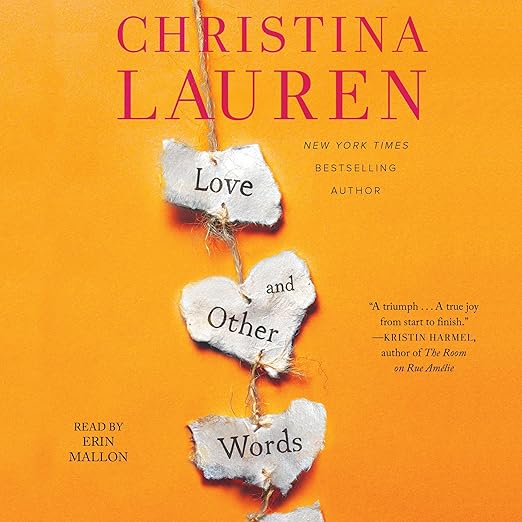
Quick Take
- Narration: Erin Mallon brings real tenderness to both the teenage and adult versions of Macy, handling the dual-timeline structure with consistent emotional clarity.
- Themes: Second-chance love and the cost of a decade of silence, grief and its long shadow, the language of connection
- Mood: Sweet and aching, with the warmth of a remembered summer and the weight of what was lost
- Verdict: Christina Lauren’s most emotionally sustained single-protagonist romance, tender in a way that earns its ending rather than assuming it.
I came to Love and Other Words later than most. It had been on my list since it first appeared, during that window when Christina Lauren, the author duo of Christina Hobbs and Lauren Billings, could seemingly do no wrong for a certain reading community. I had read their lighter work and enjoyed it. This one had a reputation for being different, and I wanted to come to it in the right frame of mind rather than in the mood for something breezy. I queued it up on a long train journey, which turned out to be exactly the right context. This is a novel about the particular quality of love you feel in a space set apart from ordinary life, and a long train journey has that quality.
Macy Sorensen is a pediatrics resident, engaged to an older and financially stable man, her life organized around competence and emotional containment. She runs into Elliot Petropoulos, her first love, the person she has not seen in ten years, and the careful arrangement of her adult life begins to come apart. The structure alternates between Then and Now: teenage Macy and Elliot discovering each other in a house outside San Francisco, spending their weekends building a shared vocabulary from books and favorite words; and adult Macy, trying to understand what happened and whether it can be undone.
The Dual Timeline as Emotional Architecture
Christina Lauren’s decision to alternate between the Then and the Now is the novel’s central structural bet, and it pays off because the writers understand that the past timeline is not backstory, it is the whole point. The San Francisco house, the nook full of books, the ritual of sharing a word you love and explaining why: these scenes are written with specific, careful pleasure. They need to feel like something worth losing, or the Now storyline has no weight. They do. Listeners who respond to the Then sections with the particular ache of knowing a happiness is temporary, because you are already reading the aftermath, will find the adult storyline’s central mystery genuinely affecting when it resolves.
What the Decade of Silence Is Actually About
The synopsis is careful about the night Elliot declared his love and everything broke. The story withholds the specific reasons for Macy’s silence, and that withholding is part of the narrative’s architecture. I will not elaborate except to say that the explanation, when it arrives, is grounded in grief rather than miscommunication, and that the distinction matters enormously for how you feel about the decade lost. This is not a second-chance romance built on a misunderstanding. It is built on something harder, and the novel is honest about that.
Erin Mallon and the Problem of Playing Someone at Two Ages
Narrating a dual-timeline novel with a single protagonist at two different life stages is a specific challenge. The teenage Macy and the adult Macy need to be recognizably the same person while being audibly different in register, one person before grief, one after. Mallon manages this transition with consistency. The teenage sections have a brightness and openness that contracts almost imperceptibly across the novel’s runtime until the adult Macy’s emotional cautiousness becomes audible as a character quality rather than simply a narrative choice. The warmth she brings to the Then sections makes the Now sections feel like something was taken from her, which is correct.
Who This Is For and What to Expect
This is Christina Lauren operating with more emotional seriousness than their romcoms deliver, and it is better for that decision. Readers who love second-chance romance with genuine stakes and a willingness to sit in grief before the resolution will find this rewarding. Those who want pure breezy warmth throughout may find the middle section heavier than expected. The ending is earned and satisfying, but it asks for patience. Listeners who have been burned by romance audiobooks that mistake sentiment for depth will find this does not make that error.
Frequently Asked Questions
How does Love and Other Words compare in tone to Christina Lauren’s lighter romcoms like The Unhoneymooners?
It is considerably more emotionally serious. Love and Other Words deals with grief, sustained loss, and a decade of silence rather than comedic misunderstandings. The warmth that characterizes all of Christina Lauren’s work is present, but this novel has more weight and asks more of the listener emotionally.
Does the dual-timeline structure require careful attention, or can you follow the alternating Then and Now easily?
The structure is clearly signposted and Erin Mallon’s performance differentiates the timelines through register and tone. Most listeners find it easy to follow. The alternation is a feature rather than a complexity, the contrast between the Then and Now is how the story builds its emotional argument.
Is there a specific reveal about why Macy and Elliot separated, and does it land convincingly?
Yes, and according to reader consensus it lands convincingly. The reason for the decade of silence is rooted in grief and circumstance rather than miscommunication, and reviewers consistently describe the explanation as both surprising and emotionally coherent.
Does Love and Other Words connect to other Christina Lauren books, or is it standalone?
It is completely standalone. Christina Lauren has written dozens of novels, but Love and Other Words has no shared characters or universe with their other work. No prior reading of their catalog is required or particularly advantageous.