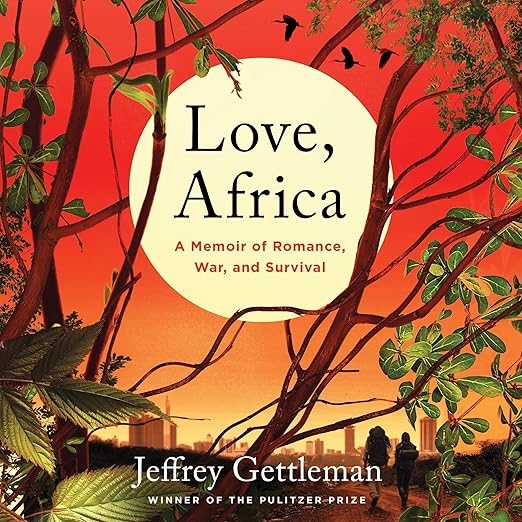
Jeffrey Gettleman's Love, Africa arrives in audiobook form, read by Charlie Thurston, as one of the more structurally honest foreign correspondent memoirs in recent years: it refuses to let the continent be merely a backdrop for a man's professional self-actualization. Gettleman won the Pulitzer Prize in 2012 for his East Africa coverage for the New York Times, and this 11-hour-and-56-minute listen is his account of how he got there, to Nairobi, to the bureau chief post, to the Pulitzer, and what the getting cost him personally over more than a decade of divided loyalties. The 4.5 rating across nearly 1,000 reviews reflects a book that rewards listeners who come for the journalism and stay for the harder, more private accounting.
The Verdict, Briefly
The book's central tension is announced in its title: two loves, not one. Africa was Gettleman's adolescent dream, imprinted after a community service trip at nineteen that showed him a continent in the throes of change that he could not stop thinking about. Courtenay, the Cornell student who became his long-term partner and eventually his wife, was the other claim on his life, a fierce, accomplished lawyer who built her career in America while Gettleman spent a decade chasing assignment to Nairobi. The audiobook is an account of how these two loves pulled in opposite directions for years before he found a way, finally, to stop choosing between them and inhabit both fully.
Reviewer John Beckham noted that Gettleman's insights into the mechanics of journalism fill the book, how trust transfers between reporters, how sourcing actually works in conflict zones, how the profession selects for specific personality types who can function under sustained moral pressure. These passages are among the most valuable in the audiobook for listeners who want to understand how foreign correspondence actually functions rather than how it looks from the outside. Gettleman covers Afghanistan, Iraq, and the Congo in addition to his sustained East Africa assignment, and his account of building the reporting relationships that sustained the Nairobi bureau's work across multiple crises, Darfur, Somalia's famine, the LRA atrocities in Uganda, reads as both professional memoir and survival manual for maintaining one's humanity in the proximity of sustained violence.
Why Love, Africa Works as an Audiobook
Charlie Thurston's narration holds the book's dual registers without collapsing them. Gettleman's writing moves between intimate relationship memoir, the long-distance periods with Courtenay, the marital strains that coverage of violence and instability creates, the parenthood that eventually provides a different kind of anchor, and the outward-facing prose of a reporter describing what he witnessed in the field. These are genuinely different modes, and Thurston navigates the shift without losing the listener in the transition. The Africa passages are read with the measured attentiveness they deserve; the relationship passages with a slightly warmer cadence that makes the personal cost of the professional ambition feel concrete rather than abstract or self-aggrandizing.
One reviewer found the book's first third paced more slowly than the rest, noting that the early chapters covering Gettleman's undergraduate years and first Africa trip take time before the adult reporter emerges. That pacing concern is accurate. The book is structured as a coming-of-age account, which means the formative years receive the attention that formation requires, and the payoff, the East Africa bureau work, the Pulitzer coverage, the eventual integration of the two loves, arrives in a second half that accelerates substantially. The more impatient listener should know that the first third is not throat-clearing; it establishes the depth of both loves so that the conflict between them in the middle section carries the weight it needs to.
Points to Consider
Gettleman is unusual among foreign correspondents for the degree of self-examination he applies to his own blind spots and choices. He does not spare himself on the Courtenay relationship, acknowledging that his decade of wavering between Africa and their shared life was not fair to her. He does not present his Pulitzer-winning journalism as uncomplicated professional achievement. The coverage of the Darfur conflict, the Somalia famine, the LRA atrocities in Uganda, these are not presented as career highlights but as experiences that required a specific moral accounting about what it means to witness and report suffering rather than preventing it. That accountability is rare in the genre and gives the audiobook an honesty that distinguishes it from the standard foreign correspondent memoir, which tends to dwell on the adventure and elide the cost.
Reviewer Adam noted pacing unevenness alongside praise for the "philosophical ponderings" about Africa, and that combination of admiration and critique feels like an accurate description of a book that earns its emotional reach through honesty about its subject's limitations. Gettleman is not a perfect man or a perfect journalist. He is a man who wanted two things and needed most of his adult life to figure out that wanting both does not make you dishonest, but that failing to be honest about how much you want them does. The memoir is the long accounting of that lesson.
Should You Listen to Love, Africa?
This audiobook is essential for readers interested in African political history from the 1990s through the 2010s who want a personal guide through the region's major conflicts rather than a straightforward policy analysis. It works equally well for listeners interested in the mechanics of war correspondence and the professional culture of elite journalism, what it actually requires of the people who do it and what it takes from them. Readers who came for the travel memoir dimension, the particular rendering of Nairobi, the specific East African landscapes, will find those passages throughout. Those expecting a straightforward love story in the romantic sense should recalibrate: this is a love story, but Gettleman's Africa love is as complicated and demanding as any human relationship, and the book treats it with equivalent seriousness.
Quick Take
- Voice: Charlie Thurston navigates the memoir's dual registers, war correspondence and intimate relationship history, with a shift in warmth that keeps both modes credible across nearly 12 hours.
- Big ideas: Divided loyalties between calling and commitment, war journalism and its personal costs, the imprint of Africa on a young correspondent's imagination
- Atmosphere: Reflective and honest, with the pacing of a memoir that earned its conclusions the hard way
- Worth it?: Gettleman's account of finding both his calling and his marriage in the same decade is the foreign correspondent memoir that most honestly reckons with what the job actually costs.
A Few Questions About Love, Africa
Is the Love, Africa audiobook good for listeners interested in journalism as a profession?
Strongly yes. Reviewer John Beckham specifically noted how Gettleman's insights into the mechanics of trust between reporters and the realities of sourcing in conflict zones fill the book, making it as useful as a professional document as it is as memoir.
Does the Love, Africa audiobook move slowly in its early sections?
The first third, covering Gettleman's undergraduate years and first Africa trip, is more measured in pace. One reviewer specifically noted this. The payoff in the later chapters, the bureau work, the Pulitzer coverage, the resolution of the two loves, is worth the investment.
How does Charlie Thurston's narration handle the Africa travel passages in the Love, Africa audiobook?
Thurston reads the Africa descriptions with measured attentiveness and gives the relationship passages a slightly warmer tone, tracking the writing's own shifts in register. The transition between modes is smooth enough that the listener rarely notices the pivot.