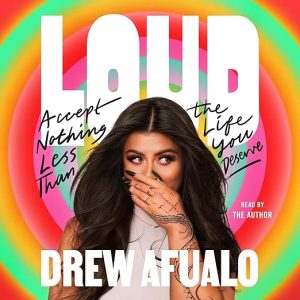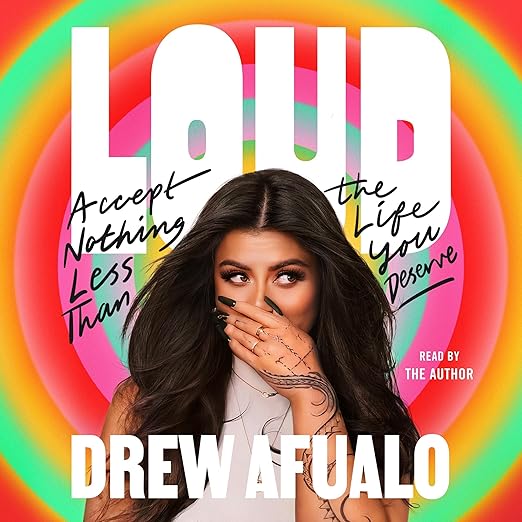
I had seen clips of Drew Afualo online before I listened to Loud, and I went in with a specific assumption about what the audiobook would be: sharp, funny, weaponized against misogyny, probably a lot like extended social media content in book form. What I did not expect was the vulnerability. About a third of the way through, Afualo starts talking about the parts of herself she does not share on her platforms, and the tone shifts in a way that is genuinely affecting. That shift is what makes this more than a very entertaining content creator's memoir.
Afualo built her following on TikTok and Instagram by confronting men who were making sexist, racist, and fat-phobic content. Her laugh, the sharp signature laugh that closes most of her videos, became an internet shorthand for a specific kind of feminist accountability. By 2024, when this audiobook was published by Macmillan Audio under the AUWA Books imprint, she had over nine million followers and a platform that had become its own cultural institution. Loud is where she explains the philosophy behind the platform rather than simply demonstrating it.
The book's structural description as part manual, part manifesto, part memoir is accurate, though the proportions shift across chapters. The manifesto sections engage directly with the problem Afualo identified in 2020: men creating sexist content were not simply being offensive, they were producing a sustained argument that women should define themselves in relation to male approval. Her counter-argument is not simply that this is wrong but that it is architecturally damaging, a structural interference with how women build self-concept from the inside.
The manual sections follow from this diagnosis. Afualo offers practical approaches to dismantling the habit of centering male perspective in self-evaluation, and the specificity here is more useful than most self-help writing in this space. She draws on her own experiences with fatphobia and online abuse rather than abstract recommendations, which gives the advice a grounded quality that motivational frameworks typically lack. One reviewer noted that the book helped with social anxiety in concrete ways that persisted after listening, which is a different and more durable kind of endorsement than simply calling it inspiring or empowering.
The Strengths
The memoir sections are where Loud earns its most distinctive quality. Afualo has strong platform boundaries about what she shares publicly, and the audiobook represents a deliberate choice to go behind those boundaries. The passages about family, about the experiences that formed her before she became the Crusader for Women, and about the doubt that coexists with the fierce public persona, these are worth the price of admission regardless of how you feel about her social media content.
One reviewer described coming away with renewed passion to be wholly themselves in every way. Another bought both the audiobook and a physical copy because the material felt important enough to have in multiple forms. That kind of dual-format purchase is meaningful data about what the content actually delivers versus what it promises. Afualo does not perform invulnerability here. The book is honest about the personal cost of occupying the role she has built, and that honesty does more work than any number of declarative statements about self-confidence ever could.
Things to Know Before Starting Loud
The audiobook format is the right primary format for this text. Afualo's voice carries rhythms and emphases that a page cannot reproduce, and the sections where her humor surfaces most powerfully, particularly the passages about the specific behavior patterns of the men she confronts online, land with timing that depends entirely on live delivery. The six-hour-forty-eight-minute runtime moves quickly, and the new afterword added to this edition offers genuine updating of the conversation the book started at initial publication. A 4.6 rating across 952 reviews reflects an audience that found both the manifesto and the memoir layers effective and worth returning to.
It is also worth noting how the book handles social media culture as a subject rather than simply as a platform. Afualo has spent years in that environment and understands its mechanics with unusual clarity. The sections where she analyzes why misogynistic content spreads, how the algorithms interact with outrage and shame, and what it means to build a counter-presence in that space are among the sharpest media criticism you will find in a memoir format. This is not an accident. Afualo is not simply recounting her experiences. She is analyzing the structures that made those experiences possible and offering a framework for navigating them. That analytical layer is what separates Loud from the large category of empowerment memoirs that describe the problem without examining its architecture.
The new afterword is also, in a quiet way, a document about what happens when a cultural moment gets crystallized into a book. Afualo reflects on what has changed since Loud first appeared and what has remained stubbornly the same, which is itself an argument about the durability of the structural problems the book diagnoses. The men she confronted online were not exceptional. They were representative. And the platform she built was not simply a viral success story but a response to conditions that had been in place long before social media and that will require ongoing work rather than a single cultural intervention to genuinely shift. The afterword is brief, but it adds a dimension to the book that the main text alone could not provide.
Recommended For
Loud is most directly addressed to women and femmes, particularly those who have spent significant time measuring themselves against standards they never chose. The practical sections work for any reader working on self-confidence, but the memoir sections are specifically rooted in Afualo's experience of existing as a large, Samoan woman in public life. Listeners who come for the social media firebrand may be surprised by the introspection. Listeners who come for depth will find more of it than the platform persona might lead them to expect.