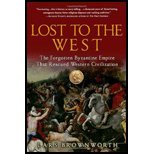
I studied history at university and came away with approximately six lectures worth of Byzantine Empire, crammed into the tail end of a Roman history survey course as though the eastern empire's survival for a thousand years after Rome's fall was a minor administrative detail. Lost to the West was my proper introduction to what I had missed, and I have been recommending it to people with similar gaps ever since. Lars Brownworth does something rare for a popular historian: he writes with genuine urgency about a subject that most of his readers have been trained to overlook.
The premise of the book is stated plainly in its title and its argument. The Byzantine Empire was not a declining remnant of Rome. It was a living, adapting civilization that preserved ancient knowledge, held the eastern Mediterranean against successive waves of would-be conquerors, and shaped the course of European history in ways that Western historiography consistently undervalues. Brownworth intends to correct this omission, and he does so with the kind of focused energy that makes popular history actually worth reading.
What We Made of It
Brownworth's central argument, developed through successive biographical chapters on key Byzantine emperors and historical moments, is that the Byzantine Empire served as a bulwark that made the Western European Middle Ages possible. While Charlemagne was building the early Frankish kingdom on the ruins of Roman administrative structures, Constantinople was maintaining the full weight of classical Greek and Roman learning, keeping it intact against the disruptions that might otherwise have destroyed it permanently.
This argument is not new to Byzantine historians, but Brownworth makes it vivid for a general audience by grounding it in specific figures and moments. Justinian's attempted reconquest of the western empire, Heraclius's extraordinary campaigns against the Sassanid Persian empire, the successive crises of the dark seventh century when Arab conquests stripped away North Africa and Syria and left Constantinople nearly isolated. These are stories with genuine dramatic stakes, and Brownworth understands that history needs human protagonists to sustain a listener's attention across ten hours of audio.
Why Listen to Lost to the West
The decision to have Brownworth narrate his own work is the right one here. He is not a professional voice actor, and his delivery occasionally has the texture of a very good lecture rather than a polished studio performance. But his familiarity with the material produces something no professional narrator could replicate: the sense of a scholar who genuinely cares about these events and these figures, who has lived with them long enough to know which moments deserve to be lingered over and which should be moved through quickly.
Brownworth's podcasting background, which predates and in some ways gave rise to this book, means he is comfortable with extended spoken explanation. He does not write in the compressed academic style that makes some history books torture to hear read aloud. His sentences are built for the ear as much as the eye, which is a real skill and not a common one among historians. The result is a listening experience that rewards sustained attention without demanding the kind of concentration that densely academic audio can require.
What Might Not Land
The available synopsis for this audiobook is thin, which means prospective listeners are largely relying on the book's strong reputation and Brownworth's established credibility. What I can add is that the book proceeds roughly chronologically from Constantine through the fall of Constantinople in 1453, organized around individual rulers rather than strict linear chronology, which is a structural choice that makes the material more emotionally accessible at the cost of some historical precision. You understand the Byzantine Empire as a series of extraordinary human stories rather than as a set of institutional developments. For a general listener, this is the correct trade-off.
Brownworth is honest about this approach's limitations. He is not trying to replace academic Byzantine history. He is trying to create the conditions under which a general reader might want to pursue that academic history. The 4.5 rating from nearly two thousand listeners suggests the book succeeds at exactly this goal, which is arguably harder than writing rigorous scholarship because it requires making a case for why something matters to people who have not yet decided that it does.
Who Should Pick Up Lost to the West
Lost to the West is genuinely for everyone with an interest in history and a willingness to discover that the thousand years between Rome's fall and the Renaissance were considerably more eventful and interesting than the standard Western curriculum suggests. It is particularly valuable for listeners who loved Edward Gibbon's framing of Byzantine history as decline and fall and want to encounter the serious scholarly counterargument to that influential but misleading narrative.
Specialist Byzantine historians will find Brownworth's coverage necessarily simplified, and they will know the stories already. This is explicitly popular history for a general audience, and it should be evaluated on those terms. For that audience, it is close to an ideal introduction: engaging, well-narrated, and appropriately urgent about a subject that deserves far more attention than it receives. At just over ten hours, the runtime is proportionate to the ambition of the project.
In Brief
- Narrator: Lars Brownworth narrates his own work, and his academic familiarity with the material comes through as genuine engagement rather than performance; the self-narration works particularly well for a history built on personal research.
- Subjects: Byzantine persistence and adaptation, the forgotten half of Rome, how civilizations survive through reinvention
- Tone: Revelatory and quietly urgent, with the energy of an author genuinely frustrated that this story isn't better known
- Tone: Revelatory and quietly urgent, with the energy of an author determined to restore a forgotten civilization to its proper place in the Western imagination
- Bottom line: An essential correction to the historical blind spot that treats Byzantine history as a footnote; accessible and compelling for anyone curious about a thousand years of history the West has largely ignored.
Do you need any background in Roman history before listening to Lost to the West?
Brownworth assumes no specialist knowledge. He provides enough context at the start to orient readers unfamiliar with how the Eastern Roman Empire emerged from the Roman Empire's division, and he builds from there. A general interest in history is sufficient preparation.
How does Lars Brownworth's self-narration compare to his podcast style?
Listeners familiar with Brownworth's 12 Byzantine Rulers podcast, which preceded this book, will find his narration consistent with that audio style: clear, engaged, and more conversational than a typical professional narrator while remaining entirely accessible.
Is this the same content as Lars Brownworth's Byzantine history podcast?
Lost to the West as a book expands substantially on the material from the 12 Byzantine Rulers podcast and is organized differently, with deeper contextual coverage. It is a more comprehensive and polished version of those ideas rather than a simple repackaging of podcast episodes.