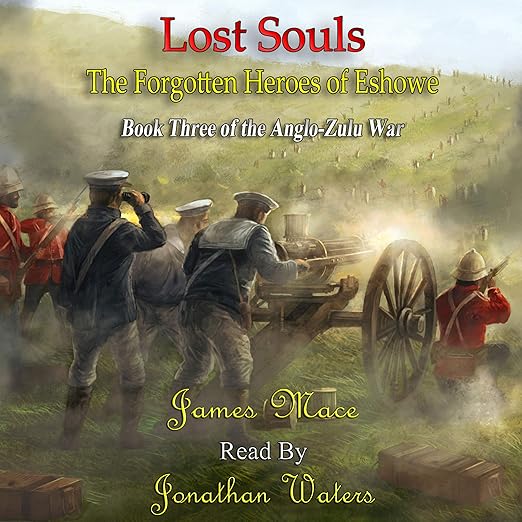
Quick Take
- Narration: Jonathan Waters delivers Mace’s dense regimental history with measured authority, handling both British officers and Zulu perspectives with equal steadiness.
- Themes: Siege warfare, imperial overreach, forgotten campaigns of the Anglo-Zulu War
- Mood: Claustrophobic and rain-soaked, with the slow dread of encirclement
- Verdict: The third book in Mace’s Anglo-Zulu War series pays close attention to the officers and men trapped at Eshowe, a campaign that rarely gets its due outside specialist circles.
I came to this one mid-series, which is probably the wrong way to approach James Mace’s Anglo-Zulu War sequence. I had enough background from the first two entries to follow the thread, but I spent the opening hour orienting myself in a way that listeners who started with the first book simply won’t have to. That said, by the time the rain-soaked column of Colonel Pearson was slogging through the coastal hills toward Eshowe, I was fully in it. I listened to the bulk of this on a series of grey November evenings that felt, in some small meteorological sympathy, appropriate.
Mace has built his reputation on making Victorian military history feel inhabited rather than merely documented. That quality is very much present here, and Jonathan Waters’ narration suits the register, measured, never theatrical, with enough variation to keep eighteen hours of regimental campaigning from becoming monotonous. What makes Lost Souls distinctive within the series is its focus on stasis. Where the earlier volumes follow the kinetic disaster at Isandlwana and the desperate stand at Rorke’s Drift, this book is about waiting, about the particular psychological weight of being cut off, supplied by rumor, and uncertain whether relief will ever arrive.
The Siege That History Forgot
The garrison at Eshowe is genuinely underappreciated in the popular record. Isandlwana and Rorke’s Drift have been dramatized, analyzed, and adapted repeatedly since the 1964 film Zulu. Eshowe barely registers in popular consciousness, despite the fact that over a thousand British soldiers spent months behind its earthworks, watching the road south for a relief column that took far longer to arrive than anyone hoped. Mace’s achievement here is making the reader feel the accumulation of days: the dwindling rations, the outbreak of disease, the grinding uncertainty as to whether what happened to the central column would now happen to them. He is careful to distinguish this from romanticized siege narratives. The soldiers at Eshowe were not particularly heroic in the storybook sense, they endured, which is a quieter and in some ways more demanding thing.
Chelmsford’s Race Against His Own Catastrophe
The parallel narrative following Lord Chelmsford’s attempts to rally reinforcements and organize a relief column provides the book’s structural spine. Mace is even-handed in his treatment of Chelmsford, neither the villain of revisionist readings nor the capable general his supporters claimed. What comes through clearly is the institutional machinery of Victorian Britain grinding into emergency gear: the political embarrassment of an unauthorized war, the logistical nightmare of moving troops from England to southern Africa, and the clock ticking against the men trapped behind Pearson’s earthworks. Reviewer Bob Jarvis notes that Mace brings the story to life while staying tightly anchored to actual events, and this tonal discipline is what separates the series from more indulgent historical fiction. The invented characters feel plausible within the documented record rather than pulling attention away from it.
Where Waters’ Narration Earns Its Keep
Jonathan Waters has now narrated all three entries in this series, and the accumulated familiarity pays off. His handling of the Zulu perspective, commanders, warriors, the king’s court deliberations, carries genuine weight without sliding into caricature. His British officers are distinct without being parodied. The pacing of his delivery suits Mace’s tendency toward dense tactical exposition; Waters doesn’t rush through troop movements and column positions the way a less attentive narrator might. At seventeen-plus hours, this is a commitment, and a narrator who treated the logistics sections as something to get through would undermine everything Mace is trying to accomplish. Waters doesn’t. Listener Brian Campbell’s observation that the series rewards those who have followed from the beginning applies double to the audio experience: the narrator’s familiarity with the material compounds across volumes.
Who Should Listen, Who Should Skip
If you’ve read or listened to the first two books in the Anglo-Zulu War series and want to continue the campaign, this is exactly what you’re looking for. Listeners with a serious interest in Victorian-era military history who find the Isandlwana-Rorke’s Drift axis somewhat well-trodden will find that Mace’s focus on the forgotten Eshowe garrison makes this a meaningful supplement to more canonical accounts. Skip it if you haven’t read books one and two, the series is designed to be followed in order and the emotional weight of the siege depends on events established in earlier entries. Also skip if you’re looking for something pacier; this is deliberate, immersive historical fiction that trusts the listener to find the drama in endurance rather than action.
Frequently Asked Questions
Do I need to have listened to the first two books in the Anglo-Zulu War series before starting this one?
Yes, strongly. The series follows a continuous timeline from the outbreak of the war, and the emotional stakes of the Eshowe siege depend on knowing what happened at Isandlwana and Rorke’s Drift. Start with Brutal Valour (Book 1).
How accurate is Mace’s account of the Eshowe siege compared to historical records?
Reviewers consistently note that Mace stays tightly anchored to documented events and actual historical figures. He adds fictional characters to humanize the experience, but the strategic situation, troop movements, and senior officers are drawn from the historical record. Bob Jarvis, a reviewer with substantial knowledge of the war, confirms the accuracy.
Does Jonathan Waters narrate this the same way as the earlier books in the series?
Yes, Waters has narrated all entries in the Anglo-Zulu War series, and listeners who followed from book one will find his voice immediately familiar. His handling of both British and Zulu characters is consistent throughout.
Is the Eshowe siege a major or minor event in the wider Anglo-Zulu War?
Significant but often overlooked. While Isandlwana and Rorke’s Drift dominate popular accounts, the siege of Eshowe kept over a thousand British soldiers pinned down for months and forced Chelmsford to mount a major relief operation, which is itself a substantial portion of this book.