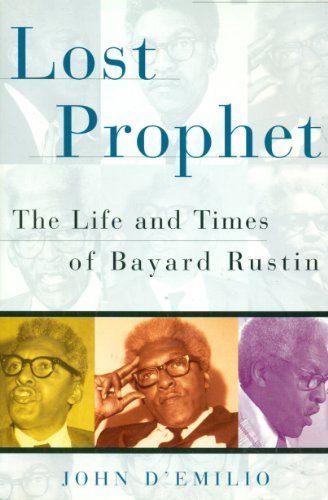
Scott R. Pollak narrates John D'Emilio's Lost Prophet, a twenty-hour biographical audiobook study of Bayard Rustin, one of the most consequential and deliberately forgotten figures in twentieth-century American civil rights activism. D'Emilio is a historian whose scholarly background in the intersection of sexuality and politics makes him precisely the right person to write this particular life: Rustin was an openly gay Black man in an era when that combination made him both dangerous to his political allies and invisible to mainstream historical accounts. The biography functions simultaneously as civil rights history, political philosophy, and an extended examination of the gap between a movement's stated ideals and its willingness to protect its own members when protection became politically costly.
Facts as the Argument, Delivered Without Inflection
Rustin's erasure from popular civil rights memory was not accidental and not a matter of historical oversight. He was the chief organizer of the 1963 March on Washington, the man who essentially introduced Martin Luther King Jr. to the tactical framework of nonviolent direct action through his own training with followers of Gandhi's methods, and a strategic intelligence whose influence on the movement was foundational rather than peripheral. He was also gay, a fact that his colleagues, including Adam Clayton Powell, used explicitly as leverage to remove him from public visibility when his presence became politically inconvenient for the movement's presentation to mainstream audiences.
D'Emilio does not soften this history or present it with the kind of retrospective sympathy that allows readers to maintain comfortable distance. The biography documents in precise detail how the civil rights establishment chose respectability politics over its own stated principles, repeatedly, when Rustin's sexuality could be weaponized against the movement by its opponents. Pollak's narration of these sections is notably restrained; he delivers D'Emilio's documented account without editorial inflection, which is the right approach for material where the facts themselves are the argument. A more theatrical performance would have made the biography feel like advocacy rather than scholarship.
At twenty hours, this audiobook is a serious commitment of time and attention. D'Emilio earns that commitment because he is not padding the biography with anecdote or rhetorical flourish. He is building a complete account of a life that partial tellings have consistently misrepresented, and the length reflects that ambition. Pollak maintains the quality of his delivery across the full runtime without the kind of fatigue that sometimes becomes audible in very long biographical recordings.
A Life Conducted Through Persuasion, Reactivated by Narration
The biographical audiobook format is particularly well suited to Rustin's story because so much of his life was conducted through direct personal persuasion, conversation, and the kind of charismatic presence that contemporary accounts describe as transformative. Rustin was a gifted public speaker and organizer who worked primarily through human connection rather than institutional power, and a well-paced audio narration reactivates something of that quality in ways that silent reading cannot quite replicate. Pollak's measured delivery across the twenty hours provides the kind of sustained attention that the subject's complexity genuinely requires.
D'Emilio's academic background as a historian of sexuality gives the biography an intellectual precision that goes beyond standard civil rights narrative structure. He situates Rustin's life within the development of the American labor movement, the peace movement, and the emerging gay rights activism, showing how these overlapping commitments made Rustin more politically radical than most of his contemporaries and more vulnerable to the institutional abandonment that ended his most visible phase of organizing. That contextual breadth is what distinguishes this biography from a simpler inspirational account of personal courage against discrimination.
Organizing 250,000 People Before Contemporary Communication
Pay particular attention to the sections covering Rustin's years with the War Resisters League and his involvement in early African independence movements during the late 1950s and 1960s. These are the chapters where D'Emilio establishes the full international scope of Rustin's political thinking, which extended well beyond American domestic civil rights concerns and was consistently more globalist and anti-imperialist than his colleagues were comfortable acknowledging publicly. Understanding this wider ideological framework makes the later marginalization more comprehensible: the civil rights establishment needed Rustin's tactical expertise for specific campaigns but not his fully developed political analysis, and the relationship was always conditional on his willingness to stay within boundaries that the movement's mainstream leadership had unilaterally defined.
Pollak's narration of the 1963 March on Washington sequences is some of the most compelling audio in the full twenty hours. D'Emilio documents the logistical achievement of organizing 250,000 people through methods that predated contemporary communication infrastructure by decades, and the scale of what Rustin accomplished while simultaneously being positioned as a potential liability by the movement's most prominent public faces is genuinely astonishing when laid out in complete documented detail. The section also illuminates the specific mechanics of how Rustin was kept out of the public imagery of an event he was primarily responsible for creating, which is one of the most striking episodes in the biography.
The chapters covering Rustin's later career, after his most visible phase of civil rights organizing had been effectively ended, trace his evolution toward labor movement work and eventually toward the emerging LGBTQ rights advocacy of the 1970s and 1980s. D'Emilio handles this material without the biographical sentimentality of a narrative that needs its subject to be purely heroic. Rustin's political positions in his later years were contested within the left, and the biography does not smooth over those debates in the service of a simple rehabilitation arc.
Sustained Attention for One Specific Figure
Listeners interested in American civil rights history who want to engage with accounts beyond the most familiar canonical narratives will find this biography essential background material for understanding the movement's full complexity. Those drawn to the intersection of race, sexuality, and radical politics in twentieth-century America will find D'Emilio's framing rigorous and intellectually sustained throughout the full runtime. Skip this audiobook if you are looking for an introductory survey of the civil rights movement; Rustin's story is a deeply specific engagement with a particular figure's life and politics, not an overview. The twenty-hour commitment requires sustained attention that casual listeners may find difficult to maintain across multiple sessions. Those who stay with it receive what the biography's title promises: a complete account of one of American history's most unjustly obscured political figures, restored to the full complexity of his actual life.
Key Details
- Narration: Scott R. Pollak handles this twenty-hour biography with the steady, measured delivery that serious historical biography requires, keeping the material accessible without simplifying the intellectual and political arguments at its core.
- Themes: Radical activism and institutional marginalization, sexuality and politics in mid-century America, the cost of ideological consistency
- Mood: Scholarly and serious, with the weight of a life examined unflinchingly
- Verdict: A rigorous, substantial biography that rewards patient listeners interested in the more complicated and deliberately overlooked figures of civil rights history.
Before You Listen
How does Scott R. Pollak's narration hold up across this twenty-hour audiobook?
Pollak maintains consistency across the full runtime without the audible fatigue that sometimes appears in very long biographical recordings. His delivery is measured and clear throughout, suited to D'Emilio's academic prose style without dramatizing the material in ways that would undermine its scholarly authority.
Does this audiobook cover Rustin's role in both civil rights and LGBTQ rights history?
Yes. D'Emilio traces Rustin's life from his Quaker upbringing through his civil rights organizing and into his later advocacy within emerging LGBTQ rights movements in the 1980s. The biography addresses both the suppression of his public role and his eventual rehabilitation as a historically significant figure across multiple overlapping social movements.