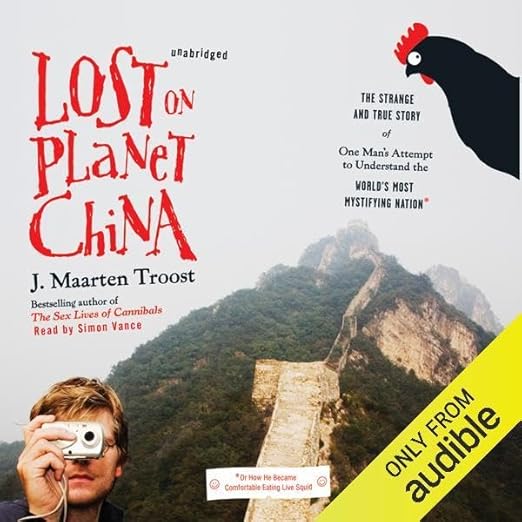
Quick Take
- Narration: Simon Vance brings polished, authoritative delivery to Troost’s comic voice, an interesting pairing that occasionally makes the gonzo observations sound more measured than the prose intends.
- Themes: Cross-cultural bewilderment, the tension between rapid development and ancient tradition, a Westerner’s honest confusion
- Mood: Irreverent, surprising, and frequently very funny
- Verdict: Troost’s China travelogue is an unapologetically gonzo journey through a country that defies easy summary, and it has aged better than most books of its kind.
I was halfway through my morning commute when Troost described eating yak in Tibet and then immediately pivoting to a meditation on the cattle penis with garlic he had encountered on a restaurant menu the previous evening, and I laughed loudly enough that a man across the subway car looked up from his phone. Lost on Planet China is that kind of book: the humor arrives without warning and hits harder than you expect, and then five paragraphs later Troost is making a genuinely astute observation about Chinese urban development that you want to write down somewhere.
J. Maarten Troost built his reputation on two previous books about Pacific island life, The Sex Lives of Cannibals and Getting Stoned with Savages, both of which deployed the same formula: put a somewhat unprepared Western writer in a radically unfamiliar environment, observe what happens to his assumptions, and report back with honesty and comic timing. China presented a different kind of challenge. It is not remote or small. It is the most populous nation on earth, a country that was simultaneously ancient and undergoing the fastest large-scale urbanization in human history at the time Troost visited. The book was published in 2008, which means the China it describes was at the inflection point between its rise and its arrival.
The Comic Method and Its Serious Subtext
Troost’s humor works because it is never contemptuous. He is not the Western tourist sneering at unfamiliar customs; he is the Western tourist genuinely bewildered by a culture he cannot decode, and the bewilderment is reciprocal. China confuses him. He confuses China. The comedy emerges from that mutual incomprehension rather than from any sense of superiority, and it is this quality that has made his books more durable than the genre average.
A reviewer who claimed to have read thirty or forty books about China in two decades described Lost on Planet China as one of the only ones that kept them totally involved across all of its pages. That is significant testimony. The China travel memoir is a crowded genre, and Troost distinguishes himself by refusing to be authoritative. He does not understand China. He says so, repeatedly, and the honesty is more illuminating than most confident pronouncements. He is dodging deadly drivers in Shanghai, visiting Chairman Mao’s preserved body, and deciphering menus that defeat him completely, and none of it is performed for the reader’s entertainment alone.
Simon Vance and the Problem of Comic Narration
Vance is one of the most technically accomplished narrators in the audiobook industry. His voice has a gravitas that serves historical fiction, military history, and literary adaptation with equal authority. Lost on Planet China presents a different demand: Troost’s prose is wry, self-deprecating, and built for comedic timing. Vance handles it with competence but occasionally irons out the crinkles in passages that benefit from a looser, more informal delivery.
This is a genuine but mild limitation. The writing is funny enough that it survives a slightly too-composed reading, and Vance’s clarity is an asset during the more complex passages about Chinese urban planning, political history, and regional geography. The chapter on Beijing in particular, where Troost grapples with the city’s Olympic-era transformation, benefits from Vance’s more grounded register. The broader travelogue sections, the restaurant disasters, the traffic near-misses, the encounters with Mao’s preserved remains, would have popped with a narrator who allows themselves more comedic latitude.
The China on These Pages vs. the China Now
Any 2008 China travel memoir carries the weight of what has happened since. The country Troost describes was still in the process of becoming something that neither Troost nor anyone else could fully anticipate. He makes observations about Chinese politics and society that have since been complicated, confirmed, or overtaken by events. Reading this book in the present tense requires some tolerance for the specific historical moment it captures.
That said, the cultural observations most rooted in history rather than the political moment remain accurate and often illuminating. Troost’s visit to Tibet and his description of the contrast between the region’s ancient texture and the Han Chinese administrative presence is one of the sharper passages in the book. His observations about the pace of Shanghai’s transformation, the literal daily disappearance of old neighborhoods, were prescient about forces that have only accelerated in the years since.
What Troost Does Best
Troost is at his best when he abandons any pretense of comprehensive understanding and simply reports what he sees, tastes, smells, and nearly gets hit by in the street. A reviewer in France noted they had actually traveled many of the same routes and found Troost’s account capturing something true about the experience. That is the ultimate test of travel writing: whether someone who knows the territory independently recognizes the portrait.
Lost on Planet China will not teach you everything about China. It will give you a specific perspective on a specific country at a specific moment, told by a writer with an excellent comic gift and enough self-awareness to know the limits of what he can claim. For listeners who want honest, funny company for an imaginary journey through one of the most consequential countries on the planet, this remains a reliable choice.
Simon Vance’s narration, despite its occasional over-composure, does serve the book in one important respect: it prevents Troost from tipping into the kind of broad comedy that can reduce travel writing to a series of punchlines. The slight formality in Vance’s reading keeps the book’s more serious undercurrents audible. When Troost is genuinely unnerved by something, whether the sheer scale of Beijing’s Olympic transformation or the abrupt transition between Tibet’s ancient monasticism and its administered modernity, Vance lets those moments land with appropriate weight rather than rushing to the next comic beat.
Frequently Asked Questions
Does Lost on Planet China hold up now that it was written in 2008, given how much China has changed since?
The political and economic observations are of their moment and should be read with that context in mind. The cultural and sensory observations, particularly around food, regional geography, and the pace of urbanization, remain largely recognizable to travelers with recent China experience.
Is Simon Vance’s narration a good fit for Troost’s comedic travel writing style?
Vance is technically excellent but brings more gravity to the performance than Troost’s prose strictly requires. The humor survives his delivery, but listeners who have encountered Troost’s writing on the page may find the audio slightly more composed than the text warrants.
Is prior knowledge of Chinese history or culture necessary to enjoy this audiobook?
No. Troost explicitly positions himself as an outsider learning as he goes, and the book is accessible to listeners with no prior knowledge. It may actually work better for complete newcomers to the subject because Troost explains what he does not understand in ways that are useful for audiences who share his unfamiliarity.
How does Lost on Planet China compare to Troost’s Pacific island books in terms of tone and ambition?
China is a larger and more complex subject than a South Pacific atoll, and Troost’s ambition is correspondingly greater. The books share the same comic self-deprecating voice, but Lost on Planet China is more consciously a book about a transforming civilization rather than simply a personal adventure.