Quick Take
- Narration: Peter Ganim delivers a careful, authoritative performance suited to a history that covers five centuries of complex political and territorial terrain.
- Themes: Russian nationalism and imperial identity, the construction of historical narrative as a political tool, Ukraine and Belarus as contested territories
- Mood: Scholarly and urgent, a history that reads as current events even when published years before the events it anticipated
- Verdict: Essential listening for anyone trying to understand the ideological machinery behind Russian expansionism, from one of the foremost historians of Eastern Europe.
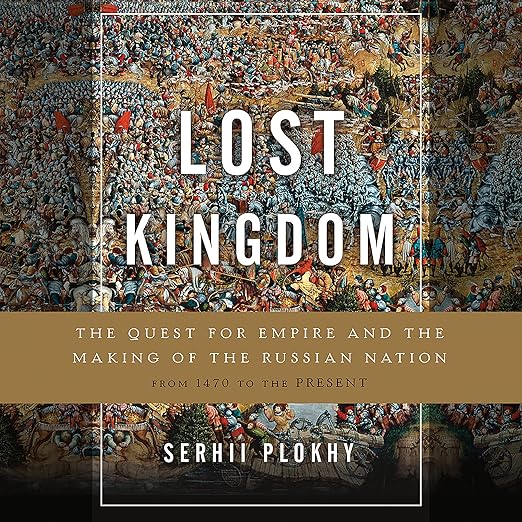
I started Lost Kingdom the week after a news cycle that had once again made Russia’s stated historical claims about Ukraine the subject of widespread debate. Serhii Plokhy published this book in 2017, a few years after the annexation of Crimea and before the full-scale invasion of 2022, but its analysis reads with an urgency that only deepens in retrospect. The prizewinning author of Chernobyl had already established himself as the most important English-language historian of Eastern Europe working today. This is the book that most directly addresses the ideological architecture of Russian imperialism.
Plokhy’s argument is foundational: to understand what Russia is doing now, you have to understand what Russia has believed about itself for five hundred years. Lost Kingdom traces that belief system from the end of Mongol rule through Ivan the Terrible, through the various iterations of the Romanov empire, through Soviet nationality policy, and up to Putin’s deployment of pan-Russian identity as justification for territorial ambition. The through-line is not a conspiracy. It is a set of ideas about who belongs to Russia, who Russia belongs to, and what the nation’s historical mission requires of its leaders.
Our Take on Lost Kingdom
What distinguishes this book from other accounts of Russian history is its willingness to treat the historical narrative itself as a political object. Plokhy is a professor of Ukrainian history at Harvard, and he writes with clear awareness of how historiography functions as an instrument of power. The stories that Russians have told about their origins, the Rus, Kyiv as the mother of Russian cities, the idea of a pan-Slavic civilization in which Ukrainians and Belarusians are essentially Russians who got geographically separated, are examined here as constructions, not facts.
This is scholarly work that does not sacrifice accessibility. One reviewer described it as demolishing much misleading conventional wisdom about Russian history while being crisply written and readable. That is accurate. Plokhy writes for an educated general reader, not exclusively for specialists, and the sixteen-hour audiobook moves with a momentum that dense history does not always achieve.
Why Listen to Lost Kingdom
Peter Ganim’s narration is measured and authoritative, which suits a book covering five centuries without becoming breathless. History that spans from the 15th century to the present risks losing the listener in a blur of names, places, and dates, and Ganim’s clear articulation of the Eastern Slavic proper nouns, no small skill, keeps the narrative legible throughout. His pacing gives the listener time to absorb the analytical sections without making the narrative sections feel slow.
For listeners coming to this book specifically because of the Russia-Ukraine conflict, Ganim’s steady delivery is an asset. This is not a book that wants to feel like commentary. It wants to feel like scholarship, and the narration supports that register throughout the sixteen-hour run.
What to Watch For in Lost Kingdom
Plokhy is a Ukrainian-American historian writing about a subject in which Ukraine’s interpretation of history differs fundamentally from Russia’s. He does not disguise this orientation, he argues explicitly that the pan-Russian narrative is an imperial construct, not a historical truth. Readers who want a more Russia-sympathetic account of the same history will not find it here, and should probably be honest with themselves about whether the history or the comfort of a particular framing matters more to them.
The book’s scope is its ambition and occasionally its limitation. Five centuries is a lot of ground, and some periods receive more detailed treatment than others. The 20th-century Soviet section is particularly strong; some of the earlier medieval material can feel compressed. But the analytical architecture holds across the full span.
Who Should Listen to Lost Kingdom
Anyone trying to understand the ideological and historical context of Russian foreign policy toward Ukraine and Belarus, this is the most direct and scholarly available answer to that question in English. History readers who enjoyed Plokhy’s Chernobyl will find this a complementary and equally rewarding listen, though its register is more political and less narrative. Skip it if you want a straightforward political history without historiographical argument, but understand that the historiographical argument is the point of this particular book.
Frequently Asked Questions
Is Lost Kingdom directly relevant to understanding the current Russia-Ukraine conflict?
Yes, and in a remarkably precise way for a book published in 2017. Plokhy traces the ideological roots of Russian claims over Ukrainian territory across five centuries, which provides direct context for the arguments Putin has made to justify territorial ambition in the years since publication.
How does Serhii Plokhy handle the competing historical claims of Russia, Ukraine, and Belarus?
Plokhy argues explicitly that the pan-Russian historical narrative is an imperial construction, not a neutral account. He traces how leaders from Ivan the Terrible through Putin have shaped and exploited historical identity claims for political purposes. His perspective clearly supports Ukrainian sovereignty, which he does not disguise.
Does the book require significant prior knowledge of Eastern European history?
No. Plokhy writes for an educated general reader rather than specialists. The book provides enough context to be followable without prior expertise, though readers already familiar with Russian history will get additional value from the revisionist framing.
How does Peter Ganim handle the Eastern European proper nouns throughout the sixteen-hour audiobook?
Ganim navigates the Slavic names with care and consistency, which matters enormously for a book covering this geography. His articulation is clear enough that listeners can track the places and figures without losing the narrative thread across the full sixteen-hour runtime.