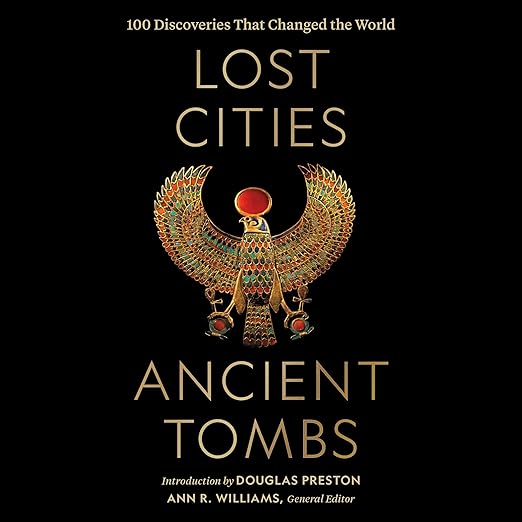
Quick Take
- Narration: Mari Weiss delivers a measured, documentary-style performance appropriate for a 100-entry anthology that spans continents and centuries.
- Themes: Archaeological discovery, the archaeology of empire, civilizational memory
- Mood: Expansive and episodic, like a museum you can wander through in any direction
- Verdict: A well-assembled compendium of a hundred extraordinary archaeological finds that works best as a session-listening reference, but the format rewards dipping in more than listening straight through.
I finished the chapters on Catalhoyuk and the Antikythera mechanism on a long train journey, and when I looked up the window I had completely lost track of where I was. That is the particular pleasure of Lost Cities, Ancient Tombs: the way each entry opens a window somewhere entirely different, and the cumulative effect of a hundred such windows creates something larger than any single story. Ann R. Williams, editing a volume originally published under the National Geographic banner, has assembled a survey that covers territory from the Dead Sea Scrolls to the City of the Monkey God, an extraordinary geographic and chronological range.
The structure is anthology. One hundred discoveries. Each one given enough space to establish what was found, how, and why it mattered, but not so much that the book loses its sense of forward motion. The archaeological discoveries include some of the most famous sites in human history alongside genuinely obscure ones, and it is often the obscure ones that are the most arresting. A reviewer who is a practicing archaeologist confirmed that the book holds up professionally. A nurse with no archaeology background loved it equally. That crossover is exactly what this kind of compilation aspires to and often misses.
How 100 Entries Become a Coherent Listen
The editorial logic that holds this together across 14 hours is thematic clustering rather than strict chronology. The discoveries are grouped in ways that generate meaningful resonance, burial practices across cultures, lost cities as a recurring phenomenon across distinct civilizations, the recurring drama of objects surviving their makers by thousands of years. This structure means you can listen sequentially and find a developing argument, or you can treat individual sections as standalone dips depending on your interest.
Reviewer Nikki Barry described it as offering plenty of subject matter to entice you to read further on your favorite subjects, which captures the book’s most useful function: it is a map of further reading as much as it is a self-contained work. Each entry points outward. If you get to the section on the Valley of the Kings and want to spend a week reading about New Kingdom Egypt, the book has done its job.
Print Reviews Contaminating the Audio Record
One of the posted reviews notes that the physical book is beautifully illustrated and nicely bound and describes buying it as a gift. This is a reminder that a significant portion of the review base for this audiobook is actually reviewing the print edition, which is a lavishly illustrated volume. The audio version does not have the visual apparatus, the photographs, the site maps, the artifact images, that give the print version so much of its impact. The audio is still worthwhile, but listeners should understand they are getting the text without its most significant supporting element.
Mari Weiss’s narration handles this limitation well in the sense that she does not rely on visual cues the listener cannot follow. The writing itself is strong enough to evoke the physical reality of the sites described. But for anyone drawn to this topic by a love of archaeological photography, print remains the more complete experience.
The 14-Hour Runtime and Session Listening
At just over 14 hours, this is a substantive listen. The hundred-entry structure means it lends itself to irregular sessions, you can stop mid-section, return days later, and not feel disoriented because each entry is self-contained. This makes it particularly well suited to commutes, travel, or the kind of diffuse listening that happens during long household tasks. It does not demand the sustained attention that a narrative history requires. It rewards curiosity rather than commitment.
Who Should Listen and Who Should Skip
Listen if you have broad interests across archaeological history and want a single, well-produced introduction to the major discoveries of the last century. It is also a strong choice for anyone who enjoyed visiting archaeological sites and wants deeper context for what they saw.
Skip if you are looking for a sustained narrative or an argument about any particular culture or period. This is breadth, not depth. Also keep in mind that the illustrated print edition offers a significantly richer experience for anyone who can engage with both formats.
Frequently Asked Questions
Is Lost Cities, Ancient Tombs organized chronologically or by region?
It is organized thematically rather than strictly chronologically or geographically. The anthology groups discoveries by type and significance, which makes it accessible to jump around but also coherent as a sequential listen.
Does the audiobook version suffer significantly from the loss of the physical book’s illustrations?
Yes, meaningfully. The print edition is a lavishly illustrated National Geographic publication. The audio version retains the narrative text but loses the site maps, artifact photographs, and visual context that give the physical book much of its impact.
Can individual sections be listened to out of order or does it require sequential listening?
Individual entries are fully self-contained and can be listened to independently. The anthology structure makes it well suited to session listening, you can return after days away without losing narrative thread.
Does the Dead Sea Scrolls discovery get substantial coverage given its historical significance?
The Dead Sea Scrolls are specifically mentioned in the synopsis as one of the landmark discoveries covered. Major finds receive proportionally more attention than minor ones, though the 100-entry structure means no single discovery gets exhaustive treatment.