Quick Take
- Narration: Mark Deakins is one of the most reliable narrators working in political nonfiction – steady, authoritative, calibrated to the analytical register Gordon writes in throughout.
- Themes: US foreign policy failure, the recurring logic of regime change, the gap between democratic ideals and imperial practice
- Mood: Rigorous and quietly devastating – the tone of a policy expert who has seen enough to stop being surprised
- Verdict: The clearest single account of why American regime-change operations in the Middle East have consistently failed, written by someone who was inside the rooms where those decisions were made.
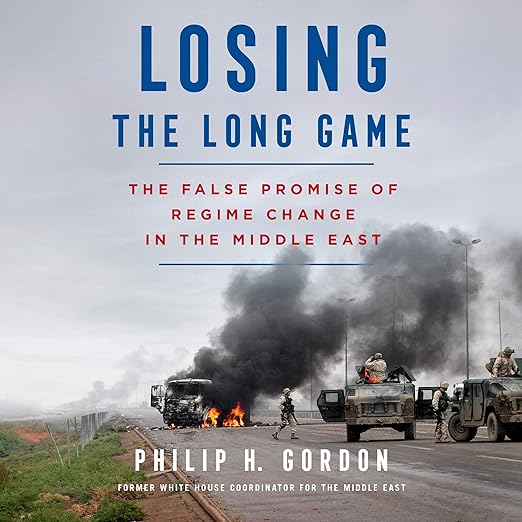
I was somewhere over the Atlantic, returning from a conference on international security, when I started Philip Gordon’s Losing the Long Game. I had about nine hours of flight time and a strong suspicion that this was the kind of book I should read without interruption. By the time we landed, I had finished it and spent the taxi ride home staring out the window, thinking about the difference between what American policymakers believed they were doing and what they actually produced.
Gordon’s argument is tight and damning. Since World War II, the United States has attempted to oust governments in the Middle East at roughly one-per-decade intervals: Iran in 1953, Iraq twice, Afghanistan twice, Egypt, Libya, Syria. The methods have varied enormously – from covert CIA operations to full-scale military occupation. What has remained constant, Gordon shows, is the outcome: regime change has never achieved its ultimate goals, has consistently produced unintended and catastrophic consequences, has cost staggering amounts in money and lives, and has often left the target countries measurably worse off than before the intervention.
Seven Cases, One Pattern
The book’s structure is its greatest strength. Gordon devotes a chapter to each major intervention, and by the time you have absorbed the third or fourth, the pattern becomes almost unbearably clear. Each operation begins with genuine grievances – and sometimes genuine threats – against an undemocratic or hostile government. Each is accompanied by optimistic projections about what a successor government would look like. Each encounters the reality that removing a regime does not automatically produce a democratic, pro-American replacement. And each generates blowback that costs more than the original problem would have.
The Iran chapter is as good as anything written on the 1953 coup, capturing the way a short-term tactical success planted the roots of the 1979 revolution. The Iraq chapters – Gordon covers both the first Gulf War’s aftermath and the 2003 invasion – are especially strong because Gordon was inside the policy process for part of the relevant period, serving as White House Coordinator for the Middle East from 2013 to 2015. He writes about decision-making at the highest levels with the specificity that only firsthand access provides, and he is honest enough to acknowledge the internal debates and the moments when the outcomes could have gone differently.
The Policy Trap Gordon Names
What makes the book more than a catalog of failures is Gordon’s sustained effort to understand why these interventions keep happening despite the track record. His answer is uncomfortable: the alternative to regime change – accepting the continued existence of hostile or repressive governments – always feels worse in the short term than the dream of replacing them. American policymakers are not stupid; they can read history. But the logic of the moment, the domestic political pressure, the availability of military tools, and the optimism that this time the conditions are different combine to produce the same choice again and again. Gordon calls this the false promise of regime change, and his analysis of why the promise remains seductive despite its consistent failure is the book’s most original contribution.
Some reviewers have noted the book can feel like stating the obvious in the post-Iraq, post-Afghanistan moment. That’s a fair observation, but it slightly misses the point. The lesson may seem obvious now because of the catastrophes that taught it; Gordon’s book is valuable precisely because it makes the logic of each failure explicit and shows how the same cognitive traps recur even among people who lived through previous disasters. The seven cases are not repetitions of stupidity; they are repetitions of a structural problem in how American foreign policy processes military options.
Mark Deakins and the Nine-Hour Investment
At under ten hours, this is a compact listen for a book of its analytical ambition. Mark Deakins reads the policy-dense material without condescension – he trusts the listener to follow the argument, doesn’t over-dramatize the horror of the intervention outcomes, and maintains a measured pace that matches Gordon’s own careful tone. This is exactly what a book like this needs from a narrator: clarity, steadiness, and no decoration.
For Whom This Is Essential Reading
Anyone trying to understand the structural dynamics of American foreign policy in the Middle East should start here. Listeners who want operational detail about individual battles or a blow-by-blow narrative of any specific conflict will find the book too analytical for that purpose – Gordon is interested in the policy logic, not the ground-level experience. But for the question of why the US keeps making the same category of mistake, Losing the Long Game is the most direct and best-documented answer currently available in audiobook form.
Frequently Asked Questions
Does Philip Gordon offer a concrete alternative to regime change?
Yes, though the final section is less developed than the case studies. Gordon argues for a combination of deterrence, diplomatic engagement, and patience – accepting that imperfect regimes sometimes require long-term containment rather than removal. He is more persuasive about what doesn’t work than about what should replace it, which some reviewers found unsatisfying.
Does the book cover Syria and Libya in depth?
Yes. Both are treated as case studies in the book’s larger argument. The Syria chapter is particularly detailed given Gordon’s involvement in the Obama administration’s deliberations, and it captures the internal debates about the limits of American intervention with unusual candor.
How biased is the book – does it read as a critique of specific administrations?
Gordon explicitly frames his critique as bipartisan. The regime-change operations he examines span Republican and Democratic administrations, and he is critical of both. His insider status in the Obama administration means his treatment of that period is informed by genuine knowledge of the decision-making process rather than external analysis.
Is this book still relevant after the US withdrawal from Afghanistan in 2021?
Extremely so. The Afghanistan withdrawal is the most recent confirmation of Gordon’s thesis, and though the book was published before the full withdrawal, the 2021 collapse of the Afghan government after two decades of American investment is precisely the outcome his framework predicts. The argument has only become more urgent.