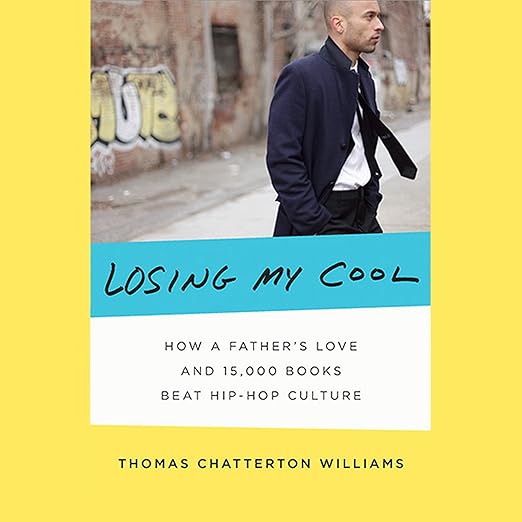
Fifteen thousand books in one house: what does a father do with a library that size, and what does he expect it to do for his son? That number is the hinge of Losing My Cool, and the audiobook arrives with a three-word production note sitting in the publisher description, 'Read by the author', which on this particular memoir is not a throwaway credit. The description runs to four short lines in total. Almost everything else you need has to come from the book itself, from the reviews, and from paying attention to how the publisher phrased those four lines.
Look at the verb. The copy describes how hip-hop culture 'drew in' the author and how his father 'drew him out again', the same word running in opposite directions across a single sentence. That is the entire architecture of the memoir compressed into a blurb, and it is the reason the book is more interesting than the culture-war summary it sometimes gets reduced to. Two forces are pulling on one adolescent, and both of them are using the same kind of pressure. The publisher also reaches for a musical term, calling it a 'pitch-perfect account', which for a book about a music culture reads as a deliberate choice rather than a lazy one.
The written reviews fill in what the description leaves out, and one of them lands a specific craft claim worth repeating. A four-star reviewer writes that Thomas Chatterton Williams 'is clearly a gifted writer' and that 'it's easy to see how this book could be adapted into a screenplay', crediting him with knowing 'how to paint the picture, describe people and places, and set the scenery'. I would go further. That is a scene-building compliment rather than an argument-quality one, and it matches exactly what I think the memoir is doing at its best: this is a book of rooms, cars, conversations and particular afternoons, not a treatise. A five-star reviewer, coming at it from a different angle, calls it 'articulate and expressive' and shelves it beside works on Black American life and neuroscience, which tells you which conversation this reader thought it had joined.
Code-Switching Through a Single Throat
The strongest argument for the audio edition is the one the publisher flags without elaborating. This is a memoir about a young man moving between two vocabularies: the language of the culture that claimed him, and the register of a father who kept fifteen thousand books in the house. Code-switching is the actual subject matter. Having Williams read it himself means those two registers pass through a single throat belonging to the person who actually did the switching, rather than being assigned to an interpreter making choices about how each should sound. Whatever the result, the arrangement is structurally right for this book in a way it would not be for most memoirs.
The compression helps too. At five hours and change this is a short listen by memoir standards, and the density is the point: no career retrospective, no second act in journalism, just the formation. You can finish it across two evenings and then spend considerably longer arguing with it, which is the correct ratio for a book like this.
The framing device is genuinely unusual, too. Most memoirs about escaping something credit a teacher, a move, a lucky break. This one credits a private library and a parent who treated reading as an intervention rather than an enrichment activity. Fifteen thousand volumes is not a detail; it is a strategy, and the book is at its best when it examines what that strategy cost as well as what it bought.
Five Hours Here, Seven in the Publisher's Own Copy
Check the runtime before you buy. This listing states five hours and twenty-four minutes, while the publisher description attached to the same page opens with the line 'Unabridged, 7 hours'. Those two figures cannot both describe the recording you will receive. The likeliest explanation is that the description traveled over from a different edition or an older packaging and was never reconciled, which happens more often than catalogs admit. If the seven-hour figure is what persuaded you, confirm the length and the unabridged status on the product page first.
Take the content note seriously if you are buying for a young reader. One five-star reviewer recommends the book for every young adult aged seventeen and up, then adds a caution: 'Because of language and sexual overtones' it may not suit anyone under sixteen reading unsupervised. That is a reasonable summary of a memoir about adolescence in a culture the author is describing candidly rather than sanitizing.
Understand also that the argument is contested and always has been. A book about being drawn out of hip-hop culture is making a claim about what that culture does to the people inside it, and plenty of readers reject the premise, the direction of travel, or both. My own position is that the memoir is far more persuasive as one specific account of one specific household than as a general diagnosis, and that it works best when read as testimony rather than as verdict. Listeners who want a sociological treatment, or a defense of the culture in question, will need a different book.
One last adjustment, to your expectations of the product page itself. Four lines of description on a memoir with 272 ratings is unusually sparse, so the reviews carry more of the descriptive load than they normally would. Read all three before deciding; between them they tell you more about the shape of the book than the copy does.
Parents Turn Out to Be the Second Audience
This belongs with readers of Black American memoir and cultural criticism, particularly those interested in the friction between a family's ambitions and a neighborhood's. It also has an unexpected second audience: parents. The father in this book has a theory of what reading does to a child and acts on it with a ferocity that will make some listeners cheer and others wince, and the memoir is honest about both reactions.
Look elsewhere if you want a full career retrospective, since the material stops well before the author became a working critic. Look elsewhere too if you want the case for hip-hop as formative rather than as something to be extracted from, because that case is not made here and is not attempted. For a compact, well-observed account of one adolescence and one library, five and a half hours is a fair trade.