Quick Take
- Narration: Ann Richardson delivers Brown’s essayistic, travelogue-inflected prose with a steady, intelligent calm, well-suited to a book that moves unhurriedly between geological history, Icelandic mythology, and environmental philosophy.
- Themes: animism and environmental ethics, the epistemology of belief, Iceland’s relationship with its landscape
- Mood: Curious, meditative, and quietly urgent
- Verdict: A genuinely unusual book that uses elves as an entry point into serious questions about how different disciplines construct reality, worth the attention of readers who like their nonfiction to resist easy categorization.
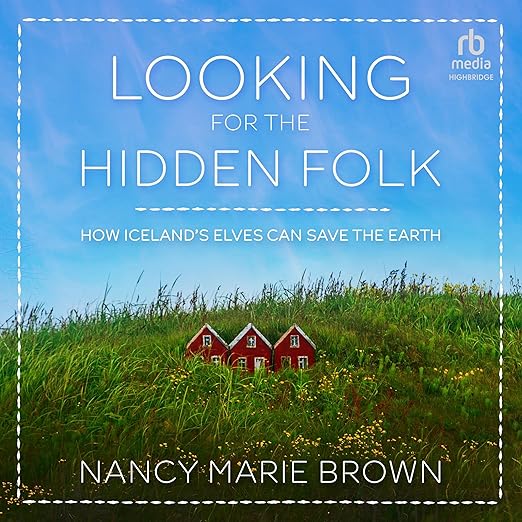
I picked up Looking for the Hidden Folk expecting a quirky cultural study of Icelandic folklore and got something considerably more ambitious, and more useful. Nancy Marie Brown is using elves the way a good essayist uses any unusual premise: as a lens that makes visible things you cannot see directly. The question is not really whether elves exist. The question is why different systems of knowledge define what exists so differently, and what those definitions cost us ecologically.
This is the kind of book I find genuinely hard to summarize without flattening it, which is usually a good sign. It is part travelogue, part intellectual history, part environmental philosophy, and it uses Brown’s own encounters with Iceland, in ancient lava fields, on horseback across the cold desert interior, beside glaciers and erupting volcanoes, as both evidence and argument. The physical landscape of Iceland is not a backdrop here. It is the subject, approached through the particular lens that Icelandic belief in the hidden folk provides.
Our Take on Looking for the Hidden Folk
Brown’s central argument, as I understand it, is that Icelanders’ belief in elves, and the protections that belief has provided for certain geological formations and landscapes, reveals something important about the relationship between epistemological framework and ecological behavior. If you believe that the rocks are inhabited by beings with their own claims on existence, you treat the rocks differently than if you believe they are inert matter available for human use. The book is interested in what different disciplines, science, religion, art, history, define as real, and in what is lost when one framework crowds out all others.
This is more rigorous than it might sound from that description, and Brown is careful not to romanticize the Icelandic tradition or to dismiss scientific rationalism. She is working at the intersection rather than choosing a side, and the resulting analysis is more interesting for it. The comparison to climate change and the Anthropocene is made explicitly, Brown argues that Iceland suggests a different way of relating to the Earth, one that takes seriously the possibility that the land has its own integrity independent of human use.
Why Listen to Looking for the Hidden Folk
Ann Richardson’s narration suits the essayistic quality of Brown’s prose. This is not a fast-moving book, it accumulates its argument through observation and digression and return, and Richardson’s pace reflects that structure without making it feel slow. The travelogue sections, in particular, benefit from being heard rather than read, because the rhythm of the prose as spoken has a meditative quality that matches Brown’s experience of moving through the Icelandic landscape.
Brown is a scholar of medieval Scandinavian literature, and that background shows in the depth of her engagement with the historical and literary sources for the hidden folk tradition. She is not writing as an outsider to Icelandic culture speculating about its significance, she has spent decades in and with that material, and the audiobook carries the authority of genuine expertise without the inaccessibility of academic prose.
What to Watch For in Looking for the Hidden Folk
A dissenting review in the metadata describes the book as reading “more like a geological history” and argues that the title’s implied promise of sustained engagement with the hidden folk specifically is not delivered. That criticism is worth taking seriously, readers who arrive expecting an ethnographic study of Icelandic elf belief will encounter something significantly broader and more philosophical. Brown is using the hidden folk as a starting point, not as the sustained subject.
The book is also, by its nature, interdisciplinary in a way that will suit some readers better than others. It moves between geological history, Icelandic myth, environmental science, and philosophy of knowledge without fully resolving into any one of them. This is intellectually generative if you like synthesis; it is frustrating if you want a book that stays in its lane.
Who Should Listen to Looking for the Hidden Folk
This is a strong recommendation for readers interested in environmental humanities, the anthropology of belief, or the intersection of folklore and ecology. Fans of Robin Wall Kimmerer’s work on indigenous plant relationships or Robert Macfarlane’s landscape writing will find Brown a complementary voice, she is interested in the same question of how our stories about the land shape our treatment of it, approached from a different cultural tradition.
Listeners who want a lighter, more folkloric engagement with Icelandic elves and hidden folk traditions will find this book more demanding than expected. And listeners who need a thesis that can be stated in a paragraph will find the essayistic, accumulative method of the book frustrating. But for the reader who is willing to follow Brown through her extended inquiry, the destination is worth the journey.
Frequently Asked Questions
Does Looking for the Hidden Folk require prior knowledge of Icelandic history or mythology?
No prior knowledge is assumed or necessary. Brown introduces historical and mythological context as she goes, and her background as a scholar of medieval Scandinavian literature means the explanations are thorough and reliable. The book is accessible to readers who are entirely new to Iceland’s cultural history.
Is this book primarily about elves and Icelandic folklore, or is it doing something more broadly philosophical?
The elves are the entry point rather than the sustained subject. Brown uses Icelandic belief in the hidden folk to investigate how different disciplines, science, religion, art, history, define what is real, and to argue that those definitions have ecological consequences. Readers expecting sustained ethnographic study of elf belief specifically will find the book considerably broader than that.
How does the book connect Icelandic elf belief to contemporary environmental concerns?
Brown argues that treating the land as inhabited, as having its own integrity and claims on existence independent of human use, generates different ecological behavior than treating it as inert resource. Iceland’s protection of certain geological formations based on elf belief becomes, in her analysis, a model for a different relationship with the Earth that has implications for how we think about climate change and biodiversity loss.
Is Ann Richardson’s narration a good match for the interdisciplinary and essayistic quality of Brown’s prose?
Richardson’s measured, intelligent delivery is well-suited to a book that moves unhurriedly between travelogue, mythology, geology, and philosophy. She does not perform the text dramaticaly, which would sit poorly with Brown’s essayistic register, but she maintains enough variation to keep the listener oriented across different modes of writing.