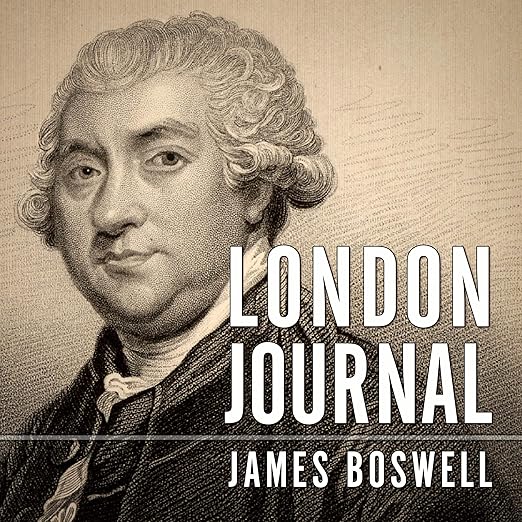
Boswell arrived in London in November 1762 as a twenty-two-year-old Edinburgh gentleman with aspirations toward a military commission, a taste for theater and coffee-house society, and a need to record everything. The journal he kept during that year and into 1763 sat largely unknown for over a century and a half, and when it finally emerged it became a bestseller precisely because it had been subject to less censorship than Boswell's other journals. This audiobook, narrated by Qarie Marshall at thirteen hours and seven minutes, is an encounter with one of the most unguarded personal documents in the literary archive of the English-speaking world.
The historical question about Boswell is always the same one: do we read him for the Georgian world he so vividly depicts, or do we read him for himself? The London Journal gives both in roughly equal measure, and the ratio shifts from entry to entry. Some passages are primarily social history: Boswell in the theaters, in the coffee houses, at the salons, describing the manners and conversations of mid-eighteenth-century London with a reporter's instinct for telling detail. Others are almost painfully interior, Boswell negotiating with his own vanity, his anxieties about rank and ambition, and his complicated appetites with a frankness that would surprise readers who know him only as the author of the monumental Life of Samuel Johnson.
The encounter with Samuel Johnson, which begins in this journal and would eventually generate the most famous literary biography in the English language, arrives about midway through the record and immediately shifts its texture. Boswell's account of their first meeting, and the beginning of the friendship that would define both their reputations, is one of the most interesting moments of literary history to have been written down by a direct participant at the time of occurrence rather than reconstructed from memory. Marshall's narration handles these passages with the right kind of reverence without becoming reverential, which would misrepresent how Boswell actually experienced them in the moment.
One reviewer notes that after a few months of journal entries, the experience of being inside Boswell's head becomes fatiguing. That is an honest response to the material. Boswell is a brilliant observer and a relentless self-observer, and his intelligence does not protect him from circularity. The same anxieties return, the same negotiations between aspiration and reality. For readers of the Life of Johnson who want to understand how Boswell constructed his masterpiece, as another reviewer suggests, the London Journal is useful as both context and contrast: the spontaneous, confessional daily record against the polished, architecturally organized biography.
Marshall's Narration Turns a Text Into a Shared Record
Qarie Marshall's narration brings a particular quality to Boswell's voice that print cannot quite replicate. Georgian English prose has rhythms that become more natural when spoken aloud, and Marshall finds those rhythms without the stilted formality that period narration can slip into. The confessional passages, where Boswell is most nakedly himself, benefit from a reader who treats them as human documents rather than literary artifacts. The effect is that the journal sounds like a private record being shared rather than a historical text being performed.
The thirteen-hour runtime reflects the density of the journal: Boswell wrote daily, and every entry is here. This is not a condensed or edited audio presentation but a complete record, which means it rewards the kind of sustained listening that a long train journey or a dedicated daily session provides. The social history value compounds across the runtime: listeners who stay with it accumulate a portrait of Georgian London that is more vivid than almost any documentary source because it is mediated through a very specific intelligence whose limitations are as revealing as his perceptions.
Formation of a Sensibility, Before Johnson Ever Appears
The racy material that the synopsis mentions as a factor in the journal's posthumous bestseller status is present but not the center of gravity. What is more interesting is Boswell's social performance: his awareness of how he is being seen, his anxiety about rank and belonging, and his pleasure in company that the Georgian coffee-house culture organized around wit and argument. These are the passages that illuminate the social world most clearly, and they recur throughout the journal in forms that accumulate meaning across the runtime.
The meeting with Johnson is the dramatic event that the literary-minded listener will be anticipating, but the months before that meeting are not merely prelude. Boswell in 1762 is an unformed version of the figure who will eventually sit across from Johnson and understand immediately that he is in the presence of someone worth recording. The London Journal shows the formation of that sensibility, which is its own kind of historical interest.
Essential Complementary Listening for Life of Johnson Readers
Readers of Boswell's Life of Samuel Johnson who want the biographical and temperamental context for that work will find the London Journal essential complementary listening. Literary historians, students of eighteenth-century culture, and listeners interested in the diaries-and-correspondence tradition as a genre will find Marshall's narration a genuinely useful access point to a demanding but rewarding document.
Listeners who need narrative momentum and plot progression will find the journal format challenging at this length. Boswell's world is vivid but repetitive, his concerns consistent across months of entries. This is a listening experience for those willing to follow the texture of a specific life rather than a story with directed momentum. The audiobook rewards sustained attention rather than passive listening; the cumulative portrait of Georgian London that emerges across the thirteen-hour runtime is richer than any single entry suggests.
The Short Version
- Narrator: Qarie Marshall handles Boswell's period voice and confessional register with a naturalism that prevents the Georgian prose from feeling museum-piece stiff.
- Subjects: Youth and ambition, social performance in Georgian London, the making of a writer
- Tone: Vivid and intimate, occasionally indulgent
- Bottom line: One of the most candid personal documents of the eighteenth century, narrated with intelligence and warmth, though listeners must accept that Boswell's self-absorption is the point, not the problem.
Is the audiobook narration accessible for listeners unfamiliar with eighteenth-century prose?
Qarie Marshall's narration handles the Georgian register fluently enough that the language does not become a barrier. The occasional archaic phrase or reference may require a pause, but the overall experience is more immediately accessible than reading the print journal.
Is this audiobook appropriate for someone who is not already interested in Georgian London or eighteenth-century literature?
It depends on tolerance for sustained personal voice without plot. Boswell is an entertaining and often funny writer, and Marshall's narration brings that humor forward. But the thirteen-hour runtime requires genuine interest in the period or the figure to sustain.