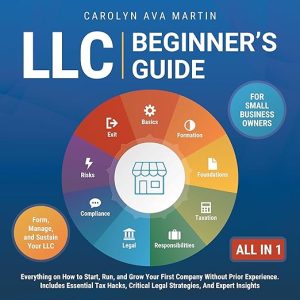
![LLC Beginner's Guide [All-in-1]](https://audiobookdaily.com/wp-content/uploads/2026/03/llc-beginner-s-guide-all-in-1.jpg)
A friend of mine spent the better part of a winter afternoon staring at state filing forms and IRS publications, trying to figure out whether to register her freelance design practice as a sole proprietorship or an LLC. She called me in a mild panic at around three o'clock. I did not have a good answer for her, and I am generally someone who has read more business books than is probably healthy. That afternoon came back to me while I was listening to Carolyn Ava Martin's LLC Beginner's Guide All-in-1, because this is precisely the book I wish I had been able to recommend to her.
The audiobook, narrated by Myrna Ghanem, runs just over four hours and is structured as a self-contained crash course in Limited Liability Company formation and management. Martin does not assume any prior knowledge of business law or accounting. She begins with what an LLC actually is, why someone might choose it over a sole proprietorship or corporation, and how different structures serve different purposes. From there she moves through a step-by-step formation guide, compliance requirements, risk management frameworks, and eventually growth and financing strategies. Reviewer Melanie Pendleton described the experience as having a knowledgeable mentor walking you through every step, and that framing is accurate. The book does not lecture; it guides.
Beyond Formation Into Ongoing LLC Operations
The bundled structure is one of the book's genuine strengths. Rather than stopping at incorporation paperwork, Martin extends the scope into ongoing operations: how to maintain your LLC's legal standing, how to separate personal and business finances, what to understand about pass-through taxation, and how to think about scaling. Reviewer Eduardo Soler called it much needed knowledge and good step-by-step instruction, and even reviewer Amy Hempel, who was listening after her LLC was already formed, found value in using it as a checklist against what she had already done. That kind of retroactive utility is a reasonable indicator that the content holds up beyond the pure beginner use case.
The real-life case studies Martin includes are brief but effective. They function as anchors that keep abstract compliance concepts grounded in recognizable scenarios: a solo consultant navigating liability, a small product business evaluating multi-member structure. These do not replace legal counsel, and Martin is careful to say so, but they make the material considerably easier to internalize during a first listen.
Simple, But Thin on Financing and Tax
This is fundamentally a beginner's guide, and it reads like one. Reviewer Cameron O, who gave it five stars, noted it covers everything and explains it simply. That simplicity is the product's core value, but it does mean experienced business owners or those with complex multi-state operations will find the treatment too introductory. The tax coverage, for instance, gestures at the importance of quarterly estimated payments and self-employment tax without going deeply into strategy. Anyone with a functioning accountant already on retainer will be reviewing material they know.
The four-hour runtime also means some topics get compressed. Financing strategies, for example, receive a shorter treatment than formation and compliance. This is an appropriate editorial choice for a beginner guide, but listeners hoping for detailed coverage of SBA loans, equity financing, or revenue-based lending will want to supplement with a dedicated resource.
Ghanem's Clean, Reference-Style Delivery
Myrna Ghanem does the work cleanly. Her delivery is professional and clear, which is exactly what you want for a reference-style listen where you may be pausing to take notes. She does not inject personality in ways that distract from the content, and she handles the transition between sections without making the book feel choppy. One reviewer described the book as pretty easy to follow and simple enough to be understood by people who aren't familiar with business LLCs, and Ghanem's narration contributes to that accessibility. The audio format works well here because the content is inherently sequential: each section builds on the previous one in a way that suits linear listening.
For First-Timers Delaying Their LLC Paperwork
The sweet spot for this audiobook is the first-time business owner who knows they want to form an LLC and has been delaying because the paperwork and legal language feel impenetrable. At just over four hours, it is short enough to finish on a weekend and long enough to give a genuine overview of what lies ahead. Listeners in that situation will find it genuinely useful, particularly if they pair it with a consultation with a local business attorney for their specific state's requirements.
Skip it if you already have a running business with an accountant and a lawyer, or if you are looking for advanced tax optimization or entity structure strategy. For those starting from zero, though, Martin's guide offers something that is surprisingly rare in the LLC space: it is comprehensive without being intimidating, and it ends with readers feeling more capable than when they started. That is no small thing.
Before You Listen
Does the LLC Beginner's Guide cover state-specific filing requirements?
It covers general formation steps and compliance principles applicable across states, but it does not go state by state. Listeners will need to verify their specific state's filing fees, annual report requirements, and registered agent rules separately.
Is this audiobook useful if I have already formed my LLC?
Several reviewers found value in it as a retroactive checklist for ensuring their existing setup was compliant and well-structured, particularly around asset protection and ongoing maintenance requirements.
Does Carolyn Ava Martin discuss LLC taxation in detail?
She covers the basics of pass-through taxation and the difference between single-member and multi-member LLC treatment, but the tax coverage is introductory. Listeners with complex tax situations should treat this as orientation rather than strategy.
How does the audio format handle the interactive exercises mentioned in the synopsis?
The exercises are described verbally and are designed to be paused and completed offline. They work better as prompts for reflection or note-taking than as structured in-audio activities, which is typical for business guides adapted to audio format.