The Short Version
- Performance: The teacher speaks his own words at his own pace, and the live capture trades even levels for the feeling of sitting in the room.
- What it covers: Mindfulness practice, transforming fear and anger, community as support
- Feel: Soft-spoken, unhurried and patient
- Our call: Take it as a recorded teaching rather than a book and it repays the six sessions; expect fidelity to be the price.
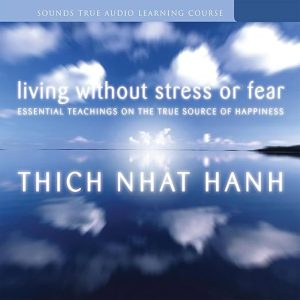
Zen teaching recorded in front of a live audience is a different audiobook proposition from a studio reading, and this one never pretends otherwise. Macmillan Audio describes six sessions of core teachings and guided practices, which is an accurate account of what plays: a teacher working through material in real time, with pauses and breathing exercises built into the delivery rather than edited around. The short title also drops the line the description leads with, The Mindful Path to Freedom from the Emotions That Cause Suffering, and that longer phrase is by far the better guide to what you are buying.
How Living Without Stress or Fear Holds Up
August 2017 brought the most useful thing anybody has written about this recording, a five-star from all414all that manages praise and warning in a single breath. Five stars, on the grounds that the teaching is superb and the person delivering it is a sweet, venerable master. One misgiving, stated without hedging: it is a little hard to hear him. On a recording whose entire subject is the quality of your attention, that is not a minor technical footnote, and I would weigh both halves of that verdict equally before spending anything.
Practice, not proposition, organizes the six sessions. Mindful breathing comes first, then being fully present while walking and eating, then a four-pebble meditation offered as a route to openness, clarity and grounding. Around those sit the framing ideas: seeds of happiness and seeds of suffering, and the argument that we decide which of them to nourish with our attention. The line at the center, no death and no birth, neither being nor non-being, gets stated and circled rather than defended, which is how the tradition handles it.
Six hours and twenty-six minutes is generous room for six sessions, and the pacing reflects a teacher in no hurry at all. Macmillan Audio put it out in January 2010 with nothing on the listing pointing to a session-by-session guide or a companion document, so you navigate by ear. The word the publisher uses for the units is sessions, not chapters, and that single choice is the most honest signal available about what kind of object this is.
Why Living Without Stress or Fear Works as an Audiobook
Rob B.'s three-sentence verdict from October 2013 gets at the practical case: the teacher is easy to listen to and understand. That matters more than it sounds. The man behind this recording has written more than forty books in English, and the plainness of that written register carries straight into the spoken one. Nothing across the six sessions asks for prior knowledge of Buddhist vocabulary, and the ideas arrive in ordinary words: seeds, breathing, a home you can return to whenever you need it.
Nothing about the biography attached here counts as decoration. Martin Luther King, Jr. nominated Thich Nhat Hanh for the 1967 Nobel Peace Prize, and the description points to a lifetime of teaching in places stricken by war, famine and despair. That history is why the material on transforming toxic energies within you does not land as a wellness exercise. Peace Is Every Step and Living Buddha, Living Christ belong to the same body of work, and anyone who knows either will recognize the register within minutes.
For a first encounter with this teacher, the guided practices make the strongest argument. The begin anew practice and the four-pebble meditation are concrete enough to try the same day you hear them, which is rarer in this category than it should be. The material on community, and on what a practicing group does to sustain any of this, is the part most likely to change what you actually do, and it is also the part that comparable spiritual audio skips almost as a rule.
Weak Spots in Living Without Stress or Fear
One response gives this a single star, and it deserves a hearing: filed in March 2024, it says plainly that this is not an audiobook but a poor recording of a live teaching. Every word of that is defensible. The description confirms the live-session provenance without quite advertising it, and a buyer expecting a produced reading with even levels and edited silence will feel misled rather than merely underwhelmed.
Structure is the other thing to prepare for. Guided practice works by asking you to stop and do something, and a linear file gives you no way back to the four-pebble instructions three weeks later when you want them again. No session list, no printed outline, no bookmarking help beyond whatever your player provides. For material designed to be repeated across months, that is a real cost of the format, and it makes a real argument for keeping a printed version alongside the file.
Expectations set by the title need adjusting as well. The page shows four plain words where the description opens with a longer subtitle promising a mindful path out of the feelings that hurt most, and the short version reads like a promise these sessions never make. Nobody here claims you will stop feeling fear. The claim is narrower and considerably more interesting: that you can build somewhere to stand while the fear moves through you.
The Right Listener for Living Without Stress or Fear
Listeners who already keep a daily sitting practice will get the most out of this, because the sessions assume you are willing to stop and follow instructions rather than take notes. An April 2013 response describes getting through only the first disc and being captivated regardless, then adds the observation that unlocks the whole recording: he speaks quietly, and that makes you get quiet and listen. Treat that as the instruction manual. It also confirms that a physical disc edition sits somewhere behind this listing.
Anyone hoping for a book will be disappointed here. This is a teacher in a room, not an author reading prose, and the sessions circle their material the way spoken teaching does rather than building an argument chapter by chapter. Anyone who needs clean audio on a noisy train, or who processes ideas better with text to follow, will be better served by one of the forty-odd printed titles under the same name.
For someone curious about mindfulness rather than committed to it, the case here is genuinely open. The teaching is unhurried, generous and free of the productivity framing that has attached itself to this subject elsewhere. The recording is imperfect and the short title undersells what it is. Go in expecting a session you attend rather than a book you consume, and the six hours give back a good deal more than they ask of you.