Quick Take
- Narration: Teralyn Davis brings an Appalachian warmth to the material that suits the book’s blend of personal memoir and folk magic documentation, making the ancestral invocation feel genuine rather than performed.
- Themes: Appalachian folk magic and ancestral veneration, the relationship between land and spiritual practice, healing traditions and their preservation
- Mood: Earthy, unhurried, and deeply personal, with the quality of sitting with someone who knows the mountains the way you know your own home
- Verdict: A partial memoir, partial field guide that succeeds most fully as an act of love for a living regional tradition, ideal for listeners who already walk a folk magic or Pagan path.
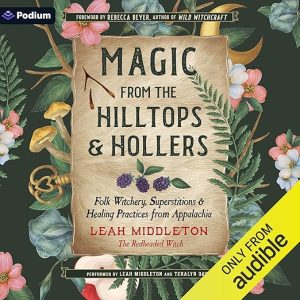
I have a particular soft spot for books that are unapologetically regional. Not books about a place written from the outside, but books written from inside a specific landscape by someone who has absorbed it over decades and cannot quite separate what they know from where they learned it. Leah Middleton’s Magic from the Hilltops and Hollers is that kind of book. She is the Redheaded Witch, a practitioner of Appalachian folk magic with deep roots in Western North Carolina, and this audiobook is her attempt to document, honor, and keep alive a tradition she loves.
I came to it on a rainy evening in late autumn, which turned out to be the exact right atmospheric conditions. Teralyn Davis’s narration has something of the mountains in it: unhurried, direct, with a warmth that does not announce itself. Middleton’s prose moves between family narrative and practical magical lore without a hard border between the two, and Davis makes that movement feel natural rather than structurally awkward.
Our Take on Magic from the Hilltops and Hollers
One reviewer described this as part memoir, part field guide, part ancestral invocation, which is the most accurate three-part description I have encountered for what Middleton is doing. She writes about the grandfathers with dirt under their fingernails, the grandmothers who bled while sewing, the practitioners who showed her the way. That veneration is not performance. It comes through in every section of the book as a genuine commitment to keeping these people and their practices visible. The superstitions of the mountains, the healing charms, the folk beliefs of witchery: Middleton presents them as living material, not museum pieces. That is the book’s central accomplishment: treating folk practice as something that belongs to the present and the future as much as it does to the past.
Why Listen to Magic from the Hilltops and Hollers
The format advantages of audio are significant here. Middleton’s charms, prayers, and folk workings have an oral tradition behind them, and hearing them rather than reading them in silence reconnects them to that ancestry in a small but real way. Davis understands this. She does not rush the ceremonial language or treat it as exotic. Reviewers noted that Middleton’s personal stories made them feel like they were right there with her, and that quality comes from both the writing and the narration’s intimacy. One listener who came to the book during a chaotic house move described it as genuinely helping them re-root in their new space, which is a specific and honest kind of testimonial.
What to Watch For in Magic from the Hilltops and Hollers
One reviewer offered a meaningful critical note: Middleton grazes the surface of the folklore and traditional superstitions of the region before jumping to something else, and the book reads as more personal narrative than systematic documentation. That criticism is fair when assessed against the expectation of a comprehensive field guide. If you come to this wanting deep-dive anthropological coverage of Appalachian superstition and practical spellwork with step-by-step detail, you will find it thinner than you hoped. But if you come to it as an invitation into one practitioner’s living relationship with her land and ancestors, it delivers exactly what it promises. Managing that expectation is the key to appreciating the book on its own terms.
Who Should Listen to Magic from the Hilltops and Hollers
This belongs to listeners who already have some investment in folk magic, Paganism, or Appalachian cultural history, and who are looking for an authentic voice from within the living tradition rather than a scholarly overview of it from the outside. It is also for anyone who has felt estranged from their ancestral landscape and wants the experience of a book that treats that longing with respect. Skip it if you need practical spell instruction or comprehensive folkloric documentation. This is a book about relationship, with place, with ancestors, and with a living tradition that Middleton refuses to treat as finished. It succeeds completely on those terms, and that is enough.
Frequently Asked Questions
Does Magic from the Hilltops and Hollers include practical spells, charms, and workings a listener could use in their own practice?
There are practical elements included, such as superstitions, healing charms, and folk beliefs with some discussion of how to engage with them. However, at least one reviewer noted that the practical instructional content is less extensive than the personal narrative. This is primarily an experiential and ancestral work rather than a how-to manual.
Is this book accessible to listeners who are not from Appalachia and have no connection to the region?
Yes. Several reviewers who described feeling geographically or ancestrally distant from Appalachia found the book welcoming and grounding. Middleton frames the material as an invitation to find connection with whatever roots you have, not as an exclusive text for cultural insiders.
How does Teralyn Davis handle the balance between the memoir sections and the folk magic documentation in the narration?
Davis transitions smoothly between the personal narrative and the more instructional or documentary sections. The warmth she brings to the family stories carries through into the magical content, which suits the book’s premise that the personal and the magical are not separate categories.
Is Magic from the Hilltops and Hollers primarily a beginner’s introduction to Appalachian folk magic, or does it assume some prior familiarity with folk practice?
It reads as accessible to newcomers but most richly rewarding for listeners who already walk some kind of folk, Pagan, or earth-based path. Beginners will find it welcoming rather than technical, but the depth of resonance increases with familiarity with the broader tradition Middleton is working within.