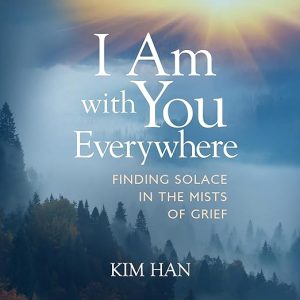
Quick Take
- Narration: Maria McCann brings gentleness and emotional care to a text that needs both, handling the memoir’s more painful moments without melodrama.
- Themes: Grief and healing, mother-daughter bonds, spiritual continuity beyond death
- Mood: Tender and searching, with the quality of a long letter written to someone who can no longer read it
- Verdict: A deeply personal grief memoir that offers genuine solace without demanding any particular spiritual framework from the listener.
Some audiobooks I listen to because I want to, and some I listen to because they find me at the right moment. I Am with You Everywhere found me during a week when I had been thinking about loss, not dramatically, not from immediate grief, but from the kind of slow ambient awareness of it that middle age produces. I did not expect the book to reach me the way it did, and that unexpectedness is part of what I want to convey in this review.
Kim Han wrote this book to honor her daughter, Siu-Ling, who died of ovarian cancer in 2016 at fifty-three. Siu-Ling was not a private or quiet person. She was an athlete who competed in a thousand-kilometer dog sledding journey, a writer and poet, a woman of striking vitality who faced her illness with the same directness she apparently brought to everything else. The book is many things at once: a memoir of the mother-daughter relationship, a guide to grief for those navigating their own loss, a collection of poetry and quotation, and an extended meditation on whether love can survive the boundaries we assume death imposes.
Our Take on I Am with You Everywhere
What keeps Han’s book from collapsing into sentimentality is the research backing her more spiritual claims. She engages seriously with the medical literature on grief, including the section on Takotsubo cardiomyopathy, the physical cardiac condition sometimes called broken heart syndrome, which gives a name and physiological reality to what loss does to the body. That grounding matters. It means the book is not asking you to accept spiritual premises on faith; it is acknowledging that grief is simultaneously a physical, psychological, and spiritual experience, and addressing all three registers rather than choosing between them.
The poetry woven throughout the text, both Siu-Ling’s own writing and the quotations Han has gathered, is one of the book’s most distinctive qualities. One reviewer described it as giving soothing advice and wisdom through poems and quotations interspersed throughout the book. In the audiobook format, this creates a rhythm of prose and verse that is unusual and, when it works, deeply affecting. The transition between Han’s narrative voice and Siu-Ling’s poems produces a kind of doubling that is hard to achieve in print: both voices present, the living and the gone, sharing the same hour of listening.
Why Listen to This Instead of Reading It
Maria McCann’s narration is well-chosen for this material. She does not impose her own emotional interpretation on the text but reads with the kind of quiet presence that allows the words to carry their own weight. The grief sections do not become performances of grief. The poetry is handled with restraint that honors the verse without turning it into recitation. At four hours, the audiobook is short enough to listen to in one extended session, which I would actually recommend. Grief literature often benefits from sustained attention rather than fragmented listening, because the cumulative effect is part of how the argument, and the comfort, is built. A reviewer noted having a hard time putting it down, and the audio version has the same quality of gentle momentum.
What to Watch For in This Audiobook
The book’s bibliography and research framework will surprise some listeners who expect pure memoir. Han draws on historical and political events she has lived through, not only personal grief, and the scope of reference is broader than the title might suggest. Some listeners expecting a linear grief narrative will need to adjust to the associative structure that moves between personal memory, medical research, poetry, and spiritual reflection without always signaling the transitions. The final chapters, which shift toward what Han describes as messages from Siu-Ling after her death, sit in territory that will resonate differently depending on the listener’s beliefs. The book does not require any particular spiritual framework but it does ask you to entertain the possibility of ongoing connection, and that invitation is one each listener will accept or resist on their own terms.
Who Should Listen to This Audiobook
Those who are navigating the loss of a parent, a child, or a close friend will find this a genuinely compassionate companion. Listeners curious about the physiology of grief, particularly the broken heart syndrome research, will find the medical sections accessible and illuminating. Readers drawn to memoir that incorporates poetry and interdisciplinary research alongside personal narrative will appreciate Han’s structural ambition. Those who prefer their grief literature strictly secular may find the later chapters move further into spiritual territory than they can follow.
Frequently Asked Questions
Is I Am with You Everywhere a religious book, or is it accessible to secular listeners?
Han’s framework includes spiritual elements, particularly the idea that her daughter’s presence continues after death, but the book does not require any specific religious belief. The medical and psychological sections on grief are grounded in research, and the spiritual material is presented as personal experience and open possibility rather than theological assertion.
What is Takotsubo cardiomyopathy, and why does Han include it in a grief memoir?
Takotsubo cardiomyopathy, sometimes called broken heart syndrome, is a real cardiac condition in which extreme emotional stress causes a temporary weakening of the heart muscle. Han includes it to establish that grief is a physical event, not only an emotional or spiritual one, and to validate the bodily weight of loss that grief culture sometimes treats as metaphor.
Does the audiobook include Siu-Ling’s poetry, and how does the narration handle the verse sections?
Yes, both Siu-Ling’s own writing and Han’s curated quotations appear throughout the text. Maria McCann reads the poetry with measured restraint rather than heightened performance, which honors the verse without making it feel theatrical. The alternation between prose narrative and poetry is one of the book’s defining structural qualities.
Is this book primarily about Han’s daughter, or does it also address the listener’s own grief?
Both. Han’s memoir of Siu-Ling provides the emotional core and the specific relationship that anchors the book’s argument. But the practical and philosophical guidance on navigating grief is explicitly addressed to the reader or listener navigating their own loss, making it a memorial tribute and a companionship text simultaneously.