Quick Take
- Narration: N.W. Edwards reads with a clear, unhurried delivery appropriate for material that many listeners will want to process carefully; the pacing allows complex legal distinctions to register without feeling condescending.
- Themes: estate planning literacy, probate avoidance, protecting family from legal and financial conflict
- Mood: Practical and reassuring, with genuine urgency about delayed action
- Verdict: A solidly useful introduction to estate planning concepts for seniors who have avoided the subject because prior resources felt inaccessible or prohibitively expensive to pursue.
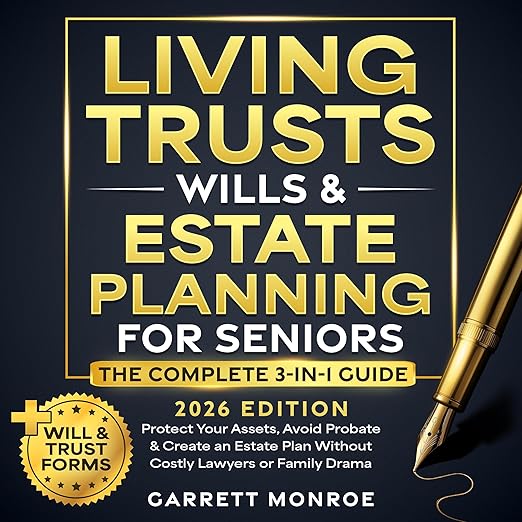
Estate planning is one of those subjects that most people know they should address and most people keep not addressing, often for decades. The reasons are usually some combination of cost, complexity, and the simple human discomfort of thinking concretely about the end of one’s life. Garrett Monroe’s Living Trusts, Wills and Estate Planning for Seniors targets exactly this avoidance pattern, and it does so with a directness that I found more useful than the genre usually manages.
I listened to this on a Tuesday morning after a conversation with my mother about documents she has been meaning to update for years. The timing was not coincidental, the book had been sitting in my queue for weeks, and that conversation was the push I needed. Within the first twenty minutes, I had a clearer working understanding of the difference between a revocable living trust and a will than I had assembled from several previous attempts to research the subject. That clarity is the book’s main accomplishment.
Making Legal Distinctions Actually Land
The core content that Monroe delivers most effectively is the trust-versus-will comparison. A 72-year-old reviewer who had spent years avoiding estate planning specifically because attorneys quoted them thousands of dollars just to begin described this section as providing the clarity they’d been searching for. That tracks with my own experience. Monroe explains not just what these instruments are but why you would choose one over the other, and the explanation is specific enough to be useful without requiring a legal background to follow.
The probate avoidance material is similarly well-handled. Monroe makes the case that bypassing probate through proper trust structure is not an obscure trick for wealthy families but a genuinely accessible goal with significant practical benefits, months of stress and thousands in court fees potentially saved for surviving family members. He does not oversell this. He explains the conditions under which it works and notes where professional legal counsel is still advisable, which is a more honest framing than some self-help legal guides manage.
The 2025 Senior Edition and What That Framing Delivers
The book positions itself specifically as a 2025 edition written for seniors, and this framing shapes its approach in useful ways. Monroe anticipates the specific concerns and hesitations of readers in their 60s, 70s, and 80s: the experience of being quoted sky-high fees for initial consultations, the distrust of generic online forms, the fear of leaving family members to manage conflict or court proceedings. Addressing these concerns directly in the early chapters helps establish credibility before the technical content begins.
The coverage of digital assets is a genuine strength and, for a book targeting seniors, a surprisingly forward-looking choice. Monroe addresses cryptocurrency, bank login credentials, email accounts, and social media presence as estate planning considerations, assets and liabilities that many estate planning guides still treat as secondary. A reviewer who called the inclusion of digital asset planning extremely important captured something real. These are assets that can be lost entirely without proper documentation, and the audiobook treats them with appropriate seriousness.
Honest Limitations
At three and a half hours, this is a survey rather than an encyclopedic resource. Monroe covers a lot of ground quickly, which means some subjects get less depth than a listener in a complex situation might need. The material is deliberately pitched at the straightforward end of estate planning, it is most useful for someone beginning to think about these issues, less so for someone managing complicated family structures, significant assets across multiple jurisdictions, or business succession concerns.
One reviewer noted some repetition, though they framed this as a feature rather than a defect, important points are reinforced across sections, which helps retention in an audio format where you cannot easily flip back to review. The repetition serves the pedagogical goal even if it slightly inflates the listening time. The book also references access to thirty-six forms and checklists through an external website, which functions better as a supplement to the audio than as a standalone resource.
Who Should Listen and Who Should Skip
Listen if you are a senior, or the adult child of a senior, who has been avoiding estate planning because the subject felt financially inaccessible or legally impenetrable. This book is genuinely designed for that audience and does its job well. Listen if you want a clear introduction to the differences between wills, revocable trusts, and irrevocable trusts before consulting an attorney, so that consultation is more productive.
Skip if you have already worked through the basics with an estate attorney and are looking for advanced planning strategies. This is foundational content, not sophisticated tax or asset-protection planning. Also skip if you need jurisdiction-specific legal advice, Monroe writes for a general US audience and notes throughout that professional counsel remains important for individual situations.
Frequently Asked Questions
Does this audiobook provide enough information to create estate planning documents without an attorney?
Monroe provides substantial educational content and references access to forms and checklists, but the book consistently recommends professional legal review for final documents. It is best understood as preparation for working with an attorney, giving you the vocabulary and framework to make those consultations more efficient and less expensive.
How does the book explain the difference between a revocable and irrevocable trust in practical terms?
Monroe covers this comparison with clarity as one of the book’s core sections. A revocable living trust allows you to modify or dissolve it during your lifetime and keeps assets out of probate; an irrevocable trust provides stronger asset protection and potential tax advantages but cannot be changed once established. The book explains scenarios where each is preferable without oversimplifying the tradeoffs.
Is the coverage of digital assets in this guide practical, or is it just a brief mention?
Multiple reviewers highlighted the digital asset section as one of the book’s genuine strengths. Monroe addresses cryptocurrency, bank logins, email accounts, and social media presence as real estate planning considerations, which is more thorough than most comparable guides. He provides actionable guidance on how to document these assets for your executor.
Is this book specific to any US state, or does it cover federal and general principles?
Monroe writes for a general US audience, covering federal principles and broadly applicable state law concepts. Estate planning law does vary by state, and the book acknowledges this, which is part of why it consistently recommends working with a local attorney for final document preparation despite providing substantial educational foundation.