Quick Take
- Narration: Michael Singer reads his own material with the unhurried, conversational tone of live teaching sessions, which is both the strength and, for some listeners, the limitation of this production.
- Themes: Releasing ego resistance, inner energy and flow, the nature of consciousness
- Mood: Meditative and spacious, with a quality of unhurried repetition that rewards repeated listening
- Verdict: Best understood as a companion and extension to The Untethered Soul rather than a standalone introduction, this production rewards patient listeners willing to sit with its slow revelations.
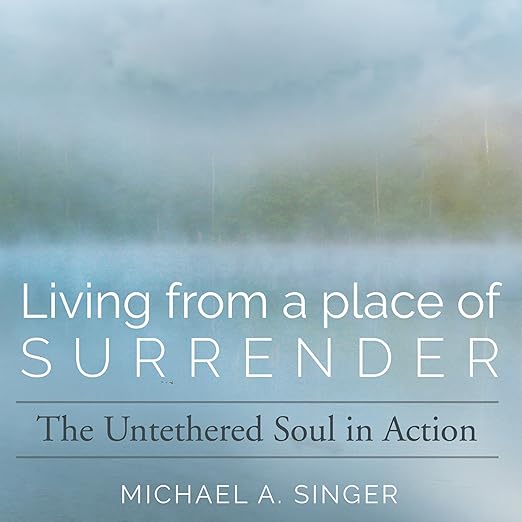
I have a particular interest in spiritual teaching that takes seriously the problem of the inner voice, the one that narrates your experience, comments on your performance, anticipates every possible bad outcome. Michael Singer has built his entire body of work on this problem, and Living from a Place of Surrender is the audio course companion to the practice he has been articulating since The Untethered Soul was published in 2007. I came to it already familiar with that earlier book, and that context matters considerably for how this one lands.
The production originated as an online course through Sounds True, and the eight sessions here carry that format’s particular texture. Singer is recorded in a live teaching environment, which means you hear the pauses, the occasional repetition, the way a thought is approached from several angles before it resolves. That quality is not an accident; it is the point. Singer explicitly argues that the goal is not merely to understand the teaching intellectually but to let it shift something in how you orient to experience. The format supports that aim, even when it can try the patience of listeners looking for a more tightly edited presentation.
Our Take on Living from a Place of Surrender
The central argument is familiar from The Untethered Soul but is developed here with particular attention to what Singer calls the root cause of the inner dialogue. He is not primarily interested in quieting the mind, the standard mindfulness goal, but in tracing why the mind talks at all, what psychological structure generates the endless commentary, and how you remove it rather than merely manage it. That distinction, between managing inner noise and addressing its source, is where this course offers something the earlier book only gestures toward.
One reviewer who is on their seventh listen notes that the middle sessions, chapters four through eight, reward repeated engagement. That tracks. The early sessions establish the framework, and the later ones do the more specific work of showing how surrender, a word Singer is careful to define precisely, operates in the practical context of daily life rather than in retreat conditions.
Why Listen to Living from a Place of Surrender
The fact that Singer reads his own material is significant. There is no interpretive layer between the teaching and the listener. His voice is calm without being artificially soft, authoritative without being domineering, and the live-session quality means you occasionally hear him thinking in real time, which gives the material a quality of genuine inquiry rather than polished performance. For listeners already oriented to Singer’s work, this authenticity is part of the value. The teaching sounds like someone who has actually lived what he is describing, which is not always true of spiritual audio content.
What to Watch For in Living from a Place of Surrender
The most substantive criticism in the reviews is also the most useful one: Singer repeats himself. He circles back through the same examples, the same scenarios, the same central moves of the argument, multiple times across the eight sessions. One reviewer argues that a tighter edit would have produced something half as long and twice as powerful. That is a legitimate critique. Whether the repetition is a flaw or a feature depends on what you are looking for. If you want information efficiently delivered, this format will frustrate you. If you are looking for something that functions more like a practice, where the ideas are meant to be absorbed rather than processed and filed, the circling repetition may feel exactly right.
Who Should Listen to Living from a Place of Surrender
Listeners who have already engaged with The Untethered Soul or The Surrender Experiment and want to go further. Those drawn to contemplative spiritual frameworks that work through direct inquiry rather than dogma. People willing to sit with material that does not resolve quickly and returns to the same territory from different angles. This is not a good entry point for someone new to Singer’s work, and it is not suited to listeners who want a crisp, structured self-help framework. Those who come prepared and patient tend, by the reviews, to find it genuinely transformative.
Frequently Asked Questions
Should I listen to The Untethered Soul before this course?
Singer’s own framing and most reviewer feedback strongly suggest yes. Living from a Place of Surrender develops concepts introduced in The Untethered Soul and assumes a degree of familiarity with that framework. Starting here without that context is possible but significantly reduces the depth of what you can get from the eight sessions.
Is the repetition in Singer’s narration a production flaw or a deliberate feature?
It is structural to the live-session format Singer uses. He views the revisiting of central ideas as part of the teaching practice rather than as padding. Whether that serves you depends on what you want from the material. Listeners approaching it as a contemplative practice tend to find it valuable; those seeking efficient information delivery tend to find it excessive.
How does this compare to a standard audiobook in terms of format and listening experience?
This is closer to a recorded course than a conventional audiobook. The eight sessions each function as a teaching unit, and Singer recommends engaging with them in sequence. Multiple reviewers describe re-listening to the later sessions many times, which suggests the format rewards a different kind of engagement than a narrative or informational audiobook.
What is the core practical takeaway from the course, beyond the philosophical framing?
Singer’s central practical argument is that you do not need to manage your inner dialogue but to stop using your psychic energy to maintain the inner blockages that generate it. The course teaches what he describes as using life events, particularly uncomfortable ones, as opportunities to release rather than reinforce those blockages. It is a practice more than a technique, and the sessions build toward that orientation progressively.