Quick Take
- Narration: Kim Butler narrates her own book with the directness of someone giving a talk rather than reading a script, which suits the practical tone but occasionally loses the nuance that a professional narrator might bring to complex financial distinctions.
- Themes: Whole life insurance as a living financial asset, policy structure and liquidity, rethinking conventional personal finance orthodoxy
- Mood: Brisk and practical, with an evangelical edge toward a contrarian financial idea
- Verdict: A short, focused primer that introduces a genuinely underexplored personal finance concept, though listeners will need supplementary reading to act on the ideas it raises.
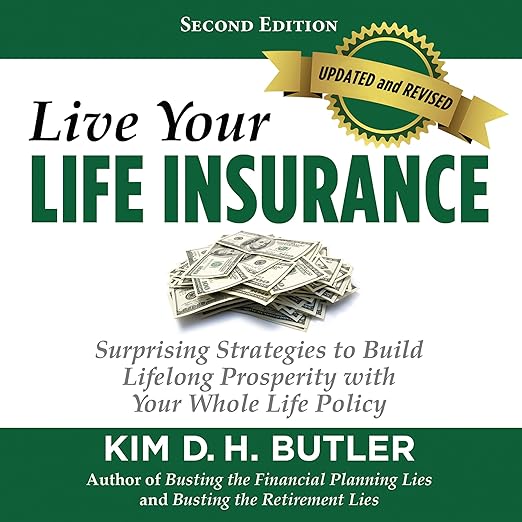
I have a particular weakness for short financial books that say one thing clearly rather than padding a single concept across three hundred pages. Live Your Life Insurance, at one hour and fifty-four minutes, is almost aggressively short, which means either it is too thin to be useful or it has done the editorial work to strip away everything that is not load-bearing. In this case it is closer to the latter. Kim Butler is not trying to give you a complete financial education. She is trying to shift how you think about a financial instrument you already own or have been told to dismiss.
The core argument is specific and counterintuitive: properly structured whole life insurance policies can function as living financial tools, not just as a death benefit for your heirs. Butler walks through how the cash value in a whole life policy accumulates, how it can be accessed during your lifetime, and how that access can be used to generate liquidity and growth in ways that term life insurance simply cannot replicate. She is making a case against the near-universal personal finance advice to “buy term and invest the difference,” and she is making it calmly and with practical examples rather than through ideology.
Our Take on Live Your Life Insurance
Butler narrating her own book creates a specific listening experience. The delivery has the quality of a practitioner talking to a client: direct, slightly compressed, assuming a level of financial competence in the listener without assuming specialized knowledge. This suits the content. She is not performing the text. She is explaining it, which is exactly right for material that is asking you to change a fairly entrenched assumption. The limitation is that complex distinctions between policy types, particularly the specifics of what makes a policy “properly structured” in the way she recommends, could benefit from the kind of pacing and emphasis that an experienced audiobook narrator might bring to dense technical content. A few passages require re-listening.
Reviewers consistently describe the book as an “eye opener” and a starting point rather than a complete guide, which is an accurate characterization. One reviewer explicitly said it “left me wanting more,” which is the intended effect. Butler is not trying to replace a financial advisor. She is trying to give you enough of a foundation that you can have an informed conversation with one.
Why Listen to Live Your Life Insurance
The framework Butler offers for thinking about different life stages and how your insurance policy’s cash value can serve different functions at each is genuinely useful. She does not claim this is appropriate for everyone in every circumstance, which gives the book more credibility than the typical financial advocacy title. The acknowledgment that the concept requires proper policy structure, which means working with an advisor who understands the method, is honest rather than a sales tactic.
One reviewer described accumulating more in cash reserves through a properly structured whole life policy in a few years than through decades of stock market investing, and the book provides enough framework to understand how that could be the case without overselling the claim. Another described the concept as something that should be part of high school financial education. That is probably an overstatement, but it reflects the genuine sense that this is information most people encounter too late if they encounter it at all.
What to Watch For in Live Your Life Insurance
At under two hours, the book is necessarily incomplete. Butler raises the concept and gives you enough foundation to pursue it, but she does not walk you through the mechanics of evaluating specific policy structures, comparing dividend rates, or determining how much coverage makes sense for your situation. Several readers noted they needed to do additional research after finishing, which is by design. The book is a primer, not a manual.
The author-as-narrator choice also means there is an inherent advocacy quality to the delivery. Butler believes strongly in this approach, which comes through clearly, and listeners should apply the same critical lens they would to any single-perspective financial advice. The ideas are well-supported but not universally embraced by the financial planning profession, and the book does not engage meaningfully with the strongest counterarguments.
Who Should Listen to Live Your Life Insurance
People who already hold whole life insurance policies and have never thought of them as living financial tools will find this immediately actionable. People who were told by a personal finance personality to buy term and invest the difference and have always assumed that settled the question will find a credible alternative perspective to consider. Those entirely new to life insurance who need a foundational understanding of how different policy types work will need to pair this with a more comprehensive introduction. Financial advisors curious about how clients are approaching the whole life conversation from the consumer side may also find it a useful read. Those looking for a rigorous, multi-perspective evaluation of whole life versus term strategies will need to look beyond this single-advocate title.
The book’s brevity is worth restating as a genuine virtue in this genre. Personal finance audiobooks have a strong tendency toward padding, repeating core concepts across multiple chapters to justify a longer runtime. Butler does not do this. The under-two-hour format means the central ideas are stated, illustrated, and allowed to stand without repetition. That restraint is its own form of confidence in the material, a signal that Butler trusts the concept to do its own work once clearly presented.
Frequently Asked Questions
Is this book appropriate for someone who knows nothing about life insurance, or does it assume some financial background?
Butler writes for readers with general adult financial awareness rather than specialized knowledge. Complete beginners to insurance and investing may find some concepts slightly compressed, but the core argument is accessible without prior expertise. Several reviewers described coming to the book with no background in the topic and finding it comprehensible, though they noted needing to research further afterward.
Does Butler address the criticism that term life insurance plus index fund investing outperforms whole life insurance?
Not in depth. The book presents the whole life case affirmatively rather than engaging systematically with the strongest counterarguments. Butler’s position is that properly structured whole life insurance is misunderstood and underutilized, not that it is definitively superior for every listener in every situation. Readers who want a rigorous comparison of both approaches should supplement this with broader reading.
Is the self-narration by Kim Butler effective for a financially complex topic?
Butler delivers the material with the directness of a practitioner rather than the polish of a professional narrator. This works well for the book’s conversational tone but occasionally makes dense technical distinctions harder to follow on first listen. A few passages benefit from re-listening at reduced speed. Listeners who find complex financial information easier to absorb in text may want to treat this as an audio supplement to the written version.
What is ‘properly structured’ whole life insurance, and does the book explain how to identify it?
Butler references proper structure throughout the book as the key condition for the strategy to work, and she explains the general principles involved. However, the specifics of evaluating whether a given policy meets that standard, dividend rates, premium structures, the ratio of death benefit to cash value, require a conversation with an advisor familiar with this approach. The book gives you the vocabulary to have that conversation rather than replacing it.