Quick Take
- Narration: Martin Shaw narrates his own work with the cadence of a practiced oral storyteller, incantatory, unhurried, and occasionally overwhelming in the best sense.
- Themes: Myth as spiritual technology, initiation and maturity, the journey from paganism to Christian faith
- Mood: Visionary and incantatory, with the texture of firelight storytelling
- Verdict: An unusual and demanding audiobook that rewards listeners willing to surrender to its logic rather than analyze it from a distance.
I listened to the opening of Liturgies of the Wild late on a Sunday night when I should have been doing something more practical, and I found myself still going an hour later, sitting in the dark with my headphones in, genuinely unsure whether I was being lectured to or sung to. Martin Shaw occupies a peculiar position in contemporary letters: he is simultaneously a mythographer, a storyteller, an academic, and what he might call a hedge priest, someone who lives and thinks at the boundary between the secular and the sacred. None of these labels fully contains him, and neither does this book.
The central argument, if argument is even the right word for what Shaw does, is that we live in a myth-impoverished age. Without the organizing power of deep stories, he contends, we become adolescent in a cultural sense, unable to meet the rites of passage that fully human lives demand. His solution is not a return to paganism or a retreat into academic folklore. It is something stranger and more personal: a 101-night vigil in a Dartmoor forest that led him, unexpectedly, to Christianity.
Our Take on Liturgies of the Wild
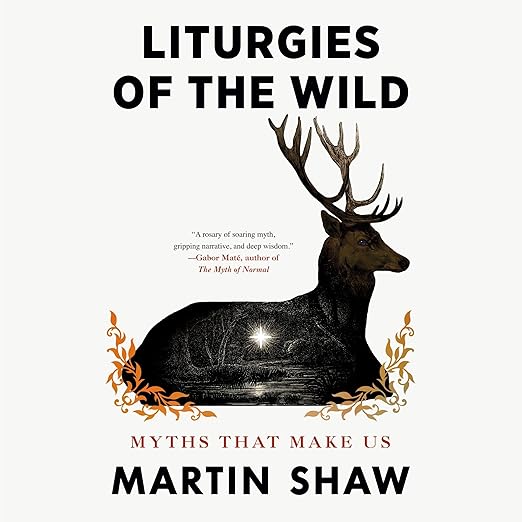
This is not an easy book to categorize, and that may be its most important quality. Gabor Mate’s blurb describes a rosary of soaring myth, gripping narrative, and deep wisdom told with breathtaking verve, which is accurate but also slightly too tidy for what Shaw actually does. He draws on Irish mythology, Christian mysticism, the tradition of C.S. Lewis and Tolkien as mythographers in the Christian tradition, and his own long practice of sitting with traditional storytelling communities. The result is a book that functions differently from almost anything else you will find in the religion or social sciences sections.
Several reviewers have noted being moved in ways that surprised them. One described being stirred, sorrowed, emboldened, strengthened, and quieted all in the course of reading. Another gave the book to a grieving mother rather than keeping it for themselves, which tells you something about the kind of resonance the work generates. These are not responses you associate with academic writing about mythology, and Shaw is doing something different from academic mythology.
Why Listen to Liturgies of the Wild
Shaw’s self-narration is essential to the book’s effect. He is, by training and practice, an oral storyteller, and the difference between reading his prose silently and hearing him deliver it is not small. His voice has a particular quality, unhurried, textured, accented by his Welsh and West Country background, that makes even the most demanding passages feel like invitation rather than instruction. Robert Bly’s description of Shaw as one of the greatest storytellers we have is visible in the narration from the first chapter.
The storytelling sequences, particularly his retellings of Irish and British mythic material, gain enormously from being heard rather than read. These are oral traditions, and Shaw knows how to carry them in the voice. If you come to this audiobook expecting a conventional nonfiction structure, with thesis, evidence, conclusion, you will be disoriented. If you come willing to be carried, it will take you somewhere most audiobooks do not reach.
What to Watch For in Liturgies of the Wild
The book’s demands are real. Shaw does not explain himself when he moves between registers, and the leaps from scholarly annotation to mythic retelling to personal confession to theological argument can leave listeners feeling groundless. This is, to some degree, intentional: he is describing initiatory experience, and initiatory experience is by definition disorienting. But listeners who need argument rather than immersion will find the method unsatisfying.
The Christian dimension of the book is also worth noting upfront. Shaw’s journey toward Christianity is neither evangelical nor conventional, and one reviewer accurately describes it as decidedly not corrupted by western evangelicalism. But readers who are deeply resistant to Christian thought in any form may find the final movement of the book uncomfortable, regardless of Shaw’s heterodox approach to the tradition.
Who Should Listen to Liturgies of the Wild
This is for listeners who are already drawn to the intersection of myth, psychology, and spirituality, readers who have found value in writers like Thomas Berry, Richard Rohr, or Clarissa Pinkola Estes, or who are curious about what happens when serious engagement with pagan mythology leads somewhere unexpected. It will also appeal to anyone who has spent time with the work of C.S. Lewis or Tolkien as theological mythmakers and wants to find that tradition extended into the contemporary moment. If you are looking for a structured argument or a clear self-help program, this is not your book. If you are looking for something that will stay with you for a long time after you finish it, it almost certainly is.
Frequently Asked Questions
Do you need to be religious or Christian to get something from Liturgies of the Wild?
No. Many reviewers have noted finding the book valuable across a wide range of belief systems. Shaw’s approach to Christianity is heterodox and philosophically grounded rather than evangelical, and the bulk of the book engages with pre-Christian mythic traditions. Skeptics and non-Christians have found it compelling even when they resist the book’s eventual theological direction.
How demanding is the audiobook to follow, given Shaw’s unconventional structure?
It is genuinely challenging in places. Shaw moves fluidly between scholarly analysis, mythic retelling, personal memoir, and theological argument without always signaling the transitions. Listeners who prefer conventional nonfiction structure may find this disorienting. Those willing to follow a more associative logic tend to find the experience unusually rewarding.
Is Martin Shaw’s self-narration accessible, or does his storytelling style require getting used to?
His delivery requires a small adjustment period if you are accustomed to the crisp neutrality of professional audiobook narrators. His pace is slower and more rhythmic, and he reads with the cadence of oral tradition rather than written prose. Most listeners find this adjustment takes no more than a chapter before the style becomes the correct one for the material.
Is Liturgies of the Wild connected to any of Shaw’s previous books, and do you need to read those first?
The book stands alone and requires no prior knowledge of Shaw’s previous work. He is an established mythographer and storyteller with several earlier titles, but Liturgies of the Wild is his most personal and integrated statement of his thought and functions as a complete work in itself.