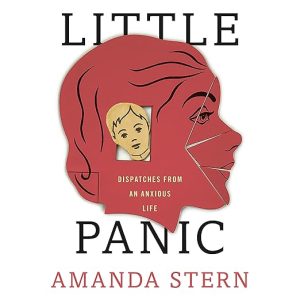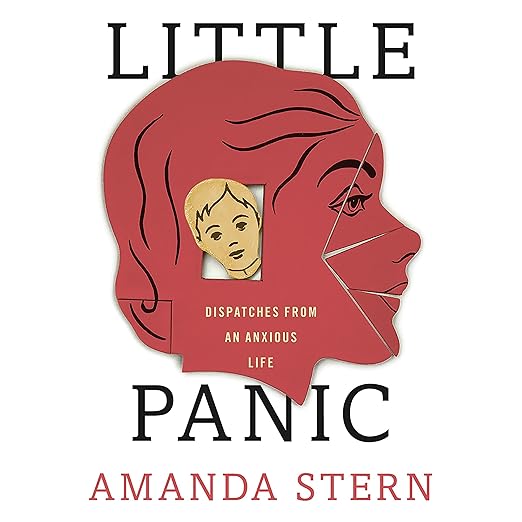
Amanda Stern wrote a memoir that refuses to settle in one time, and the audiobook inherits that decision whole. Thirteen hours and twenty minutes, in Brittany Pressley's reading, moving between a girl in 1970s Greenwich Village who cannot trust the sun to rise or gravity to hold her down, and the woman who eventually got an answer. A printed book has typography for that handoff. A recording has one voice and whatever it chooses to do with pitch. Two hundred and thirty-eight people have graded this one, and the average has held at 4.4.
Pressley Has to Sound Like Two Different Ages
Structure is the achievement here, and the readers who love this book say so before they say anything else. One five-star notice calls it "so interestingly crafted, moving back and forth seamlessly between her childhood and teen years to her adulthood and the present", and the same response puts its finger on the wound the structure exists to expose: a child whose problem, the word set inside quotation marks, went misdiagnosed for two decades. The adult sections are not commentary on the child sections. They are the record of how long it took anybody to name what was happening.
What was happening, in the description's own terms, is unrelenting panic without a word for itself. Stern grows up convinced of a defect her siblings and friends do not have to carry, certain that her mother might die or simply forget she has children and move away, treating every goodbye as the final one. She is shuttled between a barefoot bohemian household with her mother in Greenwich Village and a stricter, sanitized world of affluence uptown with her father, which means the one stable thing in her life is the fear. When Etan Patz disappears from down the block on MacDougal Street, the fear acquires evidence.
Brittany Pressley reads it, and the production question a listener should weigh is what one voice does with two registers that the prose keeps folding together. The child's reasoning is what drives the whole thing: it has to sound coherent from inside, not sad from outside, or the whole design collapses into a case study. The adult passages then need enough distance to be a different person without becoming a different narrator. I would sample a passage where the timeline shifts rather than a stretch of straight scene, since the seam is where a reading of this kind either holds or shows.
Naming the Panic Is the Book's Real Hinge
Prose is what people come back to. Readers who write about this book write about the sentences, and the strongest praise on the page calls Stern a masterful writer and storyteller before it mentions the subject at all. That is not the usual order for a memoir about mental illness, where the material generally does the recruiting.
Second, and this matters more in audio than in print, the book works physically. One reviewer describes wanting a book whose world you live in wholly while reading, experienced bodily as well as emotionally, and says of this one that "it's not always comfortable reading this book, especially if you're cut from anxious cloth yourself, but it does always feel essential and full." That is a precise description of a book that gets into your chest, and a voice in your ear is the delivery system best suited to it.
A diagnostic arc gives the whole thing a shape that most memoirs of anxiety lack. Another response describes being led through what it feels like to be "at the mercy of mysterious forces that you don't understand, almost supernatural in their power, until they can be named and tamed." Naming is the hinge. A reader who has waited years for a diagnosis of anything will recognize the specific relief of the moment a condition acquires a word, and Stern structures her book so that the relief lands where it actually landed rather than where a narrative would prefer it.
New York's Transformation Running Beneath the Memoir
Then, underneath, the city. The description calls this a document of the transformation of New York, and that layer runs quietly beneath the personal one: the Village of the 1970s and 80s, two households that might as well be two countries, a neighborhood where a child vanished. If you came for the memoir you get the social history free, and it is the part that will still be interesting on a second listen.
Shelved as Art and Literature, Not Health
This costs something to hear, and the enthusiastic responses say so more clearly than the critical one does. One five-star reader calls it enlightening "though quite exhausting" and describes a breath held throughout, in constant expectation of the tragedy about to arrive. A book about anticipatory dread transmits anticipatory dread. On the page you can put it down mid-sentence; in a recording the pace is set for you, and a stretch this long under that particular pressure is a real commitment for anyone who arrives already anxious.
A single dissenting grade sits on the page, a four star, and it names two separate things. The book, that reader says, "dragged a bit for me." The same notice also expresses frustration at how long the diagnosis took and at a family that offered little support, which is arguably the book's subject rather than its flaw, but the pacing complaint is fair warning at this length. A memoir of interior states without a plot has to earn every hour, and not everybody thinks this one does.
Two smaller notes on the listing. The average of 4.4 across two hundred and thirty-eight grades sits a little below the five visible responses, four of which are perfect scores, so the page reads warmer than the aggregate. And the title is filed under an Art and Literature tag despite being a memoir of panic disorder that would be more useful to a reader browsing health, which is worth knowing if you found it by accident and wondered what it was doing there.
Fair Warning for Readers Who Get Wrung Out
This suits the reader who wants the inside of an anxiety disorder rather than an explanation of one, and it suits anyone who spent childhood convinced something was wrong that nobody could name. It also rewards readers of literary memoir generally, since the sentences hold up independently of the subject, and readers curious about the version of the city this book documents.
Approach with care, or with a book on hand to alternate with, if you live with panic yourself: the writing is good enough to be contagious, and more than one enthusiastic reader describes finishing it wrung out. Skip it if you want a treatment guide, because the arrival of a diagnosis is the destination here rather than the opening chapter, and skip it too if a thirteen-hour interior narrative without external plot is a shape you already know you cannot sit inside.
Quick Take
- Performance: Amanda Stern does not read her own memoir; Brittany Pressley does, which puts an interpreter between you and the voice on the page.
- What it covers: Undiagnosed panic disorder, childhood misdiagnosis, 1970s New York, divided households
- Feel: Intimate, funny, quietly relentless
- Our call: A memoir of anxiety strong enough on sentences alone to justify thirteen hours, provided you can take the pressure it applies.